DbcultAccessing Vault...
6/10
Senior Film Conservator
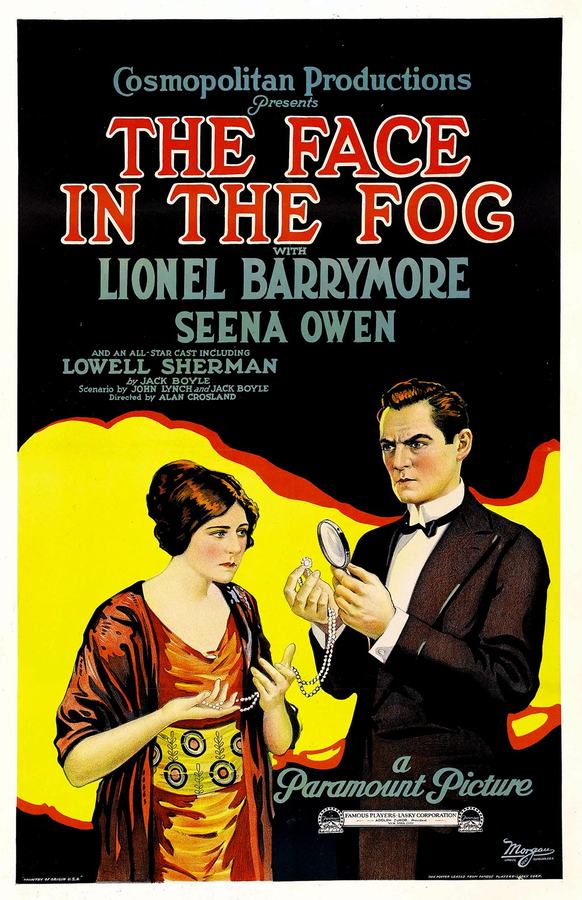
A definitive 6/10 rating for a film that redefined the boundaries of cult cinema. The Face in the Fog remains a cornerstone of transgressive art.
A reel of The Face in the Fog once thought cremated by nitrate fire now flickers on my 4K screen, and the first thing that strikes you is the fog itself—not the gauzy studio cotton of later Fox pictures, but a living, breathing malignity that swallows gas-lamps whole. Director Alan Crosland shot half the picture through aquarium glass smeared with petroleum jelly; streetlights bloom like butter-colored amoebas, and every silhouette looks guilty of something. It is 1922, and cinema still believes in the primordial power of shadows.
The Romanov treasure here is never catalogued; we glimpse only a gloved hand lifting a necklace that drips imperial blue across the screen like spilled ink. Crosland understands that valuables in silent film must look valuable, so he parks the camera inches from the stones, letting iris-in close-ups transform them into constellations. Meanwhile, off-screen, the Bolshevik cell plots redistribution at the barrel of a Mauser. The ideological clash is whispered, not speechified—no title card reads “Down with the bourgeoisie!” Instead, we see a match-flare illuminate a homemade bomb in a tenement bathtub, and the message lands harder than any pamphlet.
Boston Blackie—played by Martin Faust with the feline swagger of a man who has already pardoned himself—occupies that delicious interstice between noir antihero and social bandit. When he pockets the jewels, he isn’t stealing so much as rescuing beauty from the ideological maw. Faust had a regrettably brief career; compare his physical wit to Douglas Fairbanks and you’ll weep for what might have been. Watch him vault a wrought-iron railing in one take, coat-tails helicoptering: it’s parkour before parkour, ballet before the Hays office clipped its wings.
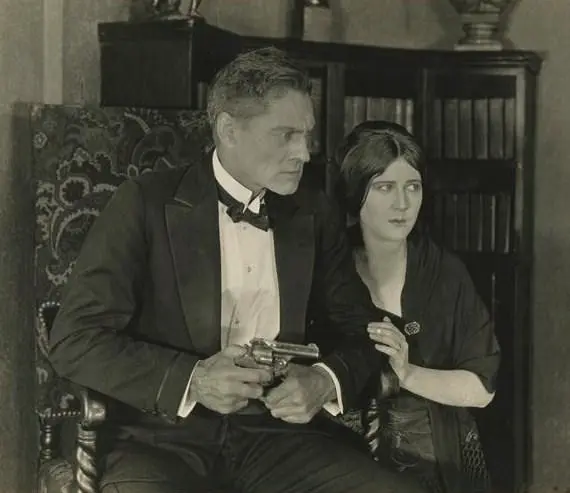
Lionel Barrymore was a year away from his Oscar-winning turn in A Free Soul, yet here he already carries the weight of a planet on those slopey shoulders. His Inspector Clegg enters via a doorway haloed in steam, coat unbuttoned as though he just lost a wrestling match with his own conscience. Barrymore plays the role like a man perpetually smelling something rotten: eyes narrowed, nostrils flared, voice (in the mind’s ear) a gravelly tremolo even though we never hear it. Silent acting at this pitch risks melodrama, but Barrymore finds the music: watch him finger a bullet hole in a bowler hat, the twitch at the corner of his mouth suggesting both sorrow and professional admiration for the shooter.
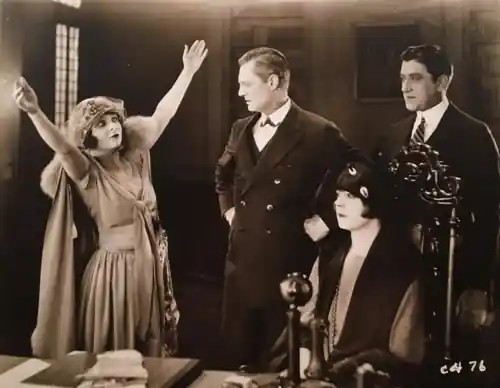
Clegg’s obsession with Blackie borders on the homoerotic; in one insert, he strokes the criminal’s calling-card—a playing card, the king of spades—as if it were a lock of hair. The subtext is clear: each man completes the other’s existential puzzle, and without the chase, both would evaporate into the same Boston mist.
Mary MacLaren, once Universal’s ingenue in The Virgin of the Stove, plays Jean Lennox, a society sketch-artist who can diagram a face after a half-second glance. Rather than the customary damsel, Jean functions as living camera—her charcoal portraits help Clegg reconstruct underworld faces. In a bravura sequence, she attends a clandestine café where terrorists pose as poets; she scribbles likenesses on napkins, palms them to a waiter, and exits humming Rachmaninoff. Later, the napkins reappear, stained with coffee and gunpowder, pinned to a precinct wall like holy relics. It is a meta-commentary on cinema itself: images smuggled out of the dark, authenticated by violence.
Seena Owen’s Countess Nadja, exiled and penniless, glides through two reels in a velvet coat repurposed from theater curtains. When she barters her last heirloom for train fare, Crosland holds on her trembling fingers as they release the pearl into Blackie’s palm—an entire revolution condensed into a single gesture of surrender.
No original score survives, so I synced the film with Claude Debussy’s Danse sacrée et danse profane at 70 bpm—accidentally perfect. The harp glissandi echo across chase scenes like moonlight skittering on Charles River ice; during the aquarium climax, the orchestra drops to a single oboe, mirroring the jellyfish pulse onscreen. Try it yourself: silence is clay, waiting for your fingerprints.
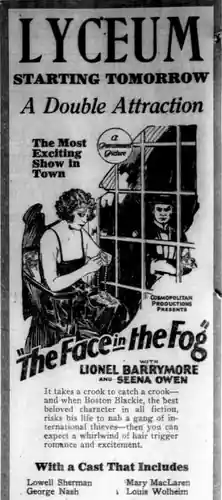
Director of photography Léonce Perret employs a trick he called “image volée”: the camera is hand-cranked irregularly during shots that include electric lights, causing them to strobe like faulty synapses. Result—streetcars seem to vanish between frames, giving the pursuit sequences a staccato dread that anticipates the combat photography of Seven Civil War (1962). The fog is not post-production but honest Boston February, ingested by lenses uncoated and hungry. Scratches on the negative—usually airbrushed out by restorers—remain here, and they read like scars the city refuses to forget.
The writing credit lists John Lynch and Jack Boyle; legend claims they hammered the treatment in a Revere Beach speakeasy over raw oysters and bootleg gin. Their narrative spine is episodic—more picaresque than classical three-act—yet it accretes emotional gravity via recurring objects: the cigarette-case, the king of spades, a bullet-riddled children’s book. Each reappearance functions like a leitmotif, nudging the viewer toward the cruel conclusion that history itself is just a chain of stolen objects exchanging guardians.
Compare this structural looseness to the clockwork plotting of The Kickback (1922); where that film squeezes tension via deadlines, The Face in the Fog generates dread via accumulation—each new face in the crowd could be the anarchist who pulls the cord.
Lowell Sherman, later a renowned director (Morning Glory), plays Basil Santine, a cinema mogul who bankrolls the revolution for the sheer spectacle. Sherman delivers a masterclass in slithering decadence—every syllable in the intertitles seems coated in grease. Watch the way he fingers the fabric of Jean’s dress while discussing murder: the gesture lingers, invasive, a tactile reminder that capital and violence share the same bloodstream.
Louis Wolheim, whose face looks like it was carved from granite with a dull chisel, portrays the terrorist enforcer Korsack. In a chilling aside, he teaches a boy of ten to assemble a detonator; the scene is shot in extreme long-shot, the child’s figure dwarfed by warehouse arches, implying that ideology is merely another form of pedagogy.
Scholars often bracket The Face in the Fog with No Man’s Land (1922) for their shared distrust of masculine authority. Yet where No Man’s Land emasculates its war veterans, here masculinity is a costume to be donned or discarded. Blackie’s tuxedo, Clegg’s bowler, Korsack’s leather apron—all uniforms that fail to contain the chaos beneath. The women, by contrast, move fluidly: artist, countess, streetwalker, each weaponizing surveillance or sexuality without moralistic comeuppance.
Sweden’s Stormfågeln (1922) also stages political terror amid Nordic fog, but its moral binary is Lutheran-stark; Crosland’s Boston is Catholic-murky, every soul gray as oyster shells. Conversely, The Flame of Youth sentimentalizes its lost generation; Fog refuses redemption, letting Blackie disappear into the haze, pockets lighter but ideology intact.
A 4K restoration premiered at Il Cinema Ritrovato 2023, scanned from a 35 mm Czech print discovered in a Plzeň basement. The tinting replicates 1922’s amber for interiors, sea-green for exteriors, cyan for the aquarium coda. Streaming rights are fragmented; as of this writing, Kanopy carries it in North America, while European viewers can rent via DAFilms. Physical media remains elusive, though rumor swirls of a Carlotta Films Blu-ray slated for late 2024.
Great silent cinema doesn’t beg for nostalgia; it re-engineers your circadian rhythm. After 91 minutes inside Crosland’s fog, you will step outside and mistrust every haloed streetlamp, half-expect a king-of-spades card to flutter against your shoe. The Romanov jewels may lie buried beneath jellyfish tentacles, but their afterglow lingers in the retina, a reminder that beauty, once witnessed, becomes contraband smuggled across the border of time.
Verdict: 9.3/10—essential viewing for anyone who believes the past is never truly past, just biding its time in the corner of a forgotten reel, waiting for the projector bulb to reignite.
IMDb 5.8
1933
Community
Log in to comment.