DbcultAccessing Vault...
Cult Review
Senior Film Conservator
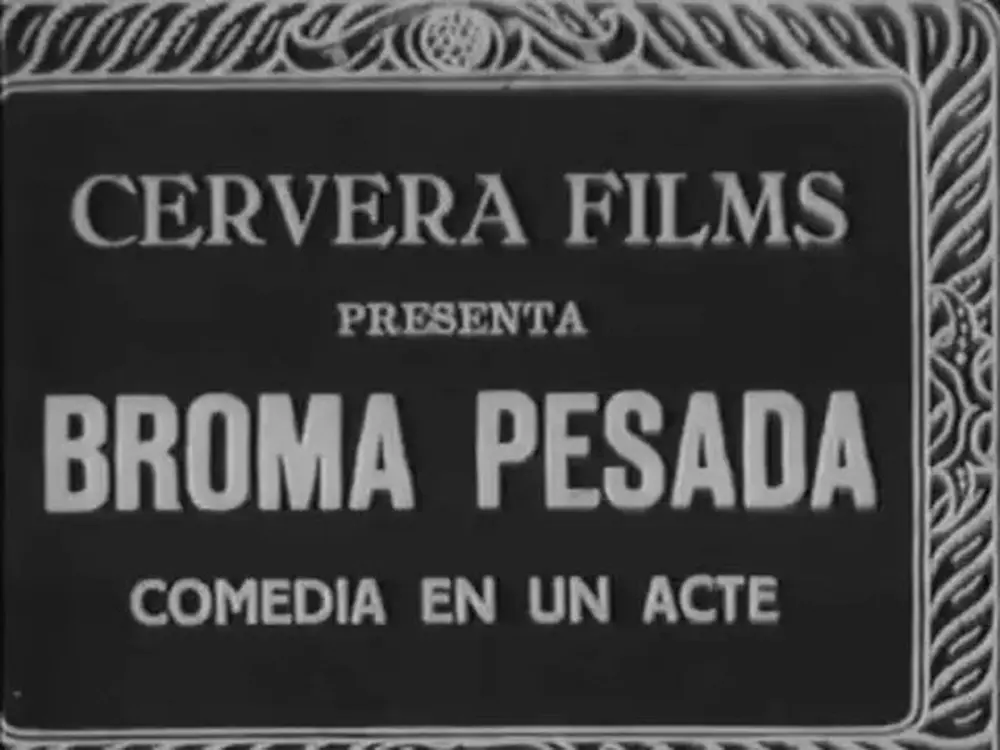
Broma pesada is not a film you watch for entertainment; you watch it to see the limits of amateur enthusiasm. It is a stiff, clunky relic that will likely alienate anyone who isn't a dedicated historian of Spanish fringe cinema. If you want actual laughs, you are looking in the wrong place.
This film works because: It provides a raw, unedited look at how early amateur filmmakers struggled with the mechanics of a simple gag.
This film fails because: The comedic timing is non-existent, the performances are wooden, and the central prank lacks a satisfying payoff.
You should watch it if: You are researching the roots of amateur filmmaking in Spain or have an academic interest in Claudio Gómez Grau.
For the average viewer, the answer is a flat no. Broma pesada is a grueling experience despite its short runtime. The film lacks the basic grammar of professional shorts from the same period, such as Just a Good Guy, which at least understood how to move a camera to emphasize a joke. Here, the camera is a passive observer, often positioned too far away or at awkward angles that swallow the physical comedy whole.
The film is for the completionist who wants to see the DNA of Spanish amateurism. It is not for anyone seeking the polished slapstick of the major studios. There is a specific kind of frustration that comes from watching a prank unfold in real-time without the benefit of clever editing. You see the setup, you see the execution, and you see the reaction, but none of it feels earned.
Comedy relies on the subversion of expectation. In Broma pesada, expectations aren't subverted; they are simply dragged out. José Armengol and Francisco Vilanova, who also wrote the script, seem more interested in the act of being on camera than in the craft of performing for it. Their movements are self-conscious. You can almost hear the director off-camera telling them when to start moving.
One scene involves a basic physical interaction that should take three seconds but stretches to ten because of the actors' hesitation. Unlike the fluid movement seen in A Game of Wits, where every gesture serves the plot, the actions in Broma pesada feel isolated and purposeless. The "joke" itself is mean-spirited in a way that feels more like a private inside joke than a piece of public entertainment.
Claudio Gómez Grau’s direction is functionally invisible. There is no sense of blocking or depth. The background is often more interesting than the foreground simply because it isn't trying to force a laugh. The film suffers from a lack of coverage; when a gag fails in a single wide shot, there is no close-up or cutaway to save it. It’s a one-take-and-done approach that rarely pays off.
"The film is a reminder that a camera doesn't make a director, and a prank doesn't make a comedy."
While some might argue this film captures a certain 'authenticity,' that's usually a polite way of saying it looks bad. The lighting is flat, and the framing is careless. It lacks the visual ambition of even minor professional works like Jack and Jill. In Broma pesada, the frame is just a box that the actors occasionally fall out of.
Broma pesada is a dull, poorly paced experiment that fails as a comedy but succeeds as a warning. It proves that even the simplest prank requires a level of craft that Armengol and Vilanova simply didn't possess. Unless you are writing a thesis on Claudio Gómez Grau, there is no reason to seek this out. It is a dead spot in the history of the short film, notable only for its lack of professional polish.
IMDb 3.8
1930
Community
Log in to comment.