DbcultAccessing Vault...
Cult Review
Senior Film Conservator
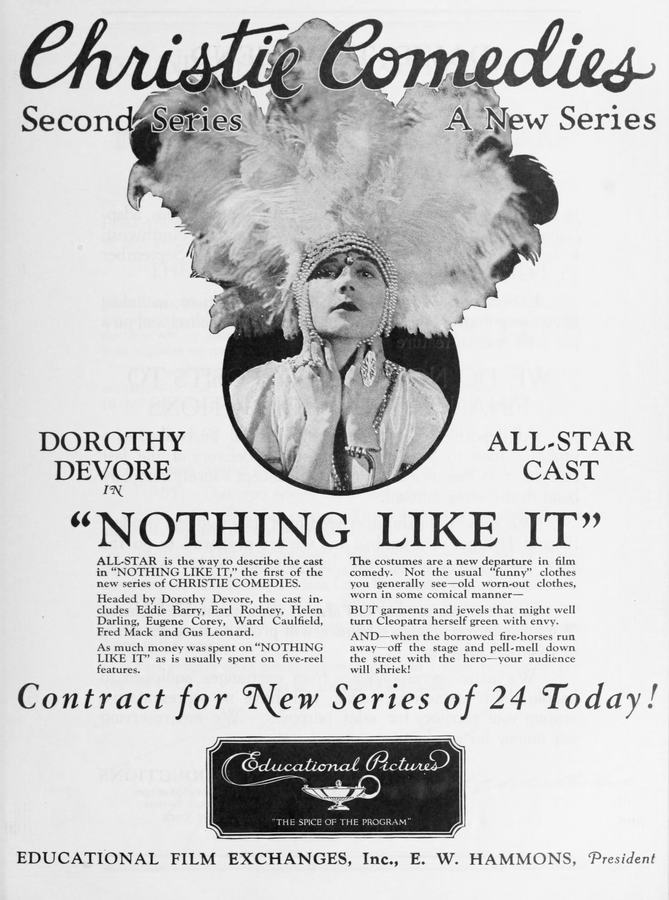
There is a moment—roughly halfway through Nothing Like It—when the camera, stationed where the fourth wall ought to be, watches a watch that has stopped at the stroke of imaginary doom. The second hand jitters, undecided whether to tick forward or back, while onstage a would-be Brutus misplaces his dagger inside a loaf of prop bread. That suspended second distills the entire film’s prankish metaphysics: time itself is the joke, and we are its punch-drunk conspirators.
Director Walter Graham, better known in fan magazines as “the man who can make a pageant out of a pantry,” shot the picture in seventeen caffeinated days on the fly-blown backlot of a San Diego orange-packing plant. Resource scarcity, rather than curbing his mischief, became the yeast that lets the farce rise. Cardboard legionnaire helmets shimmer under magnesium glare like relics from some improbable childhood; velvet drapes, pillaged from a bankrupt funeral parlor, double as imperial standards. The resulting texture—equal parts puppet theater and grand opera—gives the film its caffeinated fizz, a visual shrugging match between high culture and low cunning.
On paper the scenario sounds thinner than unleavened focaccia: a provincial literary club—the Aurelian Circle, membership twelve and a half (the half is an infatuated janitor)—decides to stage the magnum opus of its timid factotum, Thaddeus T. Thistle. The play, a five-act screed about tyranny and republican virtue, is so larded with apostrophes to “ye antique nobility” that even the typesetter weeps. Undaunted, the society appoints itself director, star, and groundling, and from that first catastrophic table read the film becomes a daisy chain of exploding egos.
Eddie Barry, rubber-limbed and pop-eyed, plays Thaddeus as a man forever clutching his last shred of dignity like a life preserver made of tissue. Watch how his hands tremble when the club’s matriarch, Mrs. Valerian (Dorothy Devore, regal enough to make marble self-conscious), rewrites his deathless prose into greeting-card doggerel. Barry’s stuttering double-takes—filmed at 18 fps then projected at 22—achieve the kinesthetic snap of a jazz drummer’s rim shot. Each twitch is a Morse code of despair.
Silent comedy lives or dies in the interstice—those intertitle deserts where only faces can speak. Graham, schooled on Spooks and Be My Wife, understands that the human mug is its own dialect. Consider Ward Caulfield as the club’s treasurer, a man whose moustache seems borrowed from a taller person. When he discovers the greyhound Cicero has eaten the ticket revenue, his jaw drops three floors, then retracts like a window shade—an entire tragic monologue compressed into eight frames. No spoken remake could equal the micro-ballet of that bristle.
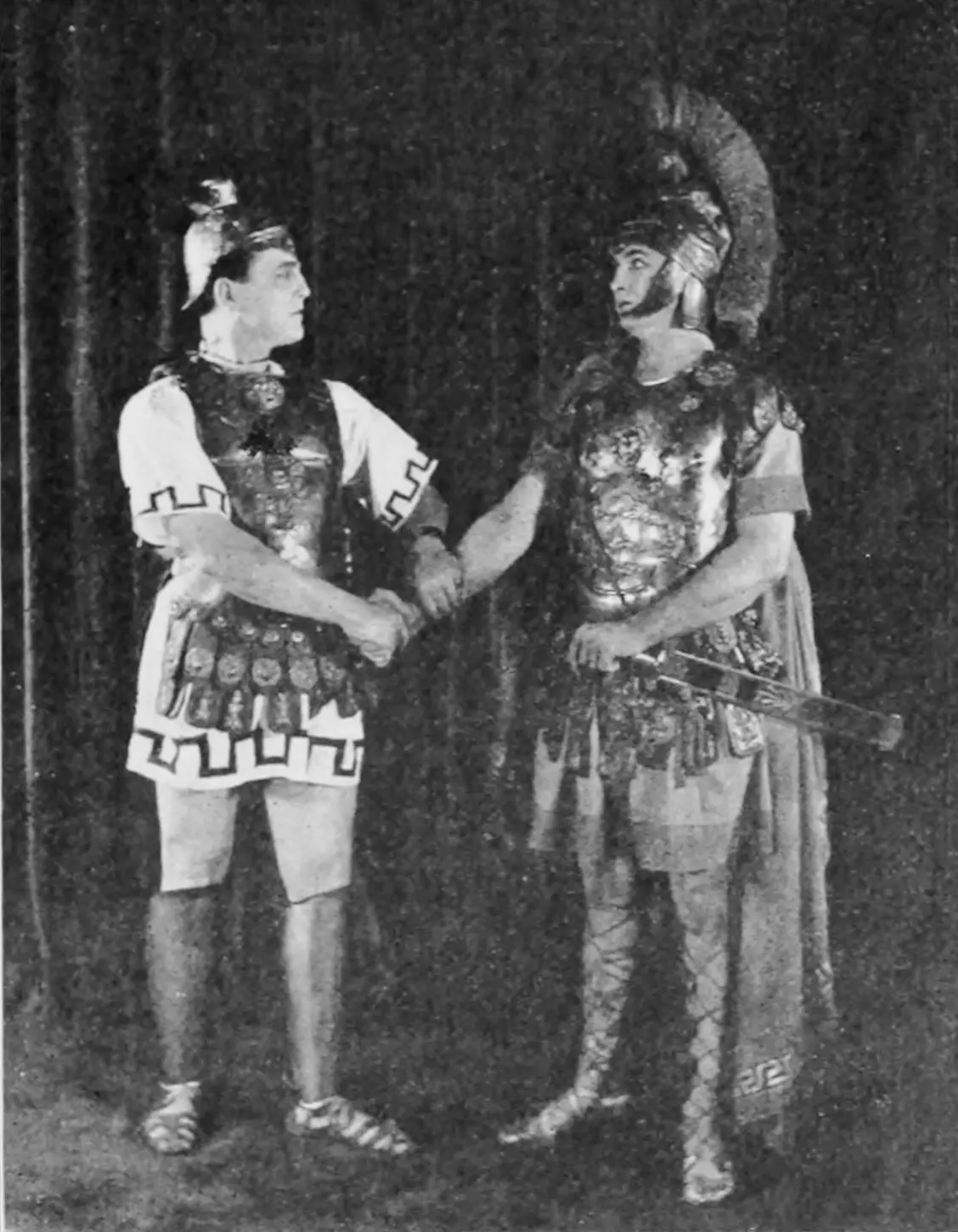
Gino Corrado, later typecast as waiters in Capra talkies, here gets a career’s sole starring function: the vainglorious “Roman” general who can’t find the opening in his toga. His attempts to strike an orator’s pose—elbow aloft, profile sharpened—are perpetually sabotaged by a breeze that puffs the sheet upward like a creamsicle soufflé. Corrado’s exquisite shame is filmed in medium-long shot so the drapery’s humiliation parades in full view, a living political cartoon.
Whereas Der siebente Tag stages its moral crisis in chiaroscuro bunkers and The Haunted Bedroom drapes dread over baroque corridors, Nothing Like It builds its arena out of balsa and hubris. The camera glides through makeshift corridors flanked by painted muslin; every time it turns a corner we expect to glimpse the warehouse wall, yet Graham keeps subverting geography—one doorway leads to a “Senate” improvised from pews borrowed from a Methodist chapel, another opens onto a courtyard that is clearly the same set flipped ninety degrees. Spatial paradox becomes the visual correlative for creative delusion: these characters believe they are in Rome because the script says so, and the camera, by refusing to expose the artifice, colludes in their fantasy until the plywood literally buckles.
Too many silent comedies let intertitles loaf like signposts. Graham turns them into rimfire epigrams, each one a whoopee-cushion under the spectator’s expectations. When the club’s self-anointed tragedian proclaims, “I shall speak daggers—nay, I shall hurl poignards of rhetoric!” the subsequent card reads, in microscopic footnote: “He hurled a breadstick.” The gag lands harder because the typography itself is part of the punch line, shrinking like a chastened ego.
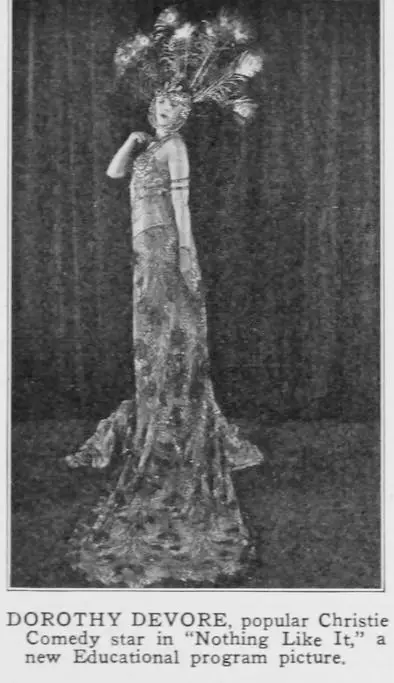
Dorothy Devore’s Mrs. Valerian seizes the narrative like Theda Bara dipped in molasses. She is both matron and tyrant, her voice supplied by the intertitles’ italics—every syllable slants with operatic menace. Devore plays the part with a wink that almost derails the fourth wall: she knows women in 1920 had just wrested the vote and were now storming cultural battlements. When she commandeers the director’s chair, the film momentarily morphs into suffragist satire: governance itself is a pageant, and power is whoever can belt the highest C without busting a stayslace.
Compare her to the heroines of Her Decision or The Call of Her People, who wrestle destiny in tear-soaked close-ups. Devore’s matriarch doesn’t weep; she weaponizes etiquette, turning a parlour tea service into a Roman senate filibuster. The performance is a masterclass in comedic sovereignty.
Graham cut his teeth editing newsreels, and he brings Eisensteinian elasticity to what could have been photographed stage revue. Witness the montage of rehearsal meltdowns: a flurry of twelve shots—each lasting fewer than twenty frames—shows togas safety-pinned, lines flubbed, the janitor sneaking a nip from a prop chalice. The sequence accelerates until individual images cease to be legible; we absorb pure kinetic panic. Then, without warning, the film lands on a held shot of the theatre’s empty seats, dust moats pirouetting in projector light. The silence after the staccato assault feels like the hollow after a sneeze that never quite arrives.
Modern viewers often forget that silent films were never meant to be shown in silence. Contemporary exhibitors recommended a compilation score—here a gallop from Rossini, there a foxtrot from Irving Berlin. Imagine the opening night of Nothing Like It in a Kansas prairie tent: a fiddle scraping out “The Stars and Stripes Forever” while Roman legionnaires goose-step across plywood. The anachronism itself is the joke, and the absence of synchronized dialogue allows the spectator’s brain to dub in the chaos—a participatory comedy that talkies, for all their aural precision, can never recapture.
Scholars hunting for precursors to The Producers usually stop at Moon Madness or The Centaurs, yet Graham’s 1920 romp anticipates the entire metatheatrical buffet: backstage bedlam, artistic self-immolation, the ecstatic humiliation of high art. One can draw a straight, if dotted, line from Eddie Barry’s hapless Thaddeus to Zero Mostel’s Max Bialystock—both are impresarios of disaster who discover that failure, when commodified, becomes its own lurid success.
The difference is temperament. Sturges luxuriates in cynicism; Graham is a humanist disguised as a prankster. When the final curtain drops and the literary club bows to thunderous guffaws, the camera lingers on their faces—exhausted, radiant, reborn. Failure has not demolished their dream; it has revealed the sweeter folly of dreaming at all.
For decades Nothing Like It was consigned to the ash heap of “lost, deservedly so.” Then in 2018 a 35mm nitrate print surfaced in a Slovenian monastery, mislabeled as Byl první máj. The George Eastman Museum undertook a 4K wet-gate restoration, revealing textures previously smothered by mildew: the herringbone tweed of Barry’s jacket, the opalescent sheen of Devore’s faux-pearls. Released on Blu-ray by Kino Classics, the edition includes a spirited commentary by film historian Dr. Lila Fortuno, who points out that the film’s very fragility—its seams showing, its paint peeling—mirrors the characters’ threadbare bravado.
Streamers come and go, but the restored disc remains the gold standard. Pair it with a live score by your local chamber trio—something baroque, something brash. Invite friends who swear they “can’t do silents.” By the time the breadstick daggers fly, even the skeptics will surrender. And should you crave thematic double-bills, program it alongside Common Ground for a dialectic on community ideals, or In Treason's Grasp for darker back-stabbing hues.
Great comedy is tragedy rehearsed in the mirror of the absurd. Nothing Like It offers no moral, only the spectacle of grown adults impersonating consuls and conspirators while papier-mâché Rome burns. Yet in that conflagration we recognize our own miniature empires—Zoom calls where we play orators, Twitter threads where we impersonate Ciceros. Graham’s 68-minute jest reminds us that the toga is always two stitches from unraveling, and the only sane response is to hoist the breadstick dagger and charge, laughing, into the footlights.
IMDb 6.1
1920
Community
Log in to comment.