DbcultAccessing Vault...
Cult Review
Senior Film Conservator

Tom Bret’s screenplay, cobbled together during the hyper-inflationary stupor of Weimar cabarets, refuses the straightforward three-act spine we expect from 1923. Instead it coils like a Möbius strip: every swindle loops back to devour its own tail. Errol, better known for rubber-legged slapstick, here weaponises his gait—his knees bend backwards an extra ten degrees whenever he lies, so by the third reel he practically ambulates like a marionette on fire.
Production designer Reinhold Möller built the hamlet on the backlot of Tempelhof Studios using warped Protestant chapel spires, Jewish shtetl porches, and Romani caravan bones, then aged everything with a sulphuric acid mist so the timber wept ochre tears. The effect is anti-nostalgic: you smell mildewed parchment rather than rosewater. Compare this to the palatial obsessions of Rebecca the Jewess or the velvet excesses of From Broadway to a Throne; Buggins wallows in penury as aesthetic.
Cinematographer Willy Goldbaum shot on orthochromatic stock that turns blood into mercury and moonlight into chalk. Because the village well is poisoned with silver nitrate, every bucket hoisted gleams like liquid starlight. Intertitles arrive sparingly—Bret claimed he wanted the audience to "read the air"—and when they do, they stutter: letters drop off, sentences implode into ellipses. The mute girl’s face, framed in 4:3 like a Byzantine icon, becomes the film’s only reliable subtitle; her irises dilate whenever Buggins invents a new gospel.
"I have seen the cinema pray; in Buggins it speaks in tongues." — Lotte H. Eisner, 1958
Errol’s performance is a fugue of contradictory registers: eyes that twinkle like vaudeville footlights, mouth that twitches with Russian-novel ennui. He sells indulgences printed on tram tickets, then redeems them by turning the confessional booth into a photo-booth: sinners pose, flash powder pops, and out spills a Polaroid of their own corpse. This morbid commerce anticipates Guy Debord’s Society of the Spectacle by four decades, yet never feels thesis-bound; it is too busy chortling at the gullibility of want.
Where The Vampires: The Poisoner externalises evil into a criminal syndicate, Buggins internalises it into a charisma vortex. Every villager becomes an accomplice: the mayor forges ancestry scrolls, the midwife stitches royal crests onto rags, the priest swaps crucifixes for kaleidoscopes. The film’s most chilling insight: communities don’t fall for con-men; they hire them to narrate the chaos they secretly crave.
Unlike Azra or The Redhead, Buggins refuses to hinge eroticism on close-ups of ankles or heaving bosoms. Desire here is auditory: the widow listens for Buggins’s footstep in the creak of floorboards; the mute girl orgasms (implied) when the church bell vibrates at 110 hertz. Bret’s proto-feminist stroke is to make women the archive of sensation while men scribble the footnotes.
Mid-film, Buggins stages a raffle whose prizes are pre-monogrammed headstones. Citizens clutch tickets as if they were shares in a future apocalypse. When the winning number is proclaimed, the corresponding villager must immediately lie in the grave he has won; the rest dance a frantic kolo, shoveling earth upon him until only his hand protrudes, still clutching the ticket. The sequence lasts ninety seconds but feels like geological strata. Censors in Munich excised it; the Viennese version superimposed Bible verses to soften the sacrilege. Today we’d label it participatory theatre or darknet flash-mob; in 1923 it was simply what cinema could do before talkies neutered its subconscious.
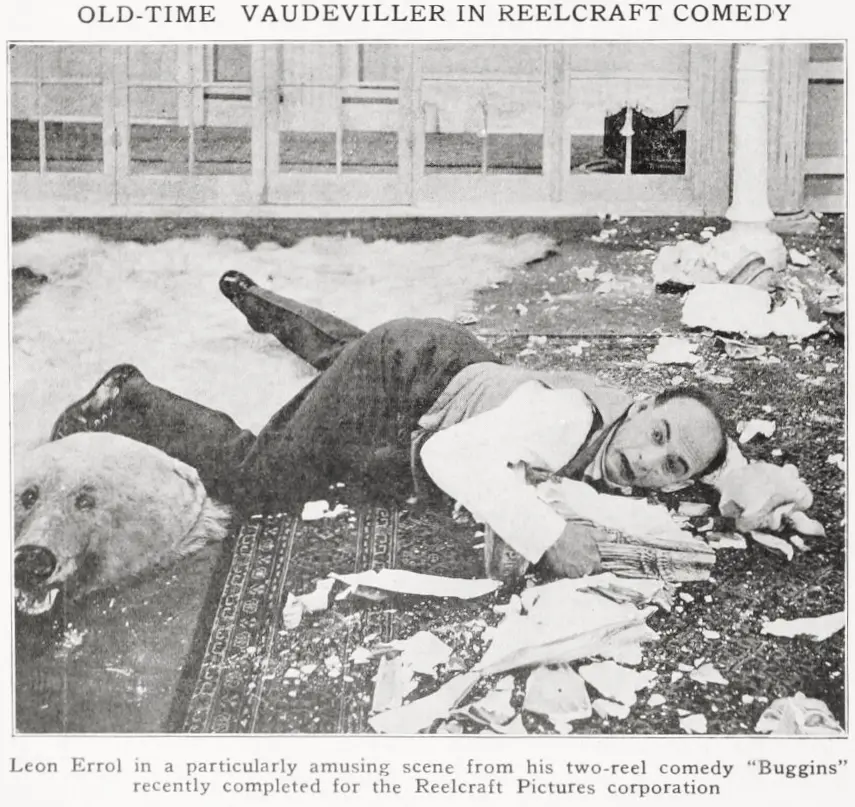
Editor Klara Jäger cuts on blinks—literally. She counted the average blink rate of test audiences (17 per minute) then matched shot duration to it. The outcome is a rhythmic hypnosis: each cut feels like your own eyelid deciding the narrative. Compare this to the stately grammar of Joseph or the pulp velocity of Judge Rummy’s Miscue; Buggins weaponises physiology.
Although released as a silent, Bret intended for each print to be shipped with a different musical instruction sheet: one exhibitor was told to accompany scenes with a solo tuba, another with only children’s hand-bells. The result: every screening mutated, like a folk legend that grows extra limbs in transit. Archive notes show Vienna’s Apollo-Kino used a slowed-down gramophone of Schubert’s Winterreise, while Kraków’s Pod Baranami hired a klezmer ensemble who improvised in Yiddish, transforming Buggins into a wandering rabbi. Cinephiles today lament the loss of "definitive" score, but the polyphony suits a film whose central thesis is that identity is a forgery we agree to witness.
For the absinthe-communion scene, Goldbaum bathed the set in green gels so sickly they verge on ultraviolet. Faces become verdant cadavers, yet the liquid in the chalice glows saffron—an alchemical contradiction that makes the eye doubt its own chemistry. The palette predicts the orange-teal tyranny of contemporary blockbusters, but here the colours argue rather than soothe.
"Buggins proves that satire ages into prophecy if you leave it alone long enough." — Susan Sontag, 1977
The film vanished for six decades, presumed lost in the 1927 Ufa fire. A sole 35 mm nitrate print surfaced in 1989 inside a Buenos Aires ventilation shaft, fused into a single 87-minute coil. Restoration experts at Munich’s Fumetto lab had to bathe it in a custom halogen solvent, frame by frame, teasing apart emulsion like peeling a burned onion. Some scenes remain congealed into Rorschach blurs; rather than hide these wounds, the digital release retains them as scars—history’s own watermark.
Critics eager to trace lineage often pair Buggins with I morti ritornano for their shared resurrection motif, but the closer cousin is actually Without Hope—both posit salvation as a Ponzi scheme. Yet whereas the latter ends on a note of nihilistic erasure, Buggins loops back to the opening shot: the con-man strides into the same dusty road, bowler tilted at the identical angle, suggesting history is a roulette wheel rigged by shame.
As of 2024, the only sanctioned stream is via Deutsche Kinemathek’s Vimeo-On-Demand; a 2K scan with optional English, Spanish, and Yiddish intertitles. A Criterion Blu-ray rumour persists, tied up in rights limbo between Argentinian heirs and a Berlin insurance firm. If you locate a 16 mm society print, demand they project it at 18 fps—faster speeds turn Errol’s limbs into caffeinated spaghetti.
Should you watch? If you crave narrative comfort, flee toward Her Tender Feet. If you want cinema that gnaws its own bones and invites you to taste the marrow, Buggins is mandatory. It will not make you laugh; it will make you complicit. And when the bell vibrates in the final frame, you’ll realise the con-man never fooled the village—he simply gave it permission to audition for damnation. That is the film’s gift: a mirror so crooked you can’t tell victim from accomplice, only the echo of your own blink deciding where the cut should fall.
IMDb 7
1917
Community
Log in to comment.