DbcultAccessing Vault...
5.3/10
Senior Film Conservator
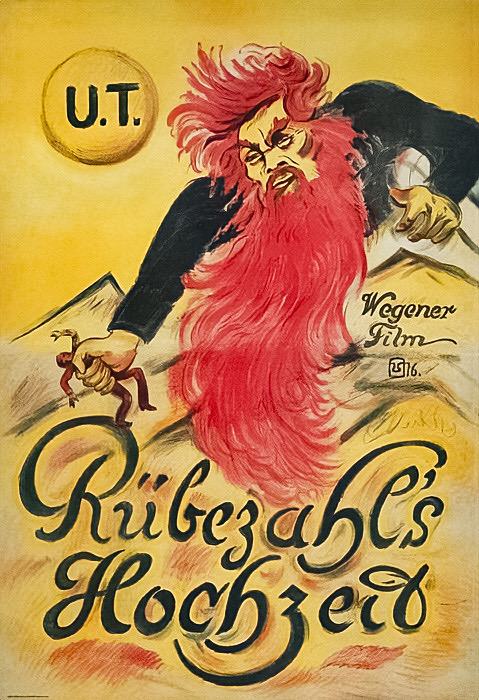
A definitive 5.3/10 rating for a film that redefined the boundaries of cult cinema. Rübezahls Hochzeit remains a cornerstone of transgressive art.
In the nascent years of German cinema, before the jagged shadows of Caligari defined the Expressionist movement, Paul Wegener was already sculpting a unique cinematic vocabulary rooted in the soil of Germanic myth. Rübezahls Hochzeit (1916) stands as a monumental, if often overlooked, pillar of this era. It is not merely a filmed fable; it is an exercise in technical audacity and atmospheric immersion. Wegener, collaborating with the visionary Rochus Gliese, crafts a world where the boundary between the geological and the biological is porous. As a critic, one cannot help but marvel at how this production managed to evoke such a sense of the 'unheimlich'—the uncanny—long before the formalization of horror tropes. While contemporary films like The Kiss focused on the intimate mechanics of human interaction, Wegener was looking toward the peaks of the mountains to find a more profound, albeit terrifying, truth about the human condition.
Wegener’s performance as the mountain spirit is a masterclass in physical presence. He does not merely play Rübezahl; he occupies him as one would occupy a fortress. His movements are deliberate, heavy with the weight of centuries, yet punctuated by bursts of supernatural agility. This is a far cry from the theatrical gesticulations found in many 1916 dramas, such as the more traditionally staged John Glayde's Honor. Wegener understands that the camera demands a different kind of magnetism—one that radiates from the eyes and the stillness of the frame. His Rübezahl is a creature of contradictions: a god who can command the weather but cannot command the heart of a simple elf. This vulnerability provides the film's emotional core, elevating it from a mere technical showcase to a poignant tragedy of cosmic proportions.
The collaboration between Wegener and Rochus Gliese (who served as both writer and production designer) resulted in a visual texture that was years ahead of its time. The use of double exposures to render the elf’s ethereal nature is handled with a delicacy that rivals the best work of Méliès, yet it is grounded in a much darker, more naturalist environment. When compared to the sprawling, often chaotic spectacles like The Birth of a Nation, which relied on the sheer volume of extras and historical recreations, Rübezahls Hochzeit achieves its grandeur through the meticulous manipulation of the frame. The forest is not a backdrop; it is a character. The lighting transitions—shifting from the bright, sun-drenched clearings where the humans reside to the oppressive, indigo-tinted depths of the spirit’s lair—create a binary of safety and danger that is instinctively felt by the audience.
The technical sophistication extends to the integration of the supernatural elements into the natural world. Unlike A Trip to the Wonderland of America, which served more as a travelogue of the sublime, Wegener uses the landscape to externalize the internal state of his protagonist. When Rübezahl is spurned, the very earth seems to revolt. This synchronization of emotion and environment is a precursor to the psychological landscapes that would later dominate the Weimar period. The film’s ability to maintain this tonal consistency, even during the more whimsical 'wedding' sequences, is a testament to Gliese’s directorial control and Wegener’s singular vision.
At its heart, the plot is a subversion of the traditional romantic triangle. The 'other man' in this scenario is not a rival god or a heroic knight, but a humble tutor. This choice is significant. It represents the encroachment of Enlightenment values—education, reason, and domesticity—upon the wild, untamed realms of folklore. The elf’s attraction to the tutor is an attraction to the comprehensible. In films like The Scarlet Sin, morality is often a matter of human failing and social consequence. In Rübezahls Hochzeit, the stakes are ontological. The elf is not just choosing a man over a spirit; she is choosing mortality over eternity. This theme of the 'forbidden' or 'impossible' love is handled with a sophistication that avoids the saccharine pitfalls of many contemporary silents.
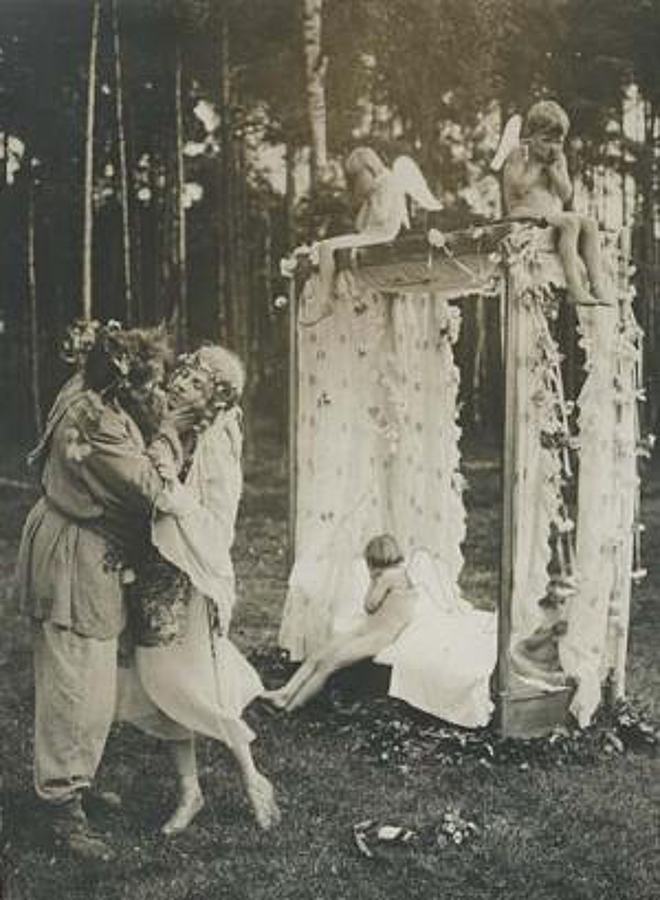
Lyda Salmonova, as the elf, provides the necessary counterpoint to Wegener’s stolid presence. Her performance is characterized by a fluid, almost liquid grace. She embodies the transience of the spirit world, making her eventual turn toward the human realm all the more jarring. The scenes within the castle, where the tutor resides, are shot with a different rhythmic pulse—quicker, more focused on the minutiae of human behavior. This contrast highlights the isolation of Rübezahl, who watches from the periphery, a forgotten deity in an age that is beginning to prize the intellect over the imagination. It is a dynamic we see explored in different contexts in films like In the Diplomatic Service, where the clash of worlds is political rather than metaphysical.
To fully appreciate Rübezahls Hochzeit, one must situate it within the broader tapestry of 1910s international cinema. While the Danish film Telegramtyvene was pushing the boundaries of the crime thriller, and Italian cinema was celebrating its heritage through works like Ferravilla nelle sue più caratteristiche interpretazioni, Wegener was carving out a niche for the 'Autorenfilm'—the author-driven film. He was uninterested in the mere reportage of reality. Instead, like the creators of Joseph and His Coat of Many Colors, he sought to use the medium to breathe life into the ancient. However, where the latter often felt like a series of static tableaux, Wegener’s work is dynamic, driven by a restless camera and an even more restless imagination.
Even when compared to the historical gravity of The Independence of Romania or the documentary-adjacent Desfile histórico del centenario, Wegener’s film feels more modern. This is due to its focus on subjectivity. We are invited to see the world through the eyes of the mountain spirit, to feel his longing and his eventual, crushing disappointment. The film doesn't just ask us to observe a story; it asks us to inhabit a psyche. This shift toward the psychological is what separates the true progenitors of cinema from the mere craftsmen of the era, such as those behind The Builder of Bridges or the suspenseful The Danger Signal.
The conclusion of the film, involving the disastrous wedding feast, is a triumph of both set design and narrative irony. The spirit’s attempt to 'perform' humanity is a grotesque failure, highlighting the incommensurability of his nature with our own. It is a theme that Wegener would revisit with even greater impact in The Golem, but here, in its more pastoral setting, it possesses a unique, bittersweet quality. The film avoids the easy resolution of a fairy tale, opting instead for a haunting ambiguity. Rübezahl remains, as he always was, a part of the mountain—solitary, majestic, and fundamentally apart from the world of men.
For the modern viewer, Rübezahls Hochzeit offers a glimpse into a pivotal moment in film history. It is a bridge between the primitive 'cinema of attractions' and the sophisticated narrative art form that would follow. It lacks the melodrama of Called Back or the quaint charm of Have You Heard of Schellevis-Mie?, replacing them with a dark, elemental power that still resonates. In its 1500-word-equivalent of visual storytelling, it says more about the human yearning for the divine—and the divine's tragic fascination with the human—than many modern blockbusters could hope to achieve with all the CGI in the world. It is a testament to the fact that in 1916, Paul Wegener was not just making movies; he was conjuring spirits.
IMDb —
1926
Community
Log in to comment.