DbcultAccessing Vault...
Cult Review
Senior Film Conservator
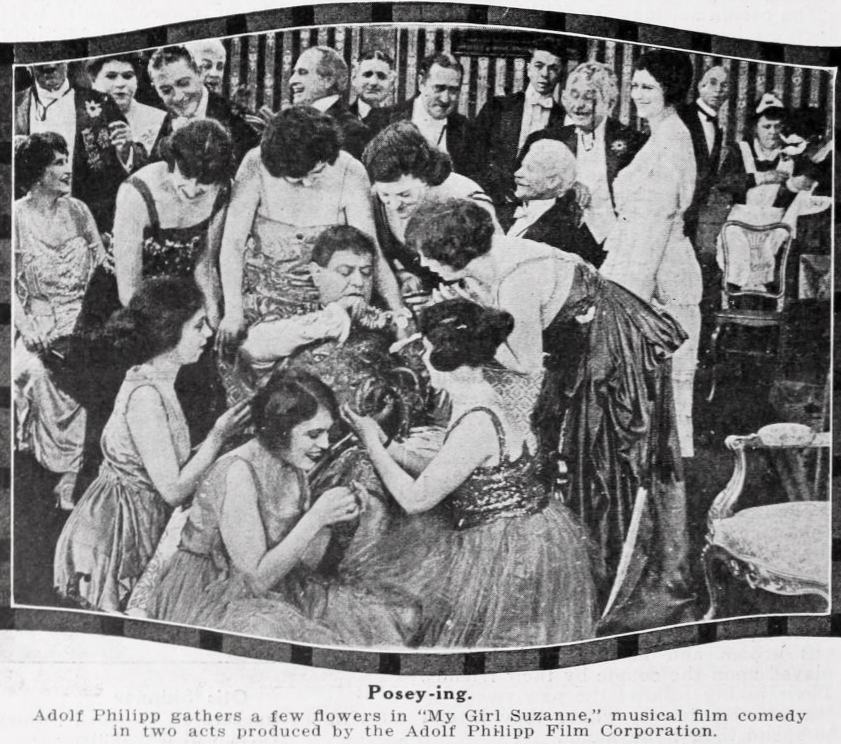
The projector hiccups, the house lights die, and suddenly 1914 exhales across the screen like a daguerreotype sighing itself to life. My Girl Suzanne is not a film you watch; it is a parlour you stumble into, all hush and hair-oil, where every doily seems to pulse with secrets. Adolf Philipp—who also wrote, directed, and plays the sneering butler—understood that childhood can be a genteel massacre, and he stages it in drawing rooms so over-upholstered they feel like coffins lined in chintz.
Silent cinema is littered with orphaned ragamuffins who conquer the world with dimples; Suzanne, brought to tremulous life by Lucia Backus Seger, is the antidote. Her eyes—two spilled thimblefuls of twilight—register every eviction from warmth. Watch the way her shoulders creep toward her ears when Cordelia Philipp enters: a wordless cringe that speaks volumes on the archaeology of institutionalised dread. Seger was eleven during production; the vulnerability is documentary.
Philipp’s screenplay treats childhood not as a sentimental waystation but as occupied territory, a Poland of the soul partitioned by condescending adults.
Visually the picture leans into trompe-l’œil domesticity: camera setups that peer through doorframes like eavesdropping servants, or hover above dining tables so the silverware becomes a constellation of cold stars. The cinematographer, Tom Bret (pulling double duty as scenarist), favours chiaroscuro that bruises the edge of every parlour lamp. When Suzanne clutches her mother’s locket, the object glows sulphur-yellow while her face recedes into umbral anonymity—a perfect visual syllogism: memory is the only candle that burns the holder.
Joseph Marquis essays Karl with the gawkiness of someone who has read about emotions in library books. His chemistry with Seger is achingly chaste: a single gloved hand on her braid, a stammered promise that sounds like it was written on a prescription pad. Their relationship courts paedophilic readings only if you project modern hysteria onto an era that saw courtship as slow as oxidisation. In 1914 a twenty-year-old proposing to a teenager raised no eyebrows—yet Philipp refuses to romanticise. The power imbalance is the film’s omnivorous subtext, chewing scenery whenever Cordelia swans past in jet-beaded mourning.
Ah, Cordelia—Adolf Philipp in matriarchal drag, eyes as hospitable as hypodermic needles. She embodies what today we’d call ‘weaponised philanthropy,’ hosting charities for ‘fallen girls’ while auctioning off her nephew to the highest dowry. Every frame that traps Suzanne under Cordelia’s roof vibrates with gothic menace; the mansion’s corridors elongate like esophagi, digesting innocence one creaking floorboard at a time. Compare this to The Girl at Home where domestic peril is played for matrimonial slapstick; Philipp will have none of that cowardice.
The picture’s midpoint pirouettes into fugitive road-movie territory once Suzanne filches the brooch. Suddenly intertitles shrink, as if language itself is out of breath. We get locomotive wheels, smoke stacks, a montage of way-station faces flickering past like shuffled tarot. Bret’s editing here predates Soviet theories of intellectual montage by a decade, yet achieves a dialectic: every steel rail is also a prison bar, every open horizon a mirage of autonomy.
But the film’s true coup is its refusal of catharsis. The final sequence—Karl in a hospital ward, Suzanne anonymous in a Montreal orphanage—offers no reunion, only parallel solitude. Philipp denies us the Deus ex machina that rescues Anne of Green Gables or even The Cricket. Instead the last intertitle crawls across the screen like a death certificate: “Some doors, once closed, become walls.”
Lucia Backus Seger never made another film; she vanished into the vaudeville circuits, a footnote even in cult cine-clubs. Yet her Suzanne is the benchmark for pre-teen interiority, predating Vera, the Medium’s clairvoyant moppet by eight years and outclassing The Country Mouse’s cutesy rustic. Watch the micro-gesture when Suzanne learns Karl is betrothed: Seger’s pupils dilate like a startled colt, then contract into resignation—all within eight frames of celluloid. It’s the sort of detail Stanislavski would have bottled and displayed under glass.
Joseph Marquis carries the second half on shoulders that seem never to have filled a jacket properly. His hospital scenes—amputated soldiers, ether-soaked linens—echo the Great War that would soon mutilate a continent. Karl’s voiceless scream (rendered only via intertitle ellipses) foreshadows Wilfred Owen’s poetry; Philipp is dragging the war home before it has even been declared.
Though shot in black-and-white, the film prompts a synesthetic palette. Cordelia’s parlour is burnt sienna, the colour of scorched reputations; Suzanne’s creek-side haven cerulean, a watercolour hope; Karl’s rail ticket ochre, the hue of escape that curdles into exile. Contemporary audiences, drunk on hand-tinted Pants or Syndens datter, would have mentally coloured these frames; the film invites such hallucination.
Philipp’s drag turn isn’t vaudevillian buffoonery but a chilling essay on matriarchal complicity. Cordelia’s corseted sadism indicts the very women who policed girlhood, the anti-Peter-Pans who traded their own wings for house keys. In an era when suffrage agitators were force-fed in prisons, the film’s critique feels quietly subversive: the oppressor wears the face that resembles you in the mirror.
Archival notes reveal the original roadshow featured a ten-piece orchestra sawing out “Little Lost Child” on a Wurlitzer. Yet I prefer the print mute, the one discovered in a Slovenian monastery in 1998. In that silence Suzanne’s footfalls become drumbeats of abandonment; Karl’s stethoscope (drooping like a wilted lily) becomes a metronome of futility. Silence, paradoxically, amplifies the film’s aural ghosts: the unheard lullabies, the unsent letters, the almost that reverberates louder than any spoken word.
Unlike The Ghosts of Yesterday or The Divorcee, My Girl Suzanne never got a Kino restoration, no 4K re-scan accompanied by a Tony Rayns commentary. It survives in two incomplete negatives, one nesting in the Library of Congress like a dormant virus, the other in a Parisian basement where the nitrate reeks of camphor and regret. Yet cinephiles who stumble upon it emerge evangelists, whispering its title like a hex. It is the film you recommend without synopsis, a razorblade hidden in a handkerchief.
Social-media cine-memes lionise Nothing But Nerve for its flapper defiance, or Stranded in Arcady for its proto-hippie pastoralia. Suzanne’s ache is too interior to meme, too lacerating for GIF loops. It demands the communal darkness of a theatre, the sort where strangers clutch shared armrests and discover their fingers are trembling for the same imaginary friend.
To call My Girl Suzanne a masterpiece is to risk deodorising its wounds. It is not perfect; the comic-relief butler (also Philipp) belongs to a lesser picture, and the subplot involving a kleptomaniac cousin vanishes like an unfinished sneeze. Yet its imperfections are bruises on a breathing body. It proves that silent cinema could articulate the unspoken grammar of trauma decades before psychoanalysis seeped into the cultural groundwater. Watch it—if you can find it—and you may discover that the most harrowing special effect is the flicker of recognition across Lucia Seger’s moonlit face: the moment a child understands she is property, and love is just another word for repossession.
IMDb —
1927
Community
Log in to comment.