DbcultAccessing Vault...
Cult Review
Senior Film Conservator
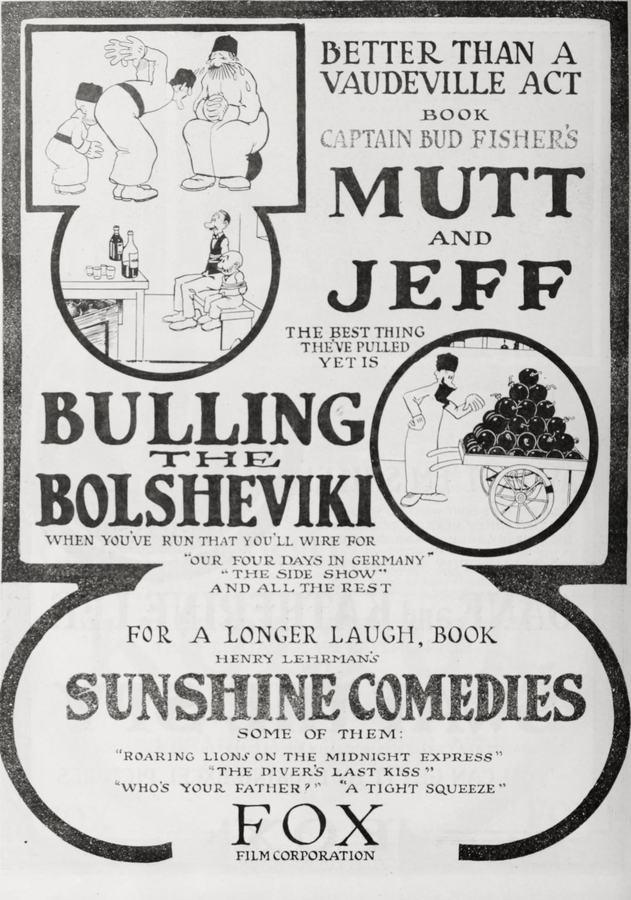
Stepping back into the nascent days of cinema, particularly the politically charged landscape of the early 20th century, we encounter a fascinating artifact: 'Bulling the Bolshevik'. Penned and starring the inimitable Bud Fisher, a name synonymous with early American comic strips and animated shorts, this film offers far more than a simple visual gag; it’s a direct, unvarnished commentary on the prevailing anxieties of its era. This wasn't merely entertainment; it was a societal mirror, albeit a distorted one, reflecting the widespread apprehension surrounding the rise of Bolshevism in post-World War I America. To truly appreciate its impact, one must contextualize it within the Red Scare, a period marked by intense anti-communist sentiment and a deep-seated fear of radical ideologies infiltrating American life. Fisher, with his characteristic blend of accessible humor and pointed social observation, delivers a narrative that is both a product of its time and a fascinating study in early cinematic propaganda. It’s a testament to the power of the moving image, even in its most rudimentary form, to shape public opinion and reinforce nationalistic narratives.
Bud Fisher, primarily known for creating the iconic Mutt and Jeff comic strip, brought a distinctive sensibility to the nascent film industry. His work was characterized by a rapid-fire wit, visual dynamism, and a knack for creating instantly recognizable archetypes. In 'Bulling the Bolshevik', these elements are harnessed to address a weighty political subject with surprising agility. The film, likely a short animated piece or a live-action comedy with heavy cartoonish elements (given Fisher's background), serves as a masterclass in how to distill complex geopolitical fears into digestible, even humorous, vignettes. The 'Bolshevik' character is not presented as a nuanced political ideologue but rather as a comical, somewhat buffoonish villain – a tactic designed to demystify and ridicule a perceived threat. This approach effectively disarms the gravity of the subject matter, making it palatable and even laughable for a mass audience, thereby strengthening the narrative of American resilience and superiority.
The casting of Bud Fisher himself, or at least his creative imprint being so central, underscores the highly personal and direct nature of the film's message. It's not an abstract political statement; it's a comedic performance, a direct address to the audience, inviting them to laugh at the 'other' and reaffirm their own values. This directness, characteristic of early silent cinema, allowed for an immediate connection with viewers, bypassing the need for complex dialogue and relying instead on visual cues, exaggerated actions, and universally understood comedic tropes. The film's brevity, too, would have contributed to its punchy impact, delivering its message swiftly and decisively before any deeper contemplation could set in.
The plot of 'Bulling the Bolshevik', while straightforward, is rich in its satirical intent. It typically involves a representative of American 'common sense' – a character embodying the industrious, pragmatic spirit of the nation – confronting a caricatured Bolshevik agitator. This revolutionary figure is often depicted with stereotypical iconography: a shaggy beard, perhaps a bomb, or a red flag, all designed to trigger immediate recognition and aversion in the audience. The Bolshevik's attempts to disrupt the peace, whether through inflammatory speeches or clumsy acts of sabotage, are invariably met with the protagonist's ingenuity and physical comedy. Imagine a scenario where the Bolshevik tries to incite a crowd, only to have his soapbox collapse, or attempts to plant a 'revolutionary' device that backfires spectacularly, covering him in soot and humiliation. These are the kinds of visual gags that would have defined Fisher's approach, transforming serious political threats into objects of ridicule.
The 'bulling' aspect of the title is crucial here. It implies not just defeat, but a forceful, almost playful subjugation. The Bolshevik isn't just outwitted; they are physically, comically, and utterly put in their place. This serves a dual purpose: it reassures the audience that the threat is not only containable but inherently weak and foolish, and it provides cathartic laughter at the expense of an enemy. The humor, while broad, is effective in its goal: to deflate the perceived power of the revolutionary ideology and bolster national confidence. The film essentially argues that American values and ingenuity are inherently superior and capable of neutralizing any foreign threat, no matter how menacing it might initially appear. This simplistic yet powerful message resonated deeply with audiences grappling with a rapidly changing world order and internal social unrest.
When we place 'Bulling the Bolshevik' alongside other cinematic works of its time, its particular brand of political messaging becomes even clearer. Films like The Land of Promise (1917), for instance, often explored themes of national identity and the challenges faced by those seeking to establish themselves within American society, albeit usually through dramatic narratives. Fisher's film takes a more aggressive, overtly confrontational stance against perceived external threats. While The Barrier might have delved into social divisions and moral dilemmas within America, 'Bulling the Bolshevik' directs its energy outward, projecting an enemy to be collectively opposed and ridiculed. This distinction highlights the unique role of political satire in shaping public discourse, offering a lighter, yet no less impactful, form of persuasion.
The film's didactic intent also finds parallels, albeit in different genres, with serials like Beatrice Fairfax Episode 8: At the Ainsley Ball, which, through episodic narratives, often reinforced moral codes and societal expectations. Fisher’s short, however, simplifies the 'good vs. evil' dynamic to a stark, comedic face-off. It lacks the complex character development one might find in a drama like Thomas Graals bästa barn (1918), where human relationships and internal struggles are paramount. Instead, its strength lies in its immediate, visceral appeal, tapping into collective fears and prejudices with a laugh-track sensibility before such things truly existed. This immediacy was a potent tool in an era where mass communication was still evolving, making cinema a powerful, unfiltered medium for public messaging.
Furthermore, one could draw a fascinating contrast with the grand cinematic ambitions of a film like Napoleon (1927), which, though later, epitomizes the epic historical drama. Where Abel Gance sought to monumentalize a historical figure and his sweeping impact on Europe, Fisher aimed for the ephemeral, the immediate, the chuckle-inducing lampoon of a contemporary threat. The scale is vastly different, but the intent to influence perception, to tell a story that resonates with national identity, remains a common thread. Even in its brevity and comedic packaging, 'Bulling the Bolshevik' contributes to a broader cinematic tapestry that reflects a nation grappling with its place in a tumultuous world.
The visual language of 'Bulling the Bolshevik' is undoubtedly rooted in the tradition of political cartoons, a medium where exaggeration and symbolic representation are paramount. Fisher, as a cartoonist, understood implicitly how to convey complex ideas through simple, striking imagery. The Bolshevik character, therefore, wouldn't have been a nuanced portrayal but a walking, talking (or rather, gesturing) caricature – a visual shorthand for a perceived danger. This reliance on visual cues was a necessity in silent film, but it also served to amplify the film's message, making it accessible even to illiterate audiences. The physical comedy, the exaggerated movements, the broad expressions – these were the tools Fisher used to communicate scorn and triumph. The 'bulling' itself would have been a series of physical gags: tripping, falling, getting caught in one's own traps, or being comically outmaneuvered by the protagonist. This type of humor, while perhaps unsophisticated by today's standards, was incredibly effective in its time, eliciting hearty laughter and reinforcing the film's underlying political message without ever needing a single spoken word.
The simplicity of the narrative also allowed for a focus on the kinetic energy of early cinema. Before the advent of sophisticated editing and camera techniques, the dynamism often came from the performers themselves and the ingenuity of the gags. Fisher, whether through animation or live-action, would have choreographed sequences that emphasized movement and reaction, turning the ideological battle into a physical spectacle. This approach contrasts sharply with the often more introspective or dramatic narratives of films like The Wolf or The Unattainable, which relied on character depth and emotional resonance. Fisher's strength lay in the immediate, the superficial, and the powerfully symbolic. He wasn’t aiming for psychological realism; he was aiming for a gut reaction, a unifying chuckle against a common, exaggerated foe.
The deepest currents of 'Bulling the Bolshevik' are undeniably socio-political. America in the wake of World War I was a nation grappling with profound shifts: the rise of industrial labor, mass immigration, and the unsettling news of the Russian Revolution. The fear of socialist and communist ideologies taking root on American soil was palpable, leading to events like the Palmer Raids and a general atmosphere of suspicion towards anything deemed 'un-American.' Fisher's film served as a cultural balm, a reassurance that these threats, while real, were ultimately conquerable through the sheer force of American spirit and comedic ingenuity. It channeled collective anxieties into a harmless, humorous outlet, defusing tension by turning the feared 'other' into a figure of fun.
In this sense, the film operates on a similar psychological level to how some comedies today might tackle contemporary political issues – by making them accessible, and often by simplifying them to the point of caricature. However, in the context of the Red Scare, this simplification carried significant weight, contributing to a broader public narrative that demonized dissent and celebrated conformity. It’s a fascinating, if sometimes uncomfortable, reminder of how entertainment can be intricately tied to political messaging, consciously or unconsciously shaping public perception. The film doesn't merely reflect the times; it actively participates in the ideological battles being waged, albeit with a smile and a slapstick flourish. Its power lies not in its artistic grandeur, but in its ability to tap directly into the zeitgeist and offer a readily digestible, emotionally satisfying resolution to complex fears.
Ultimately, 'Bulling the Bolshevik' stands as more than just a forgotten relic of early cinema. It's a vital historical document, offering an unfiltered glimpse into the political climate and cultural anxieties of its time. It showcases Bud Fisher's unique talent for blending humor with sharp social commentary, a skill he honed through his groundbreaking comic strips. While it lacks the narrative complexity of later features or the artistic ambition of European contemporaries like Pesn lyubvi nedopetaya, its directness and comedic force are undeniable. It reminds us that even in the earliest days of film, the medium was being leveraged not just for escapism, but for persuasion, for the shaping of national identity, and for the articulation of collective fears and triumphs.
The film's very title is a declaration, an assertion of power and ridicule. It encapsulates an entire national mood in a handful of words and a few minutes of screen time. For film historians, cultural critics, and anyone interested in the intersection of art and propaganda, 'Bulling the Bolshevik' remains an invaluable piece of the cinematic puzzle, a vibrant, albeit politically charged, testament to the enduring power of laughter as a weapon in the ideological arena. It's a reminder that even the simplest of stories can carry profound cultural weight, reflecting and reinforcing the dominant narratives of an age. Its analysis offers a window into how early filmmakers, like Fisher, contributed to the ongoing conversation about national values and perceived threats, long before cinema evolved into the nuanced art form we recognize today.
IMDb —
1915
Community
Log in to comment.