DbcultAccessing Vault...
Cult Review
Senior Film Conservator
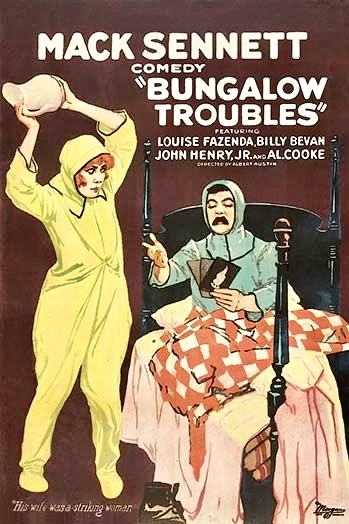
Bungalow Troubles (1920s), a film that marries slapstick with socioeconomic critique, is a forgotten gem of early cinema. Directed with a sure hand by an anonymous helmer (a common practice in the era), the film uses the microcosm of a middle-class bungalow to interrogate the broader anxieties of its time. Louise Fazenda’s portrayal of the well-meaning yet catastrophically unaware wife is a revelation. Her gestures are grandiose, her intentions pure, yet her actions—like the ill-conceived surprise party—mirror the hubris of those who believe they can control chaos. The film’s genius lies in its refusal to villainize her; instead, it frames her as a product of an era where women were both the architects and pawns of domestic order.
Al Cooke, as the husband, is a tragicomic figure, his every reaction a masterclass in understated despair. His stoicism under siege—whether from a well-meaning friend (Billy Bevan) or a mischievous neighbor (James Finlayson)—creates a tension that is both hilarious and profoundly human. The film’s set pieces are meticulously staged: a cake collision that doubles as a critique of consumerism, a garden party that becomes a battleground of class differences. Each gag is a metaphor, the humor never merely for laughs but a lens through which to view societal norms.
What elevates Bungalow Troubles beyond its contemporaries is its layered narrative. It’s not just a comedy of errors but a study in power dynamics. The wife’s party, intended as an act of love, becomes a microcosm of patriarchal control—she assumes the role of hostess, but her authority is undermined by the very guests she invites. This duality is mirrored in the film’s structure; while the plot meanders through slapstick routines, the subtext is razor-sharp. The bungalow, a symbol of domesticity, becomes a prison of expectations, its walls closing in as the party escalates into farce.
The ensemble cast, though largely forgotten by modern audiences, delivers performances that feel startlingly modern. Don Marion, as the overly enthusiastic party planner, channels a manic energy that borders on surreal. His interactions with Louise Fazenda’s character are a masterclass in comedic timing, their dialogue (or rather, the absence thereof in silent films) conveying volumes about unspoken tensions. Mildred June, as a rival in friendship or perhaps in marital advice, adds a layer of ambiguity—her motives unclear, her presence destabilizing.
James Finlayson, ever the scene-stealer, plays a meddling neighbor whose antics are both endearing and exasperating. His character’s inability to discern formality from absurdity—like mistaking a garden hose for a serpentine dance prop—highlights the film’s recurring theme: the futility of trying to impose order on chaos. The chemistry between the actors is electric, their physical comedy precise yet spontaneous, a testament to the collaborative spirit of the silent era.
At its core, Bungalow Troubles is a film about the fragility of control. The wife’s birthday surprise, a gesture rooted in love, becomes a vehicle for exploring power imbalances. Her belief in her ability to orchestrate a perfect evening is undermined by forces beyond her—social norms, economic pressures, and the inherent unpredictability of human interaction. The film’s climax, where the bungalow is overrun by guests who misinterpret every gesture, is a darkly humorous commentary on the invasion of public life into private space.
This tension is further amplified by the film’s visual language. The bungalow, initially a sanctuary, becomes a stage for farce, its domestic objects transformed into tools of chaos. A cake becomes a projectile, a garden hose a comedic weapon. These objects, mundane in isolation, gain symbolic weight as the film progresses, reflecting the erosion of domestic peace under the weight of social expectations.
Bungalow Troubles shares DNA with other pre-code comedies, but its uniqueness lies in its subversive edge. Like The Week-End (1921), it uses domestic settings to explore societal pressures, yet Bungalow Troubles’ critique is more overt. The film’s tone is reminiscent of Forbidden Fruit (1924), where innocence collides with reality, but here the collision is comedic rather than tragic. The chaotic energy of Shall We Forgive Her? (1920) is mirrored in Bungalow Troubles, though the latter’s stakes are lower—yet its emotional resonance is no less potent.
What sets Bungalow Troubles apart is its refusal to simplify its characters. The wife is not a villain, nor is her husband a victim; they are two people navigating a world that demands perfection from both. This duality is rare in comedies of the era, where moral binaries often dominate. The film’s legacy is thus twofold: it is both a product of its time and a precursor to more complex narratives that would emerge in the sound era.
The film’s visual style is deceptively simple. The use of shadow and light is minimal, yet effective, creating a stark contrast between the intimacy of the bungalow and the chaos outside its walls. The editing, though rudimentary by today’s standards, is purposeful—each cut a heartbeat in the film’s rhythm. The score, when it exists, is subtle, allowing the physical comedy to speak for itself.
One standout sequence involves a misdelivered gift that arrives as the party crescendos. The gift, a typewriter, is a symbol of the modern woman’s ambition, yet it becomes a source of farcical conflict. The typewriter’s keys are struck in a Morse code-like rhythm, a nod to the era’s fascination with technology—both as a tool of liberation and a harbinger of chaos. This sequence, like many in the film, is a microcosm of its themes: progress and tradition in collision.
Bungalow Troubles is more than a relic of the silent era—it is a film that transcends its time. Its exploration of domesticity, power, and the absurdities of social life is as relevant today as it was a century ago. The film’s enduring appeal lies in its ability to balance humor with insight, making it a must-watch for cinephiles and casual viewers alike. In an age where the line between personal and public life grows increasingly blurred, Bungalow Troubles offers a prescient commentary on the chaos of modern existence, all while keeping its audience in stitches.
IMDb 4.5
1936
Community
Log in to comment.