DbcultAccessing Vault...
Cult Review
Senior Film Conservator
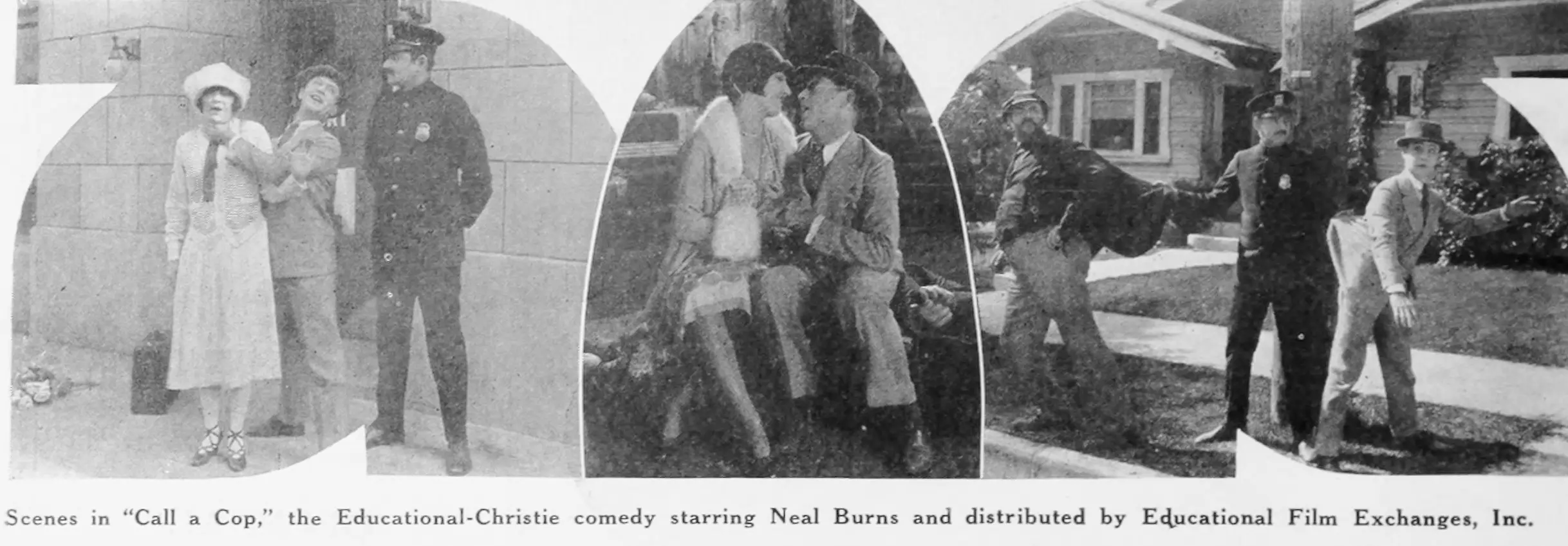
The year 1925 represents a fascinating precipice in cinematic history, a moment when the silent medium had reached a zenith of visual storytelling and rhythmic editing. In this fertile soil, Call a Cop flourishes as a testament to the Christie Comedy brand's relentless energy. While contemporary audiences might be more familiar with the dark psychological undertones of The Unholy Three, Frank Roland Conklin’s work here operates on a frequency of pure, unadulterated kineticism. It is a film that treats the legal system not as a pillar of society, but as a playground for the absurd, where the gravity of a prison sentence is outweighed by the centrifugal force of a speeding motorcar.
Neal Burns, an actor whose physicality often mirrored the elasticity of a rubber band, portrays the protagonist with a mixture of dapper desperation and naive arrogance. The premise—a young man hiring a proxy to serve a jail sentence—is a trope that echoes the class-based subversions found in The Girl and the Judge, yet here it is stripped of melodrama and infused with the frantic pacing of a ticking clock. When Neal is apprehended for speeding while en route to his paramour, he views the law as a mere transactional hurdle. His decision to hire a local 'thug' to stand in for him in the dock is the ultimate expression of Jazz Age entitlement, a theme that resonates even in modern critiques of social stratification.
The narrative hinge, however, is the judicial bait-and-switch. Expecting a slap on the wrist, Neal is horrified when the judge—played with a granite-faced severity that contrasts beautifully with Burns' jittery energy—hands down a six-month sentence. This moment of peripeteia transforms the film from a simple romantic comedy into a survivalist farce. The thug, portrayed with a brutish charm by Jack Ackroyd, is not merely a victim of Neal’s scheme but becomes a vengeful force of nature once he realizes the extent of his incarceration. The ensuing escape and pursuit create a secondary layer of tension that elevates the film beyond the standard 'boy meets girl' architecture found in Pick Out Your Husband.
Conklin’s direction shines in the middle act, where the spatial dynamics of the film become increasingly complex. The introduction of an inheritance subplot—a classic MacGuffin—serves to tether the disparate characters together. We see Neal attempting to navigate a world where he is simultaneously a fugitive from his own surrogate and a legitimate heir. The irony of Neal trying to break into jail to seek safety from the very man who escaped it is a masterclass in situational reversal. It mirrors the claustrophobic anxieties seen in European imports of the era like Gefangene Seele, though here the soul is not imprisoned by trauma, but by the sheer stupidity of its own making.
Critique Insight: The Slapstick Syntax
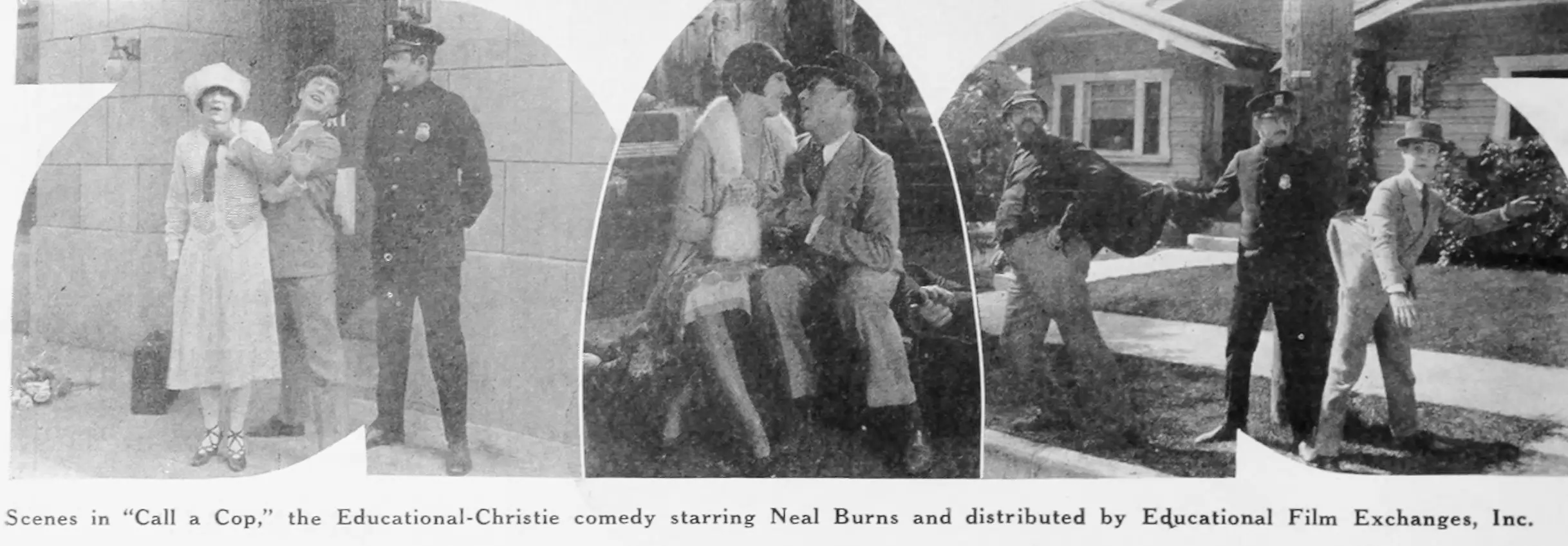
The physical comedy in 'Call a Cop' is not merely about the fall; it is about the recovery. Neal Burns utilizes a specific brand of 'eccentric dance' movement, where every near-collision is handled with a choreographed grace. This is particularly evident in the scenes involving the lawyer's house, where the architecture itself becomes a character. Doors, windows, and staircases are utilized as rhythmic instruments, creating a visual symphony that rivals the best work of Keaton or Lloyd.
Natalie Joyce provides more than just a romantic focal point; she acts as the grounding element in a story that threatens to fly off into the stratosphere. Her interactions with Burns carry a playful, if occasionally baffling, domesticity. One of the film's most curious moments involves the cop's advice to "Treat 'Em Rough," leading to a scene where Neal chokes his girl in a misguided attempt at masculine dominance. To a modern eye, this sequence is jarring, yet within the context of 1920s gender tropes—often explored with more gravity in films like The Wildcat—it serves as a satirical jab at the 'tough guy' personas popularized by the likes of Valentino or Fairbanks. It is a moment of dark absurdity that highlights the character's total inability to function within societal norms.
The fire sequence, where a false alarm precedes a genuine conflagration, adds a layer of 'peril comedy' that was a staple of the mid-20s. The technical execution of the fire effects, while primitive by today’s standards, possesses a tactile reality that CGI cannot replicate. It brings a sense of stakes to the lawyer’s house, turning the final chase into a literal and figurative pressure cooker. This use of environmental hazards is reminiscent of the tension found in Time Lock No. 776, though Conklin never lets the suspense overshadow the humor.
When comparing Call a Cop to other releases of the period, its unique blend of urban anxiety and slapstick becomes even more apparent. While Always in the Way leans heavily into the pathos of childhood abandonment, and The Black Stork ventures into the murky waters of social eugenics, 'Call a Cop' remains stubbornly committed to the joy of the chase. It shares a certain DNA with Caught in the Act, specifically in its portrayal of the 'innocent' man caught in a web of his own deceit. However, Conklin’s film is more interested in the physical repercussions of that deceit than the moral ones.
The presence of S.D. Wilcox and Lincoln Plumer in the supporting cast provides a sturdy foundation for the leads to bounce off. These veteran character actors understood the 'straight man' requirement of silent comedy—the ability to remain utterly serious while the world collapses around them. This stoicism is what makes the final chase through the lawyer's house so effective. As the porter, Neal, the girl, and the thug collide in a kaleidoscopic array of movement, the lawyer’s house becomes a microcosm of a world gone mad. It lacks the historical sweep of Dorothy Vernon of Haddon Hall, but it possesses a contemporary vitality that feels remarkably fresh.
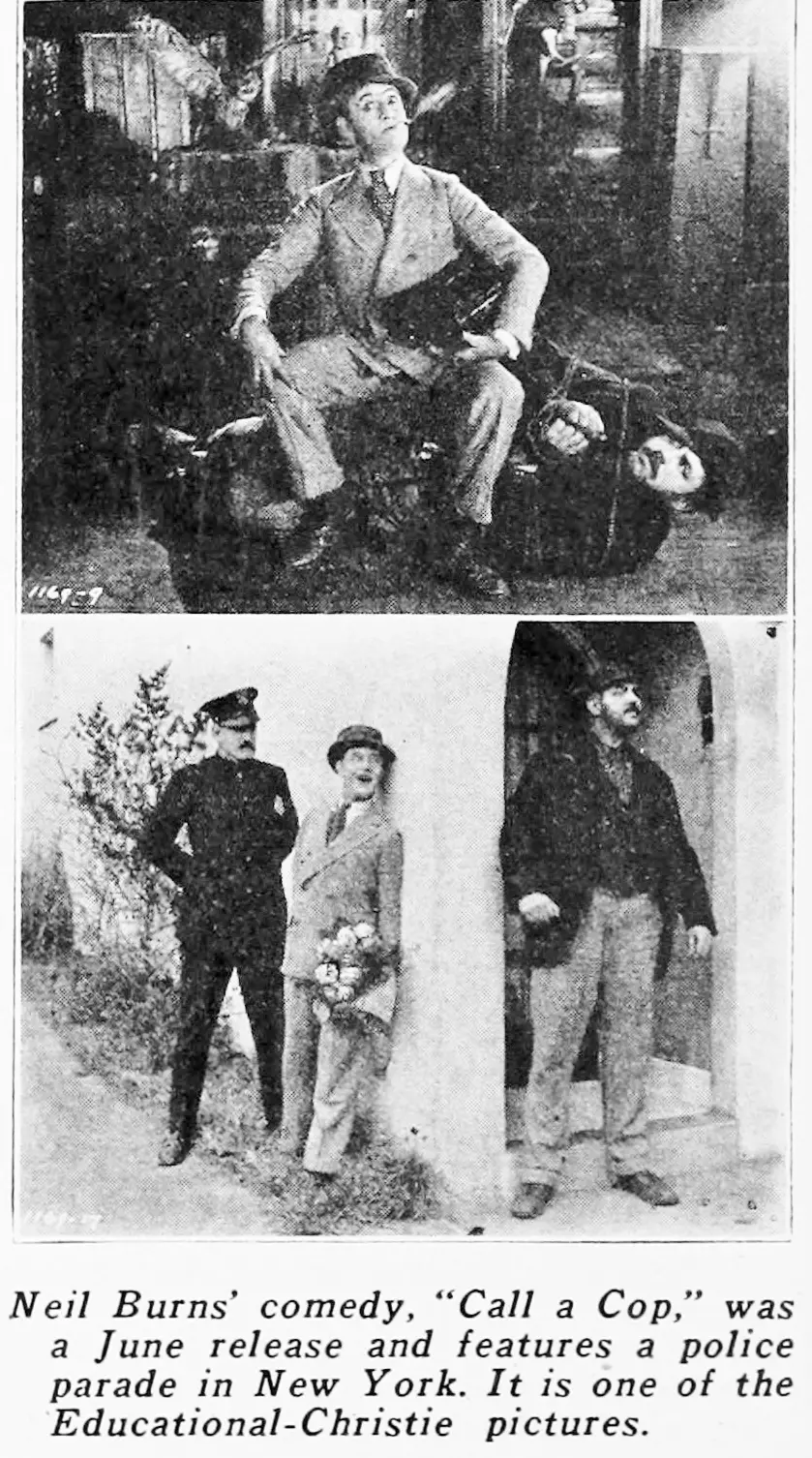
The cinematography in 'Call a Cop' utilizes the high-contrast lighting typical of the mid-20s, which serves to sharpen the slapstick. Every gesture by Neal Burns is highlighted, every scowl from the thug is deep-etched. The editing is particularly noteworthy; the cross-cutting between Neal’s attempts to enter the jail and the thug’s escape creates a parallel narrative that eventually merges into a singular, chaotic thread. This sophistication in editing was becoming more common in 1925, as seen in the psychological pacing of Black Oxen, yet here it is harnessed for the sake of laughter rather than drama.
Furthermore, the film's exploration of the 'thug' archetype is worth noting. Unlike the tragic figures in The Italian, the criminal element in 'Call a Cop' is largely a comedic foil. Yet, there is a subtle undercurrent of class resentment in the thug's pursuit of Neal. He isn't just chasing him for the money; he’s chasing him because Neal had the audacity to treat a human life as a disposable commodity for his own convenience. This adds a microscopic layer of social commentary to an otherwise breezy film, much like the subtle workplace critiques in Erlebnisse einer Sekretärin.
In the pantheon of 1925 cinema, Call a Cop might not possess the philosophical weight of the era’s grander epics, but it is a quintessential example of the 'pure' cinema that the silent age perfected. It is a film that understands that movement is the primary language of the screen. Whether it is the spinning tires of a speeding car or the frantic legs of a man trying to outrun his own mistakes, the film is in constant motion. It avoids the static theatricality that plagued many early features, opting instead for a fluid, almost musical approach to comedy.
Ultimately, the film serves as a brilliant showcase for Neal Burns, an actor who perhaps lived too much in the shadow of the 'Big Three' (Chaplin, Keaton, Lloyd) but who possessed a unique, manic charm all his own. His ability to convey complex emotions—fear, greed, love, and exhaustion—without uttering a single word is a testament to the power of the silent medium. 'Call a Cop' is a breathless ride through the legal loopholes and physical hazards of 1920s America, a film that proves that sometimes, the only way to escape the law is to run straight into it. It is a delightful anomaly, a comedy that finds humor in the most unlikely of places: the cold, hard floor of a jail cell and the burning hallways of a lawyer's estate.
A Christie Comedy Classic - Reviewed by the Cinephile's Journal

IMDb —
1918
Community
Log in to comment.