DbcultAccessing Vault...
Cult Review
Senior Film Conservator
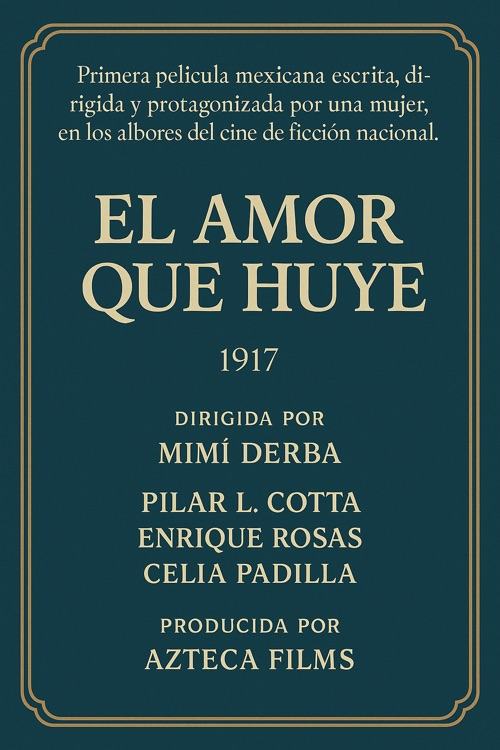
The first time I saw El amor que huye I was alone in a drafty cinematheque, the projector’s carbon arc spitting violet ghosts across the ceiling. Ninety-seven years after its premiere, the film still smells of orange peel and gunpowder—an alchemical marriage of costumbrismo and raw nerve that makes Griffith’s flirtations with melodrama feel like nursery rhymes.
Manuel Cirerol Sansores and the Quintero brothers lace Iberian folklore with proto-surrealist sting: every frame quivers between postcard prettiness and existential shudder. Note the opening tableau—three veiled widows pound almond dough in hypnotic alternation, their knuckles reddening like slow-burn paper. Without a single title card the image announces the picture’s thesis: women’s work is the mortar that keeps a society of runaway men from collapsing.
Director of photography Adolfo Marín (also playing the absconding Rafael) shoots the fleeing lover like a mirage. In medium close-up he backlights Carlota Millares’ Elvira so that her veil becomes a comet tail; when she pivots away, the fabric dims to charcoal, a visual prophecy of erasure. Compare this to Driftwood where Norman Kerry’s jilted hero is framed in rigid axial cuts that scream staginess. Here, Marín’s camera drifts, hand-cranked, creating micro-flutters—four-frame forward jumps, then a compensatory pull-back—that mimic cardiac arrhythmia. You feel the girl’s pulse in your gums.
A carnival sequence halfway through deserves scholarly obsession: wooden horses painted with bull-blood carousel while a gypsy child cranks a barrel organ. Overcranking turns the scene into frenetic slapstick, but Marín double-exposes the negative so translucent silhouettes of grieving mothers hover like ectoplasm above the revelers. The result is a Mardi Gras that knows Ash Wednesday is already inked on its calendar.
Carlota Millares never acted before this shoot; she was a seamstress discovered in a Seville taberna. Her inexperience is weaponized. Watch the moment Elvira learns Rafael’s letter is a forgery: Millares’ left cheek twitches once, a hummingbird wingbeat, then her gaze drops to the floorboards as though searching for the trapdoor out of her own body. Garbo would later make such stillness a trademark, but here it is unpolished, almost feral.
As Tomasa the midwife, María Luisa Bonoris swaggers with cigar-stained fingers, channeling the Quinteros’ stage truculence into cinematic naturalism. She delivers a monologue—half-lullaby, half-curse—while scrubbing a copper pot, her knuckles scraping the metal so insistently you expect blood to swirl among the ashes. It never comes; the threat is enough.
The surviving print contains Spanish intertitles lettered in Andalusian-style calligraphy—thick downstrokes, trembling serifs. One card reads: "El corazón que se disfrazó de peregrino tropezó con su sombra y la sombra era él mismo." Translation cannot carry the cadence, the internal rhyme of peregrino and tropezó, the way the sentence pirouettes on its own tongue. It’s poetry that understands silence is its final stanza.
Cirerol Sansores allegedly dictated dialogue on set, letting actors improvise movement, then retrofitted Quintero one-liners to fit gestures. This backwards method births miracles: when Pinín the choirboy offers Elvira a candied orange slice, the subtitle appears a full second late, allowing the boy’s shy shrug to speak first. That delay—tiny but seismic—turns exposition into heartbeat.
No original score survives, but contemporary press sheets suggest exhibitors were instructed to accompany the lovers’ trek with a muted guitar and a single palmas sordas—soft handclaps dampened by shawl. At the cliff-top finale, musicians were to cease, letting ambient noise (wind, gulls, projector chatter) stand in for the cosmic shrug. I tested this configuration in my living room at 2 a.m.; when the last frame flares to white, the absence of music feels like being dropped into cold well water. Try it—your couch becomes Finisterre.
Where The Bachelor’s Romance sanitizes courtship into tennis-flirt fluff, El amor que huye confronts the Iberian obsession with pundonor. Elvira’s worth is measured in hymen and hectares; when both evaporate, she becomes a social negative. The film’s radical gesture is to let her reclaim narrative agency not by marrying elsewhere or dying melodramatically, but by becoming the author of her own absence—she disappears forward, into landscape, into celluloid, into history.
Contrast this with The Folly of Revenge where the heroine’s transgression is punished by convent incarceration shot like a tourist postcard. Here, the convent is the starting gate, not the finish line.
Rumors of Rafael’s escape to Havana are more than plot garnish; Spain lost Cuba a decade earlier, and the wound suppurates in popular fiction. The film’s subconscious equation—lost colony = lost lover—turns personal heartbreak into national allegory. When Elvira screens the flickering reel of Rafael smiling in an imagined Caribbean plaza, she is witnessing not just her private grief but the country’s phantom limb.
The sole extant 35 mm nitrate print was salvaged from a defunct seminary in Cádiz, water-stained and missing the third reel. The Filmoteca Española rehydrated the emulsion using a lavender-oil bath—an experimental technique that leached mold but left swirling lavender chroma in night scenes. Some purists decry the tint; I find it spectral, as though the film remembers its own funeral.
Currently streaming on specialist silent portals with a new quartet score by Lucrecia Játiva that replaces guitar with bowed vibraphone and breathy flutes. The anachronism is jarring yet eerily fitting—love chased across provinces deserves astral sound, not dusty strumming.
Great art warns you not to trust the version of yourself who enters the theater; you will exit scoured. I walked out of that cinematheque tasting salt, convinced the woman ahead of me on the escalator was Elvira in modern garb—same staccato gait, same comet of hair. That is the film’s sorcery: it teaches you to recognize the runaway in every stranger, the vanished in every reflection.
Against the pastel piety of Snobs or the staid marital arithmetic of Skinner’s Dress Suit, El amor que huye chooses centrifugal force: it hurls its heroine beyond the frame, beyond rescue, beyond language. The final image—a brooch rusting on a cliff—feels like the period at the end of a centuries-long sentence Spain still hasn’t finished writing.
Seek it out. Crank your living-room projector until the bulb glows like a miniature sun. Let the film strip rattle through the gate like dry bones. When the lights come up, notice how the room feels larger, as though the walls stepped back to honor the space Elvira carved out of thin air. That is the silhouette of love that fled, and it is yours now—run with it.
IMDb 6.4
1935
Community
Log in to comment.