DbcultAccessing Vault...
Cult Review
Senior Film Conservator
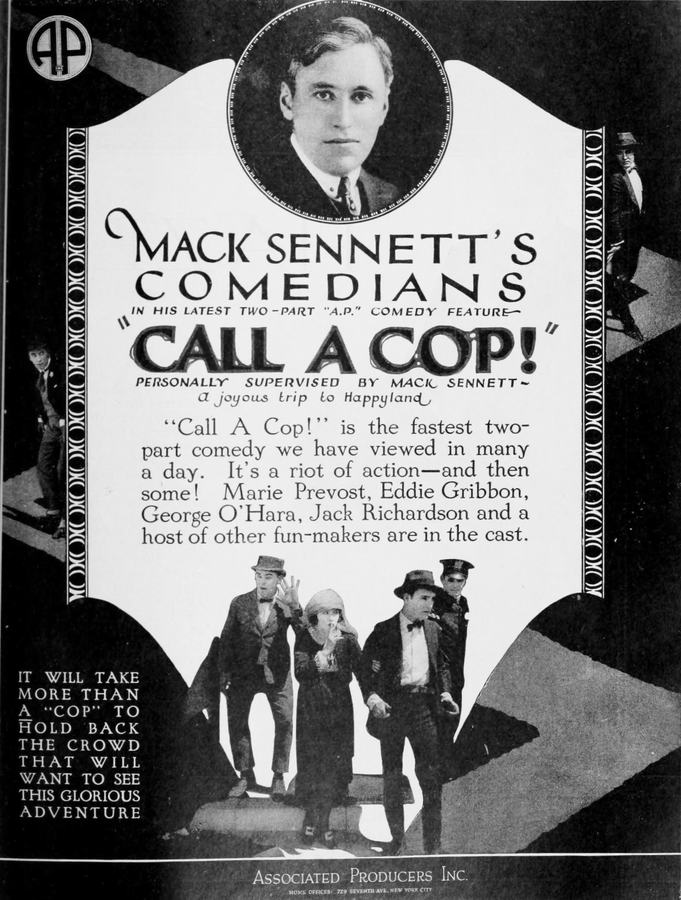
There’s a moment—blink and it detonates—when Kalla Pasha’s gargantuan police captain twists his oversized mustache so violently it becomes a propeller, whipping the dust of an entire city into a sandstorm of civic shame. That micro-burst of surreal physics is the Rosetta Stone to Call a Cop: a 1923 one-reeler that refuses to behave like a museum piece, instead leap-frogging across a century to kick modern sensibilities in the shins.
Mack Sennett’s writers—those caffeinated jesters of the slapstick pantheon—never bothered with plot scaffolding; they preferred nitroglycerin. The film’s supposed narrative is a breadcrumb trail of civic duty: a handbag is snatched, the call-box howls, and three Keystone cops—Pasha’s apoplectic chief, Gribbon’s lanky simpleton, and Tiny Ward’s barrel-shaped tyro—slam into frame like malfunctioning jack-in-the-boxes. Yet the crime is mere tinder for a city-wide carnival of collapsing scaffolding, runaway zebras, and debutantes who weaponize flirtation like assassins wielding silk fans.
Sennett’s camera, bolted to the asphalt, squats low as if bracing for a hurricane. The resulting perspective exaggerates every shin-level collision, turning ankles into ballistic missiles. Notice how editor William Hornbeck slices frames with a guillotine rhythm: a blink-long shot of a pratfall, then a smash-cut to a reaction so delayed it feels like satire of the human nervous system. The tempo is a metronome possessed—each gag arrives on the off-beat, a syncopated insult to Newtonian logic.
Comparative context? Place Call a Cop beside The Burglar and the Lady (a melodrama that treats crime as tragic opera) and the difference is the difference between a firecracker and a stick of dynamite with a lit cigar attached. The former wants redemption; the latter wants to watch the world slip on a banana peel and land face-first in its own farce.
Kalla Pasha, whose silhouette could advertise a bank vault, possesses the rare gift of inertia. He plants his boots and the universe ricochets off him. Watch the sequence where he attempts to blow his whistle: the metal instrument inflates like a balloon, then implodes into a spurt of feathers—an anti-balloon, a metaphor for municipal authority deflating into vaudeville absurdity.
Eddie Gribbon, all elbows and optimism, is the anthropomorphic embodiment of oops. His legs operate on separate union contracts; when he runs, knees negotiate against ankles in real time. In one throwaway gag he vaults over a moving Model-T, misjudges height, and spears the convertible top—only to emerge wearing the canvas like a Roman toga, saluting traffic with the solemnity of a self-crowned emperor.
Marie Prevost, criminally underused here, glides through the bedlam like a champagne bubble in a sewer. Her comic timing lies in the microscopic: a single raised eyebrow that sells the delusion of a bomb as a couture accessory. Blink and you’ll miss her swiping a policeman’s heart along with the evidence.
Beneath the cream-pie epidermis, the film needles the cult of the badge. 1923 America was busy militarizing its constabulary after Red Scare bombings; Sennett counters by imagining cops as glorified rodeo clowns. When the precinct telephone erupts, each officer races the others not for justice but for screen time—authority reduced to a footnote in its own foot chase. The climax, a kangaroo court where every character is tried for “public nuisance,” lampoons due process by sentencing the audience to a collective pie in the face. It’s the silent era’s mic-drop on institutional self-parody.
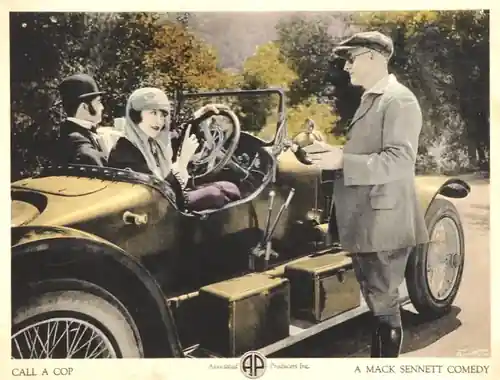
Yet the satire never curdles into cynicism. Sennett’s worldview insists that if institutions are farcical, then farce itself becomes a democratic solvent—everyone, from street sweeper to senator, slips on the same cosmic banana peel. Contrast this with the moral absolutism of God's Law and Man's, where transgression demands penance bathed in chiaroscuro. Sennett prefers absolution via pratfall.
Color palettes in 1920s monochrome are theoretical, yet the cinematographer’s grayscale choices speak volumes. Notice how high-key lighting floods the precinct foyer, bleaching faces into porcelain masks—authority as Kabuki. Cut to the alley chase: low-key shadows swallow torsos, turning limbs into disjointed silhouettes, a living flipbook. The oscillation between overexposure and chiaroscuro is the visual equivalent of a hiccupping heartbeat.
And the props—oh, the props—become characters. The call-box morphs from utilitarian object to Pandora’s lunchbox: open it and out spills an avalanche of truncheons, love letters, and one indignant cat. Even the titular police call, rather than summoning help, functions like a chaotic genie, granting three wishes nobody asked for: confusion, humiliation, and a finale involving an elephant who believes it’s a ballet dancer.
Modern viewers conditioned to Dolby explosions may find the absence of diegetic sound unnerving—until they tune into the film’s percussive visual soundtrack. Each pratfall lands like a snare hit; the rapid-fire intertitles (“CALL A COP!”) function as cymbal crashes. If you screened this in a hip club with a live drummer syncing beats to the edited chaos, Gen-Z ravers would mistake Sennett for the grandfather of EDM.
Prevost’s character, billed only as “The Girl,” weaponizes the era’s flapper iconography—rolled stockings, cupid-bow mouth, gaze like a thrown javelin. She doesn’t scream for rescue; she repurposes the bomb as a fashion statement, tucking it into her clutch as if accessorizing for a soirée. In doing so she hijacks the damsel trope, turning the Keystone continuum into a proto-feminist satire. Compare her agency to the porcelain saintliness of heroines in The Blindness of Virtue and you realize Sennett accidentally let modernity’s cat out of the bag—then watched it claw the pants off every male ego in sight.
The DNA of Call a Cop swims in the bloodstream of everything from The Naked Gun to YouTube fail compilations. Its comedic algorithm— escalate, escalate, detonate—prefigures the ADHD grammar of TikTok. Yet the film also carries a political hangover: a century later, when viral videos expose real-world police blunders, viewers laugh with a nervous aftertaste. Sennett’s clownish cops now feel like prophecy dressed in clown shoes.
A 4K restoration by Lobster Films breathes nitrate life into what was once a ghost on a Library of Congress shelf. The grain structure—once resembling a sandstorm—now glimmers like powdered diamonds. The tints, originally hand-daubed in hydrangea blues and caution-flag ambers, pulse with newfound vibrancy. Streaming on niche outlets, the print occasionally appears in 1080p on Criterion Channel’s “Silent Slapstick Shockwaves” carousel, though it ducks in and out like a fugitive.
To dismiss Call a Cop as a relic is to ignore how vigorously it still bites. It lampoons authority without curdling into nihilism, celebrates disorder while choreographing it with balletic precision, and reminds us that the most patriotic act might be laughing the system off its high horse—then handing it a custard pie for consolation. One-reel, one riot, one enduring masterpiece of anarchic joy.
Rating: ★★★★½ (4.5/5 stars)
IMDb —
1918
Community
Log in to comment.