DbcultAccessing Vault...
Cult Review
Senior Film Conservator
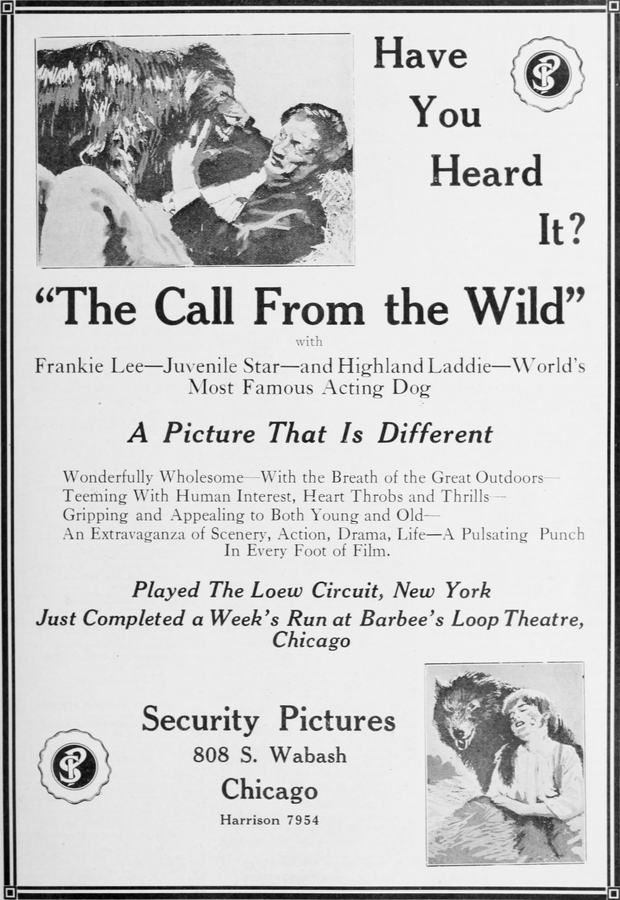
The first time I watched Call from the Wild I forgot to breathe for a solid reel; the flicker of nitrate shadows, scored only by the clatter of my projector, felt less like a museum piece and more like a paw print pressed still-warm against the present tense. Wharton James’s 1919 one-reel miracle clocks in at barely twelve minutes yet carves a saga so primordial you half expect your own backyard to sprout spruce and snow.
Forget CGI fauna; here the collie-wolf is stitched together by inference, jump-cuts, and a canine actor whose eyes hold the weary glint of an animal that has memorized the taste of its own blood. James intercuts studio underbrush with location footage of the Sierra foothills, the mismatch so brazen it becomes poetic: painted flats tremble like stage memories while real rivers slash silver across the frame. The tonal whiplash mirrors the pup’s identity fracture—house pet to lupine pariah—without a single intertitle spelling out psychology.
Frankie James—no relation to the outlaw—has the scrawled-grin impetuosity of every kid who ever bolted school for creek mud. His gestures read loud enough for the back balcony: palms thrown skyward when the trap snaps, a microscopic quiver of lip when the wolf-dog, recognizing childhood scent, lowers hackles. Symmetry arrives via the animal performer, whose tail alternates between helicopter wag and battle-flag rigidity; the oscillation becomes the film’s emotional Morse code.
James’s screenplay, leaner than winter-killed wheat, jettisons London’s Klondike baggage and keeps only the trembling vertebrae: rescue, exile, metamorphosis, reunion, reciprocal salvation. The result feels like a parable flash-burned onto parchment—every beat arrives with the thud of archetype, yet the grubby fingerprints of 1919 ranch life anchor it in sociological mulch. Compare it to Der Meisterschuß where fate also pivots on a single firearm decision; both silents understand that a gun on screen is never merely ballistic—it’s philosophy cocked and loaded.
Though technically monochrome, the surviving tinted print bathes nocturnal sequences in cobalt that bleeds toward ultraviolet, suggesting Northern Lights spilled on celluloid. Fireside moments glow amber like cough-medicine syrup, casting the boy’s freckles in bas-relief. The absence of synchronized sound becomes an acoustic negative space: you swear you hear claw on granite, river water gargling ice, the metallic shhhk of a Winchester lever. Try experiencing that with today’s Dolby Atmos littering every footstep.
Modern viewers, armored in Pixar sentimentality, may brace for anthropomorphic treacle; instead they get a narrative that gnaws its own paw off to escape moral traps. The wolf-dog’s carnivorous rampage is neither sanitized nor demonized—he emerges as both destroyer and savior, a dialectic the film refuses to collapse into greeting-card harmony. In that ambiguity it brushes shoulders with Macbeth’s blood-slicked meditation on destiny, though here the moors are internal and covered in fur.
Watch the montage where seasons wheel past the feral dog: a single frame of spring wildflowers smash-cuts into a blizzard that obliterates the lens, a visual sneeze that lasts maybe three seconds yet conveys ontological exile. James understood—years before Soviet theorists codified dialectical montage—that splicing mismatched climates could rip open a soul same as scalpels. The celluloid itself seems to pant.
If you queue a double feature with The Man from Montana—another 1919 oater wrestling with loyalty and landscape—you’ll notice both films weaponize horizon lines: characters silhouetted against infinity, dwarfed yet defiant. Meanwhile Seventeen trades wilderness for adolescent suburbia, but the transitive property of growing up-pain remains constant. And should you crave Gothic interiors after so much pine, Die Tragödie auf Schloss Rottersheim offers stone corridors where hounds howl for reasons equally existential.
The 4K restoration by Eye Filmmuseum salvaged a 35mm Dutch print riddled with vinegar syndrome; digital lavender baths stabilized the image, yet emulsion still quivers like frightened horseflesh. Some cine-purists decry the electronic interpolation, but I’d argue the tremor suits a story about creatures forever mid-transformation. When you stream it, kill the room lights, let the projector’s mechanical heartbeat drum against ribcage, remember that every pixel survived a century of floods, fires, bureaucratic contempt—mirroring the dog’s own scrape with annihilation.
Call from the Wild is not a relic; it’s a flare flung forward through time, asking whether mercy can evolve in a world still trigger-happy. The answer arrives wordlessly: boy and beast stride toward an off-screen sunset, two silhouettes sharing one elongated shadow—proof that even in 1919, cinema knew how to dream up futures worth surviving for.
Stream it, frame-freeze it, argue with it, but for god’s sake don’t domesticate it.
IMDb —
1929
Community
Log in to comment.