DbcultAccessing Vault...
Cult Review
Senior Film Conservator
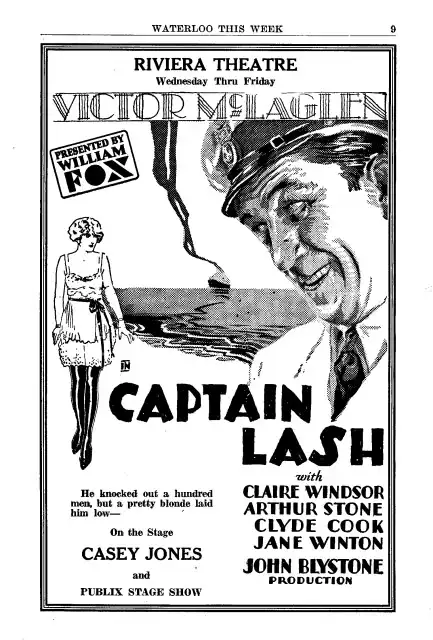
Alright, so you’re looking at Captain Lash, a silent film from 1928. Is it worth tracking down today? Well, if you’re into the feel of old cinema, especially silents, and you appreciate a strong lead performance, then yeah, there’s something here.
If you need quick cuts, loud dialogue, or a modern pace, you’ll probably find yourself checking your watch. But for those of us who like seeing how stories were told nearly a century ago, it’s a pretty interesting watch. 🚢
The whole thing really rests on Victor McLaglen, who plays Captain Lash himself. He’s this big, burly guy, and he just *owns* the screen.
Without a single spoken word, you get his whole deal: tough on the outside, but you can see that soft spot, especially in his eyes when he looks at Cora.
His grimaces, his big, lumbering walk across the ship’s deck, it all speaks volumes. He’s the kind of guy who’d probably punch you, then offer you a drink. 😂
The story itself is pretty straightforward for the era. Lash, the good-hearted brute, encounters Cora (Claire Windsor), a dance hall girl with a past she’s trying to shake.
He takes it upon himself to “save” her, or at least steer her toward a better life, which naturally means conflict with her old crowd.
There’s this one scene in a smoky bar, all low lights and shifty glances, where Lash first sees Cora. It’s not subtle, but the way his expression shifts, just a tiny bit, tells you he’s hooked.
Windsor does a fine job, too. She’s not just a damsel in distress; you get a sense of her weariness, her fight, even when she’s just reacting to McLaglen’s force of nature.
The pacing, as you’d expect for a silent, is deliberate. Some scenes feel like they stretch on, letting you soak in the atmosphere of the ship or the dingy port town.
But then there are moments of surprising energy, like a couple of rough-and-tumble brawls that are actually pretty well staged for the time.
One particular fight on the ship’s deck, all swinging fists and scrambling bodies, really picks things up.
You can almost feel the salt spray in those ship scenes, even if the sets are clearly, well, *sets*. The details are quite nice though.
Clyde Cook, who you might know for his more comedic turns, is here too. He pops up as a smaller character, mostly adding a bit of light relief with his quick, almost twitchy movements.
He doesn’t steal the show, but he’s a recognizable face in the background, doing his thing.
There’s a clear sense of right and wrong, the kind of moral clarity you often find in films from this period. The villains are pretty stock bad guys, always lurking, always trying to pull Cora back into trouble.
It’s not trying to be deep, just a solid tale about a tough guy with a heart of gold trying to do some good.
Honestly, the movie gets a noticeable boost whenever McLaglen is front and center. His presence fills the frame, his expressions doing all the heavy lifting of dialogue.
It’s a neat little window into an earlier form of storytelling, less about complex plots and more about raw character and simple human drama.
So, yeah, Captain Lash. It’s not going to blow your mind with innovation, but it’s a charming, earnest film with a fantastic central performance. Give it a shot if you’re in the mood for a trip back in time to the silent era, and you don’t mind a good, old-fashioned sailor's tale. ⚓
IMDb —
1916
Community
Log in to comment.