DbcultAccessing Vault...
6/10
Senior Film Conservator
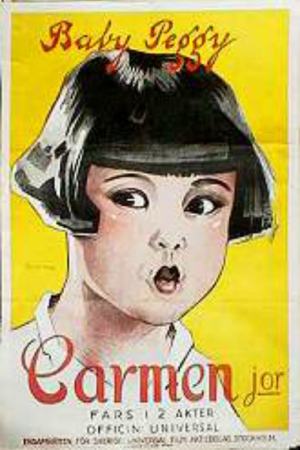
A definitive 6/10 rating for a film that redefined the boundaries of cult cinema. Carmen, Jr. remains a cornerstone of transgressive art.
The 1920s was a decade characterized by a frantic, almost desperate pursuit of novelty, and the Century Film Corporation found its golden goose in the form of Baby Peggy. In Carmen, Jr., we are not merely witnessing a child star playing dress-up; we are observing a sophisticated deconstruction of operatic tropes and gendered expectations. Unlike the heavy-handed moralism found in East Lynne, this short film eschews the lachrymose for the ludicrous. Peggy’s performance is a marvel of histrionic economy, conveying a range of emotions that would elude many of her adult contemporaries. The film operates on a dual plane: it is a slapstick romp for the masses and a sharp-witted burlesque for the culturally initiated.
The opening sequence establishes the protagonist not as a victim of her environment, but as its undisputed architect. The neighborhood boys, traditionally the enforcers of playground hierarchy, are rendered impotent by Peggy’s quick-thinking maneuvers. There is a specific kind of kinetic energy in these early scenes—a choreography of chaos that mirrors the early works of Chaplin but with a distinctively feminine, albeit juvenile, edge. The set design, while modest, evokes an atmospheric Spain that feels lived-in, a stark contrast to the sterile studio environments of lesser comedies like A Kissless Bride. The director, Alf Goulding Jr., utilizes deep focus to ensure that every reaction shot from the supporting cast—including the reliable Max Asher—contributes to the building crescendo of the gag.
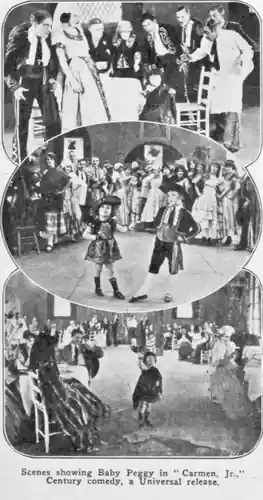
When Peggy sheds her urchin rags for the flamboyant attire of a senorita, the film shifts its satirical lens toward the performative nature of adulthood. The club scene is the heart of the film’s first act. Here, Tommy Wonder provides a perfect foil as the tango-dancing boy. Their dance is not merely a cute imitation; it is a masterclass in physical comedy. Peggy’s ability to maintain a stoic, almost bored expression while executing complex rhythmic steps creates a hilarious juxtaposition. It reminds the viewer of the stylized movements in Les Vampires, though here the mystery is replaced by a ribald sense of play. The spectators within the film are us—captivated, slightly bewildered, and utterly charmed by the audacity of the spectacle.
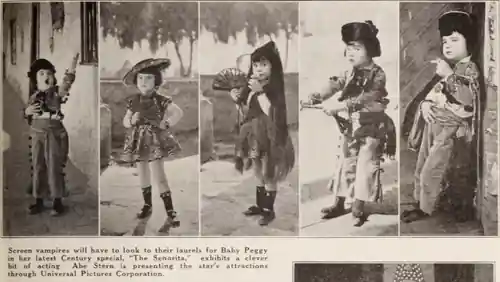
Act two transports us to the bullring, a transition that feels as epic as a shift in The Man in the Iron Mask, albeit on a miniature scale. The introduction of Bynunsky Hyman as General della Bambinodi Carradavadoves is a stroke of casting genius. Hyman, with his exaggerated military bearing, represents the pomposity of the establishment. His interaction with the child matador is a dialogue of the absurd. Peggy, draped in a suit of lights that looks both ridiculous and strangely dignified, approaches the General with the gravity of a seasoned veteran. This is where the writing by Joseph Farnham and Alfred J. Goulding shines; they understand that the funniest parodies are those that take their internal logic seriously.
The confrontation with the bull is a sequence of escalating peril and comedic timing. When Peggy’s sword fails to find its mark, the film subverts the traditional hero’s journey. There is no magical intervention, only the messy, terrifying reality of a brute force that doesn't care about the script. The moment the General falls from the stands is a pivotal shift from controlled parody to frantic survival. The tension here is palpable, reminiscent of the high-stakes drama in The Belgian, yet it never loses its comedic footing. The bull, a massive, snorting presence, serves as the ultimate straight man to Peggy’s frantic ingenuity.
Technically, Carmen, Jr. is a testament to the sophistication of early 1920s cinematography. The lighting in the arena scenes captures the harsh, bleaching sun of the Spanish afternoon, while the interior club scenes utilize shadows to create a sense of illicit excitement. The editing is brisk, never allowing a gag to overstay its welcome—a discipline that many modern comedies would do well to emulate. Compared to the somewhat static presentation of Punin i Baburin, Goulding’s camera is dynamic, following the action with a fluidity that was cutting-edge for the era. The use of intertitles is sparse but effective, allowing the visual storytelling to carry the narrative weight.
To watch Carmen, Jr. today is to engage with a lost world of child performance that was both exploitative and extraordinarily creative. Baby Peggy was a phenomenon, a child who could anchor a film with more charisma than many of the stars in The Duchess of Doubt. Her career would eventually be derailed by the very industry that elevated her, but in this film, she is at the height of her powers. She isn't just a child being coached to move; she is a comedic actress with an innate understanding of timing and pathos. The film avoids the saccharine traps of Wanted: A Baby, opting instead for a gritty, albeit hilarious, realism.
The supporting cast, from Ena Gregory to Gus Leonard, provides a solid foundation for Peggy’s antics. Each character, no matter how small, is etched with a specific comedic identity. This ensemble work is what prevents the film from becoming a mere vanity project for its young star. Even the animal performers seem to have been directed with a keen eye for the absurd. The bullfight is not just a climax; it is a commentary on the nature of spectacle itself—how we cheer for the underdog even when the odds are mathematically impossible.
In the grand tapestry of silent cinema, Carmen, Jr. stands out as a vibrant, if diminutive, thread. It lacks the existential dread of Whitechapel or the sweeping romance of The Man and the Moment, but it possesses something perhaps more valuable: a pure, unadulterated sense of joy. It is a film that celebrates the triumph of the small over the large, the clever over the powerful, and the child over the world. The final escape, which we shall not spoil, is as inventive as anything found in Homeward Bound, proving that even in a spoof of a tragedy, there is room for a triumphant, if dusty, victory.
Ultimately, the film serves as a reminder of the sheer versatility of the silent medium. Without the benefit of Bizet’s soaring score, the creators had to rely on pure visual rhythm to convey the essence of Carmen. They succeeded by leaning into the absurdity of the premise rather than shying away from it. Whether Peggy is outsmarting boys in the street or facing down a bull in the ring, she remains an indelible icon of an era that valued audacity above all else. For those seeking a bridge between the high art of the opera house and the low-brow brilliance of the vaudeville stage, Carmen, Jr. is an essential, uproarious destination.
Review by the Cinephile Collective. A deep-dive into the archives of the silent era, where every frame tells a story of ambition, artifice, and the enduring power of the silver screen.
IMDb 6.6
1927
Community
Log in to comment.