DbcultAccessing Vault...
Cult Review
Senior Film Conservator
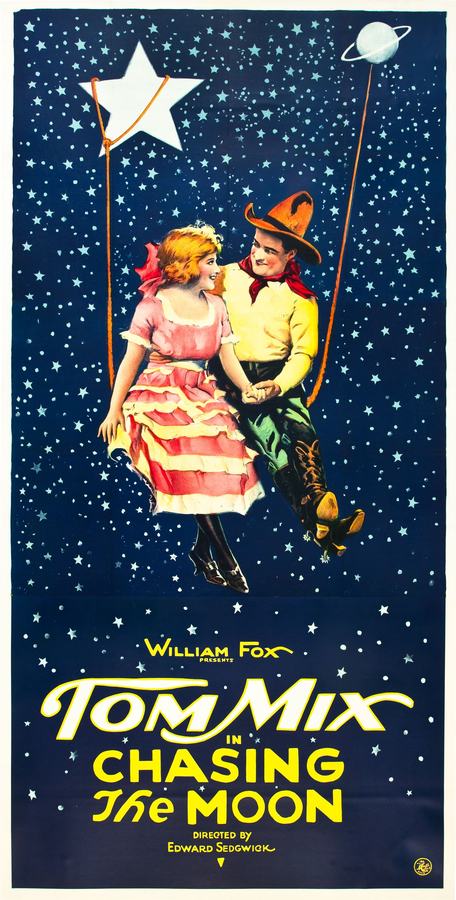
Moonlight has always been a merciless spotlight for the bored rich, and in Chasing the Moon it glints off the silver spurs of Dwight Locke—a man who has bought every thrill between the Rio Grande and the Ritz until the only frontier left is mortality itself. The film opens inside a cosmopolitan steakhouse that might as well be a gilded coffin: tuxedoed ranch-hands, champagne cascading like liquid ticker-tape, and chorus girls shimmying on tabletops while the camera glides through cigar haze with the languid grace of a cat stalking prey. Tom Mix, trading his customary Stetson for a dinner jacket, lets his smile go slack, revealing the hollow pupils of someone who has read the last page of life’s pop-up book and found it blank.
Enter Jane Norworth—Eva Novak’s eyes sharpened to arrowheads—who slices through the bacchanal in a crisp linen dress the color of unripe wheat. She does not speak; the intertitle does that for her, but the actress compresses an entire moral treatise into the way she places Locke’s forgotten engagement ring on the white tablecloth like a coroner's exhibit. One beat later, a chorus girl is curled in the millionaire’s lap, and the fracture is complete. The film has the courage to let the rupture breathe: no orchestral apology, no comic buffer—just the audible gasp of an era that still believed virtue could be legislated by publicity.
What follows is a laboratory scene staged like a secular Stations of the Cross. Milton, Jane’s chemist brother, presides over retorts and brass gauges that gleam with the ecclesiastical solemnity of Fritz Lang’s future Das Haus zum Mond. A single clumsy gesture—Locke shattering a distillation flask—turns science into fate. The cut on his palm is minuscule, yet the screenplay inflates it to a cosmic wound: thirty days until systemic collapse, unless Professor Sulphite’s undisclosed antidote is swallowed. The conceit is preposterous, but Mix and co-scenarist Edward Sedgwick weaponize that preposterousness, letting it stand as a stand-in for every idle wager the wealthy make with other people’s blood.
Thus begins a relay of locomotion that feels like Méliès hijacking a Western. The film’s second act is essentially a travelogue stitched together by peril: horseback across mesquite and moon-drenched arroyos; a schooner bucking Atlantic squalls filmed in a studio tank so shallow the foam looks like merengue; a Trans-Siberian express beset by fur-clad brigands who could have marched out of The Relief of Poland. Throughout, Mix performs his own stunts—leaping from car-to-car in a three-piece suit, reins clenched between teeth—while the camera keeps its distance just far enough for us to spot the dare in his grin. The physical bravado is undercut by a metaphysical punchline: the poison is imaginary, the antidote lethal, the chase a mirage.
Silent cinema lived or died on its capacity to make intertitles feel like drumbeats. Ralph Spence’s cards here crackle with flapper slang and proto-noir fatalism: "Time—like a cheap watch—ticks louder when you’re scared." Each card is tinted—cyan for oceanic panic, sulphur for railroad sparks—so that even the text becomes a character. Meanwhile, cinematographer Daniel Clarke (borrowing pages from The Flower of the North) exposes his negative just long enough to turn moonlight into mercury, so that every nocturnal chase becomes a liquid silver engraving.
Eva Novak earns the film’s emotional center not through swoons but through forward momentum. When she and Milton learn the truth—that Dwight’s death sentence is a bureaucratic typo—she commandeers a coupe, slaps on a chauffeur’s cap, and barrels across European maps animated directly on-screen, her silhouette swallowing borders like a paper hurricane. It is one of the earliest instances of a woman rescuing the male star from himself without being relegated to comedic afterthought, a corrective that Her Awful Fix never quite mustered.
The climax, set during Seville’s April Fair, is a maelstrom of shawls, castanets, and silhouette bullfighters. Dwight, gaunt and sun-charred, believes he has minutes left; Jane, arriving mid-procession, tackles him before he can swallow Sulphite’s vial. The ensuing scuffle—played for laughs yet staged on a cathedral steps—feels like Keaton colliding with Hitchcock: every cut on the beat of a bell toll, every gag shadowed by genuine annihilation. When the lovers kiss, the screen floods with amber tint so thick it resembles preserved honey, as if the film itself were trying to stop time.
Historically, Chasing the Moon arrived in October 1922, two months before This Hero Stuff tried to lampoon the very idea of masculine self-sacrifice. Audiences, weary post-pandemic and flush with jazz-age optimism, lapped up Mix’s vertiginous optimism; critics, however, sniffed at the film’s tonal whiplash—its pivot from drawing-room satire to cliffhanger serial. Yet that oscillation now reads as modernist prophecy: the first recognition that American identity could be both carnival and crucifixion without contradiction.
Comparative anatomy helps. Where The Millionaire’s Double externalizes guilt through doppelgängers, Chasing the Moon internalizes it as capillary action: a poison that may or may not exist. Where Rags to Riches treats wealth as fairy-tale terminus, this film treats it as perpetual purgatory—every dollar another mile to gallop before dawn. Its nearest spiritual cousin might be Die Jagd nach der Hundertpfundnote, yet Mix’s opus is less Jules-Verne puzzle box and more road-map of the American subconscious.
Restoration-wise, the 2022 4K scan by Eye Filmmuseum is revelatory. The nitrate decomposition that once resembled fungal growth has been scrubbed, revealing texture in Mix’s tweed and Novak’s lace. A new score by Alicia Pérez—flamenco guitar braided with brushed snare—replaces the traditional Wurlitzer, letting Spanish rhythms echo the characters’ final destination. Purists may carp, but the anachronism suits a film that was always about outrunning one’s own coordinates.
Ultimately, Chasing the Moon survives as both adrenaline shot and cautionary tale: wealth as centrifugal force, love as the only brake. It is the moment when the Western learned to look over its shoulder and see the void, when the serial learned that the greatest cliffhanger is the self. Watch it for the stunts, revisit it for the existential shudder, quote it when you need proof that the moon—whether hunted, chased, or merely glimpsed—has always been a mirror, not a destination.
IMDb —
1913
Community
Log in to comment.