DbcultAccessing Vault...
Cult Review
Senior Film Conservator
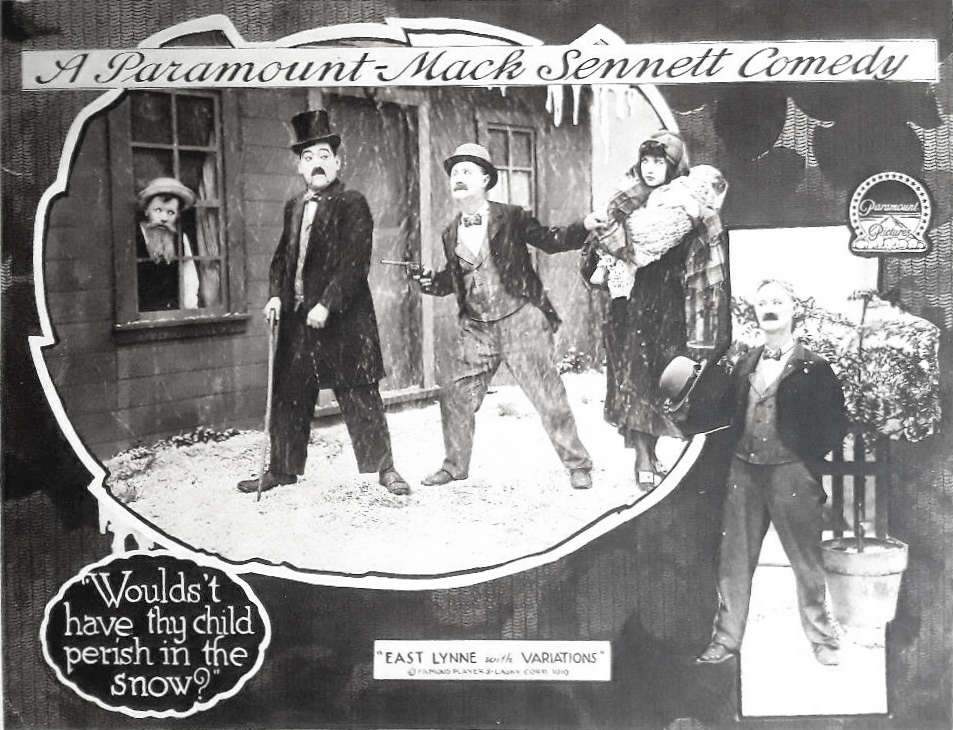
Step right up, ladies and gentlemen, and prepare for a cinematic spectacle that gleefully dismantles the very foundations of dramatic convention. Mack Sennett’s “East Lynne with Variations” isn't merely a film; it’s a boisterous, meta-theatrical carnival, a raucous send-up of the overwrought Victorian melodrama that simultaneously celebrates and subverts the nascent art of storytelling on screen. Released in an era when cinema was still finding its voice, this 1919 gem stands as a testament to Sennett’s audacious vision, pushing the boundaries of what a motion picture could be, blending slapstick absurdity with a surprisingly sophisticated commentary on performance and audience engagement.
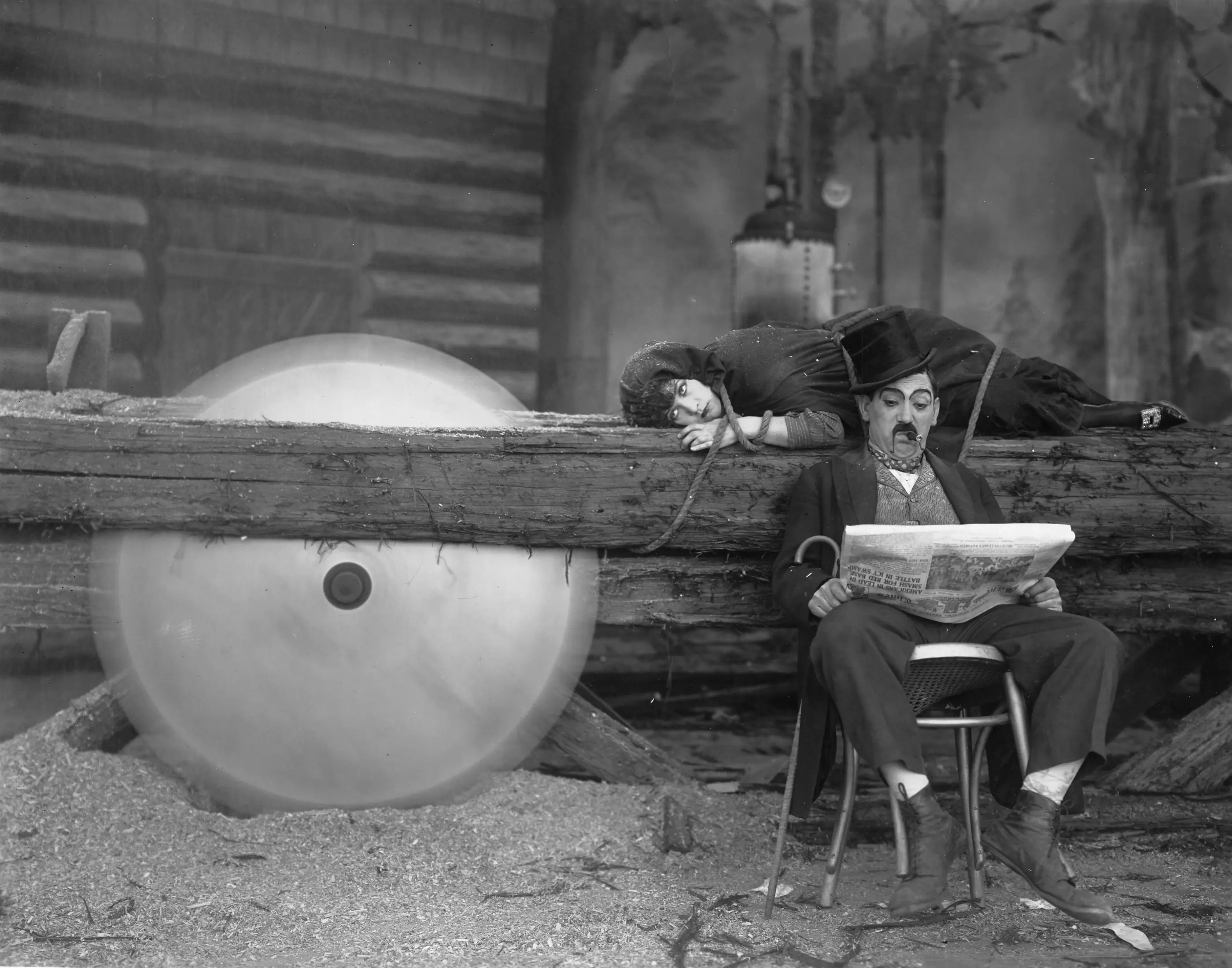
The premise itself is a stroke of comedic genius: a theatrical performance of the archetypal melodrama “East Lynne” gone spectacularly awry. We are initially presented with all the classic, heart-wrenching tropes: the deserted mother, clutching her child, bravely battling a fiendishly wicked snowstorm that pursues her with relentless theatricality. There’s the virtuous heroine, bound with dastardly intent to the unforgiving rails, a tragic fate seemingly inevitable. And, in perhaps the most visceral image of melodramatic peril, a young woman is fastened to the merciless buzz saw of a lumber mill, poised to be reduced to mincemeat. Guiding this parade of pathos is the quintessential villain, twirling his magnificent mustache with sinister glee, a cigarette dangling precariously from his lips, embodying pure, unadulterated evil. Opposing him, of course, are the noble hero and the perpetually persecuted heroine, their fates entwined in a tapestry of dramatic suffering.
But this is no mere faithful adaptation. Sennett, ever the provocateur, quickly peels back the layers of illusion. The film’s true brilliance lies in its audacious meta-narrative, a play-within-a-play structure that constantly reminds us of its constructed reality. The audience itself becomes a character, with two inebriated gentlemen in one of the theater boxes growing so passionately invested in the unfolding drama that they can no longer remain passive observers. Their boisterous interjections and attempts to physically aid the beleaguered protagonists shatter the fourth wall, injecting an element of unpredictable, anarchic humor that was revolutionary for its time. It’s a delightful precursor to later meta-commentaries, drawing parallels to the self-aware humor that would define much of modern comedy, anticipating the audience participation found in cult classics or even the interactive narratives of contemporary media. While not as overtly political as something like Her Excellency, the Governor, it shares a similar spirit of challenging established norms, albeit through laughter rather than legislation.
The chaos escalates further backstage, where personal drama spills onto the theatrical stage. The head scene shifter, consumed by a fit of jealousy over his wife, who happens to be the leading lady of the show, unceremoniously drags her from the stage mid-performance. This abrupt, unscripted intervention plunges the production into utter disarray. Resourcefulness, however, is the hallmark of Sennett’s world. The quick-thinking Ben Turpin, ever the master of improvisational comedy, rushes down into the unsuspecting audience and, in a move that defies all theatrical etiquette, "kidnaps" a beautiful young woman to assume the vacated leading role. This audacious act isn't just a plot device; it's a profound statement on the malleability of performance, the blurring of professional and amateur, and the sheer audacity of early cinematic storytelling.
The film then hurtles towards a series of startling climaxes, each more absurd than the last. The dramatic, essential snowstorm, a cornerstone of the melodrama's atmosphere, is abruptly shut down by a queer, unexplained accident, leaving the audience and the remaining players bewildered. This sudden cessation of theatrical effect is a brilliant comedic beat, highlighting the artificiality of the very emotions the melodrama strives to evoke. Just when you think the film can't possibly introduce more chaos, an equally tragic catastrophe jazzes up the ocean scene, where a furious storm and a submarine play at cross purposes, resulting in a surreal, underwater collision. This final, nonsensical flourish is a masterclass in comedic escalation, taking the dramatic stakes to an utterly illogical and hilarious extreme. While 20,000 Leagues Under the Sea presented its underwater adventures with awe-inspiring gravitas, Sennett transforms the deep into a playground for pure, unadulterated farce.
The ensemble cast, a veritable who’s who of early cinematic comedy, delivers performances that are both broad and surprisingly nuanced within the context of slapstick. Ben Turpin, with his famously crossed eyes and rubbery physicality, is a centrifugal force of comedic energy. His ability to react to the escalating absurdity with a mixture of bewildered earnestness and frantic ingenuity is a joy to behold. Alice Lake, as one of the heroines, navigates the shifting sands of the narrative with remarkable poise, often serving as the straight woman to the surrounding madness. Tom Kennedy and James Finlayson, stalwarts of the Sennett stable, contribute their distinctive physicalities and timing, embodying the various roles with an infectious commitment to the chaotic spirit. Marie Prevost, Bobby Dunn, and Ford Sterling further flesh out this vibrant tapestry of performers, each bringing a unique flavour to the ensemble. Their collective effort transforms what could have been a mere series of gags into a cohesive, if utterly bonkers, artistic statement.
Mack Sennett, credited as a writer alongside Mrs. Henry Wood, clearly infused the narrative with his signature brand of irreverent humor. Sennett’s genius lay not just in orchestrating physical comedy, but in understanding the mechanics of audience expectation and how to gleefully subvert them. “East Lynne with Variations” is a prime example of his directorial philosophy, where chaos is not merely tolerated but actively encouraged, becoming the very engine of the comedy. His films, often featuring the iconic Keystone Kops, carved out a unique niche in early cinema, defining the very essence of slapstick. Here, he takes the foundational elements of melodrama, a genre built on heightened emotions and predictable outcomes, and detonates them with explosive hilarity. It’s a bold move, daring to mock the very theatrical traditions that audiences held dear, yet doing so with such infectious glee that it’s impossible not to be charmed.
The film’s historical context is also crucial to appreciating its brilliance. In the early 20th century, cinema was still finding its footing, often borrowing heavily from established theatrical forms. Melodrama was a dominant force on stage, captivating audiences with its clear-cut morality, exaggerated emotions, and thrilling cliffhangers. Sennett’s film doesn't just parody "East Lynne" the play; it parodies the entire experience of melodrama, from the overwrought performances to the audience's emotional investment. It’s a meta-commentary on media consumption before the term even existed. One could argue that its self-referential nature makes it a spiritual cousin to later films that broke the fourth wall or satirized their own genres, such as the more dramatic but equally self-aware Betrayed, which also explored the depths of human emotion, albeit without the comedic lens. The innovation here is not just in the gags, but in the structural audacity.
The humor throughout is multifaceted. There’s the obvious physical comedy, the pratfalls, the exaggerated reactions, the sheer energy of the performers. But beneath the surface, there’s a more intellectual humor at play—the humor of expectation subverted, of logic abandoned, of the sacred made profane. The drunken audience members, for instance, are not just a source of physical comedy; they represent the blurred lines between art and life, the immersive power of storytelling, and the primal urge to intervene in a narrative. Their actions highlight the inherent absurdity of expecting a controlled, predictable experience when human nature, in all its messy glory, is involved. This engagement with the audience as a character is something rarely seen in early cinema, setting “East Lynne with Variations” apart as a truly pioneering work.
The film’s influence, while perhaps not as widely discussed as some of Sennett's more famous Keystone Kops shorts, is nonetheless significant. It demonstrates an early understanding of postmodern narrative techniques, long before the term was coined. It questions the very nature of performance, the contract between performer and audience, and the artificiality of dramatic illusion. It’s a film that asks us to laugh not just at the characters, but at ourselves, at our own complicity in the dramatic spectacle. Its spirit of playful anarchy can be seen echoing through subsequent generations of comedians and filmmakers who dared to break conventions. From the zany antics of a film like A Fugitive from Matrimony, which likely also played with comedic situations, to the more subtle subversions of expectation in later works, Sennett's fingerprints are evident.
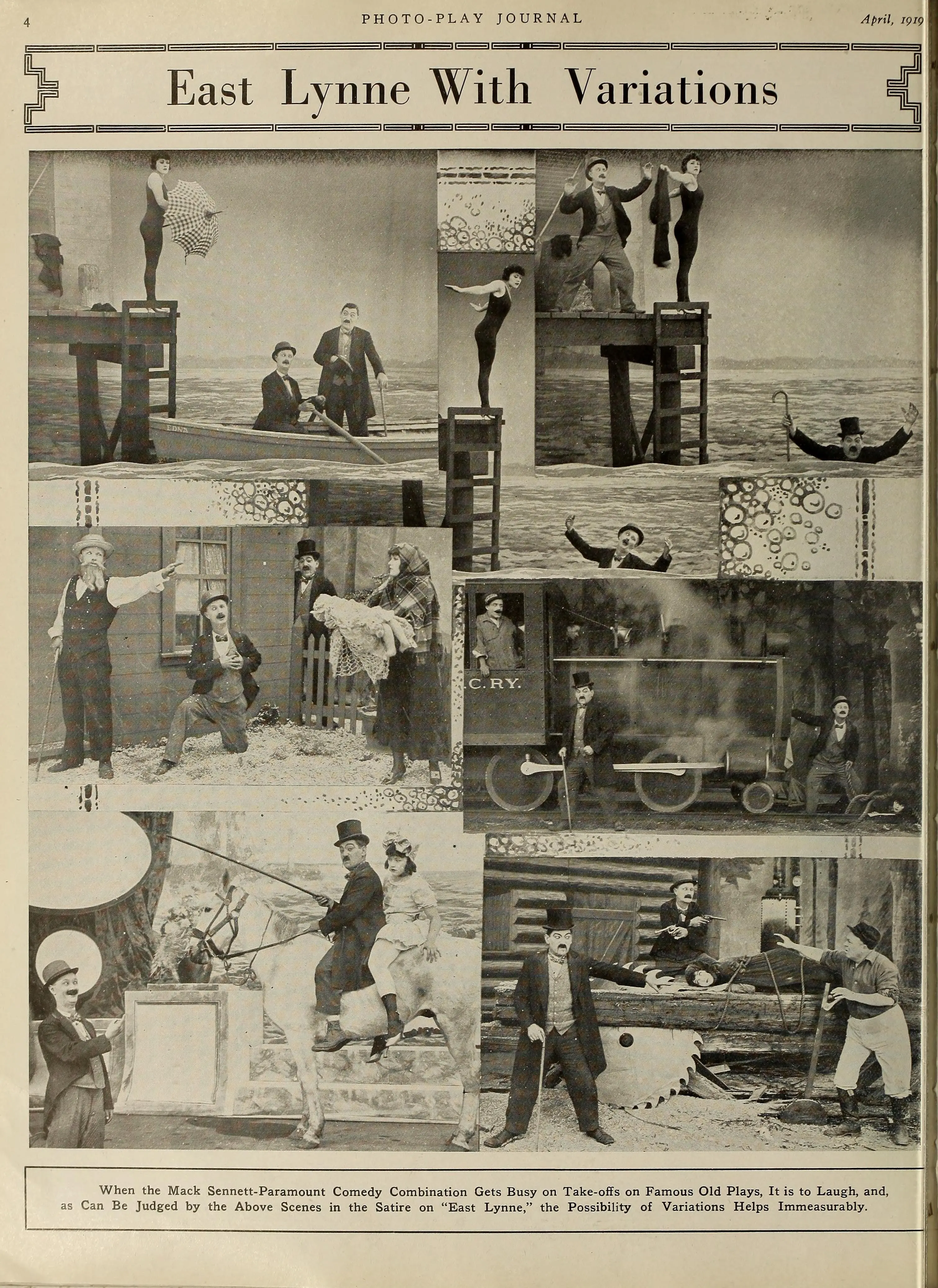
The sheer lexical diversity of the film’s visual language is another compelling aspect. Each scene, even those ostensibly part of the "melodrama," is packed with visual gags and rapid-fire action. The staging of the various perils—the snowstorm, the train tracks, the buzz saw—are meticulously crafted to maximize both dramatic tension and comedic potential. The costumes, the sets, the exaggerated expressions—all contribute to a rich tapestry of visual information that demands active engagement from the viewer. It’s a masterclass in silent film storytelling, where every gesture, every prop, every facial contortion carries significant meaning, often double meaning, for the discerning eye. The quick cuts and dynamic camera work, typical of Sennett's style, keep the pace relentless, mirroring the escalating chaos of the narrative.
Ultimately, “East Lynne with Variations” transcends its status as a simple slapstick comedy. It is a vibrant, anarchic, and surprisingly intellectual exploration of performance, perception, and the delightful absurdity of human endeavor. It reminds us that even in the most rigid of structures, chaos can erupt, and that laughter is often the most profound response to the grand theatricality of life itself. It’s a film that demands to be seen not just as a historical artifact, but as a living, breathing testament to the power of comedic innovation. It’s an experience that leaves you pondering the fragile nature of reality, and the joyous liberation found in its unraveling. This isn't just a movie; it's an event, a delightful disruption, a cinematic romp that continues to entertain and provoke, proving that true artistry, even in its most chaotic form, is timeless.
The film’s ability to sustain its high-octane energy throughout its runtime is commendable. There are no lulls, no moments where the comedic momentum falters. From the initial, seemingly earnest portrayal of melodrama to the final, fantastical underwater collision, the audience is kept on the edge of their seats, never quite knowing what fresh absurdity will be unleashed next. This relentless pacing is a hallmark of the Sennett studio, which understood the importance of keeping audiences engaged in a medium that was still novel. The performances, while broad, are precisely timed. Bobby Dunn, Alice Lake, Tom Kennedy, James Finlayson, Marie Prevost, Billy Armstrong, Ben Turpin, Ford Sterling, Heinie Conklin, Marvel Rea, Bert Roach, and Phyllis Haver – each actor contributes to this intricate dance of comedic mayhem, their individual quirks adding layers to the collective madness. It’s a testament to their skill that they can maintain character, even as the very fabric of their theatrical world disintegrates around them.
Comparing it to other films of the era, one can see how Sennett was both a product of his time and a visionary ahead of it. While many films, like Triste crepúsculo or Den skønne Evelyn, might have focused on more straightforward dramatic narratives, “East Lynne with Variations” dared to mock the very seriousness of such endeavors. It’s not just a parody of a specific play, but a parody of the genre of melodrama itself, a critique wrapped in a joyous, chaotic package. This self-awareness is what elevates it beyond mere slapstick. It’s saying, “Yes, these stories are thrilling, but aren’t they also a little bit ridiculous?” And in that gentle, yet uproarious, ridicule, it carves out a unique and enduring place in cinematic history. The film’s audacity to disrupt the narrative, to pull back the curtain, to literally involve the audience, marks it as a truly experimental piece for its time.
The ingenious way the plot points are resolved – or rather, unresolved – is another highlight. The sudden cessation of the snowstorm, not due to a heroic act but a “queer accident,” is a brilliant anti-climax that underscores the artificiality of the entire production. And the submarine collision, utterly divorced from the original melodramatic narrative, is a final, glorious surrender to pure, unadulterated nonsense. It’s a film that revels in its own illogicality, finding profound humor in the complete breakdown of narrative coherence. This embrace of the absurd is what makes it feel so fresh, even a century later. It’s a reminder that sometimes, the greatest art comes from breaking all the rules, from throwing caution to the wind and letting chaos reign supreme. It’s a film that challenges us to reconsider our expectations of storytelling, inviting us to laugh at the very seriousness with which we approach our entertainment. In an age where meta-narratives and genre subversion are commonplace, it's fascinating to see such sophisticated comedic deconstruction at the dawn of cinema. Its enduring charm lies in its unabashed embrace of the ridiculous, proving that laughter is indeed the best medicine, even for the most earnest of dramatic endeavors. This playful anarchy, this delightful dismantling of the fourth wall, ensures its place not just as a historical curiosity, but as a vibrant, living piece of cinematic artistry that continues to resonate with audiences who appreciate a good, hearty laugh at the expense of convention.
IMDb 6.3
1932
Community
Log in to comment.