DbcultAccessing Vault...
Cult Review
Senior Film Conservator
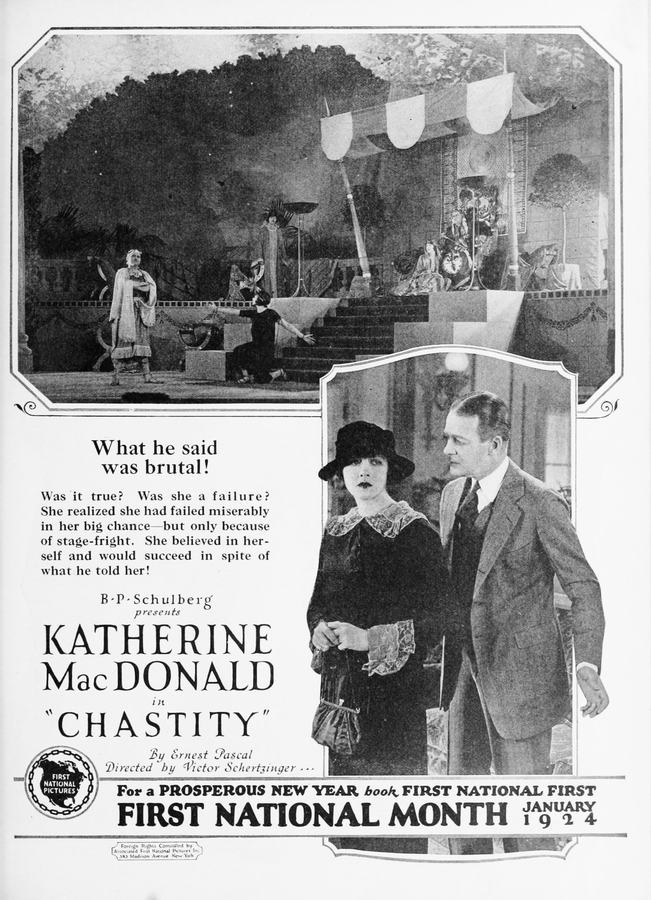
The opening frames of Chastity unfurl like a sepia‑tinted dream, immersing the viewer in the bustling studios of early Hollywood. Lila Hartley, portrayed with a fragile yet resolute poise by Katherine MacDonald, is introduced as a wide‑eyed ingénue whose aspirations are as luminous as the marquee lights she gazes upon. The screenplay, co‑crafted by Ernest Pascal and Eve Unsell, deftly sketches a dichotomy: Lila's innate modesty versus the vamp persona she is coerced to embody. The tension is palpable when the director, a caricature of the era's power brokers, urges her to "shed the girl and become the siren"—a directive that reverberates throughout the narrative.
The vamp, a fixture of silent cinema, emerges in Chastity not merely as a seductive trope but as a cultural indictment. Unlike the overtly monstrous figures in The Fall of Babylon, Lila's vamp is a socially engineered construct, a mask meticulously polished by studio hands. The film’s visual language—soft focus on Lila’s eyes, chiaroscuro lighting that casts half her face in shadow—mirrors the internal schism between her public performance and private self.
Costume designer J. Gordon Russell employs a palette of deep burgundies and midnight blues for Lila's on‑screen vamp roles, while her off‑screen wardrobe is rendered in muted pastels, underscoring the visual dissonance. When Lila steps onto the set for a seductive close‑up, the camera lingers on the glint of a dark orange brooch—#C2410C—symbolizing the seductive fire she is forced to ignite. The deliberate contrast serves as a visual cue for the audience, inviting them to interrogate the artificiality of the persona she inhabits.
Midway through the film, the narrative pivots as gossip columns begin to link Lila’s on‑screen provocations with alleged nocturnal liaisons. The scandal is not a mere plot device; it is an exposé of a media ecosystem that thrives on sensationalism. The producers, represented by Frederick Truesdell, manipulate the scandal to bolster ticket sales, while the press, embodied by Edythe Chapman’s relentless reporter, treats Lila as a commodity. The resulting courtroom drama—replete with dramatic cross‑examinations and a jury swayed by public opinion—mirrors real‑life legal battles faced by early Hollywood stars.
The legal proceedings are staged with theatrical flair, each testimony echoing the film’s central theme: the erosion of identity under the weight of public expectation. Lila’s defense attorney, a stoic figure played by Huntley Gordon, argues that the scandal is a manufactured narrative, a commentary on the industry's propensity to weaponize femininity. The courtroom scenes are shot with a stark sea‑blue filter—#0E7490—evoking an oceanic depth of moral ambiguity that engulfs the characters.
Katherine MacDonald delivers a performance that oscillates between delicate vulnerability and calculated seduction. In scenes where Lila rehearses her vamp monologue, MacDonald’s eyes flicker with a restrained ferocity, suggesting an internal rebellion against the role she is compelled to play. Conversely, in quieter moments—such as the scene where she writes a letter to her mother in a modest boarding house—the actress adopts a softer timbre, allowing the audience a glimpse of the authentic Lila beneath the veneer.
The supporting ensemble, including J. Gunnis Davis as the unscrupulous studio head and Verne Winter as the scandal‑fueling journalist, provides a textured backdrop that accentuates Lila’s isolation. Each character embodies a facet of the Hollywood machinery: exploitation, ambition, and voyeurism. Their interactions with Lila are choreographed with a precision that feels both theatrical and brutally realistic.
Director Frederick Truesdell employs a repertoire of silent‑era techniques—expressive intertitles, exaggerated gestures, and dynamic camera movements—to convey the emotional turbulence of Lila’s journey. The film’s cinematography, characterized by sweeping crane shots of the studio lot and intimate close‑ups of Lila’s trembling hands, creates a rhythm that mirrors the protagonist’s escalating anxiety.
Lighting plays a pivotal role: high‑contrast shadows envelop Lila during moments of self‑doubt, while a warm amber glow—#C2410C—bathes her during fleeting triumphs. The strategic use of a yellow filter—#EAB308—during the scandal’s climax highlights the lurid sensationalism that the press employs, casting a garish sheen over the courtroom’s otherwise somber atmosphere.
At its core, Chastity interrogates the paradox of a woman who attains fame through a fabricated identity, only to discover that the accolades are tethered to a scandal that eclipses her artistic achievements. The film’s title itself—"Chastity"—operates as an ironic counterpoint to the vamp persona, prompting viewers to contemplate the dissonance between societal expectations of purity and the seductive power wielded by women on screen.
The narrative invites comparison with other period pieces that explore similar terrain. For instance, Hands Up! examines the commodification of rebellion, while Oranges and Lemons delves into the bittersweet aftertaste of success. By situating Chastity within this cinematic lineage, one discerns a recurring motif: the tension between public adulation and private authenticity.
Although produced a century ago, the film’s exploration of image manipulation anticipates contemporary discourses surrounding social media personas and the performative nature of celebrity. Lila’s struggle mirrors the modern influencer’s dilemma: curating a brand that garners clicks while safeguarding personal integrity. In this regard, Chastity functions as a prophetic cautionary tale.
In the final tableau, Lila stands before a mirror, her reflection fractured by the myriad lenses through which she has been viewed. The camera lingers on her gaze—steady, resigned, yet tinged with a glimmer of defiance. The film closes without offering redemption; instead, it leaves the audience to contemplate the lingering echo of a name that became synonymous with scandal rather than skill.
Rating: 4.2/5 – A masterful blend of silent‑era aesthetics, incisive social commentary, and compelling performances that rewards attentive viewing.
IMDb 7.1
1929
Community
Log in to comment.