DbcultAccessing Vault...
Cult Review
Senior Film Conservator
“In the hush between gun-crack and amen, love learns to speak without subtitles.”
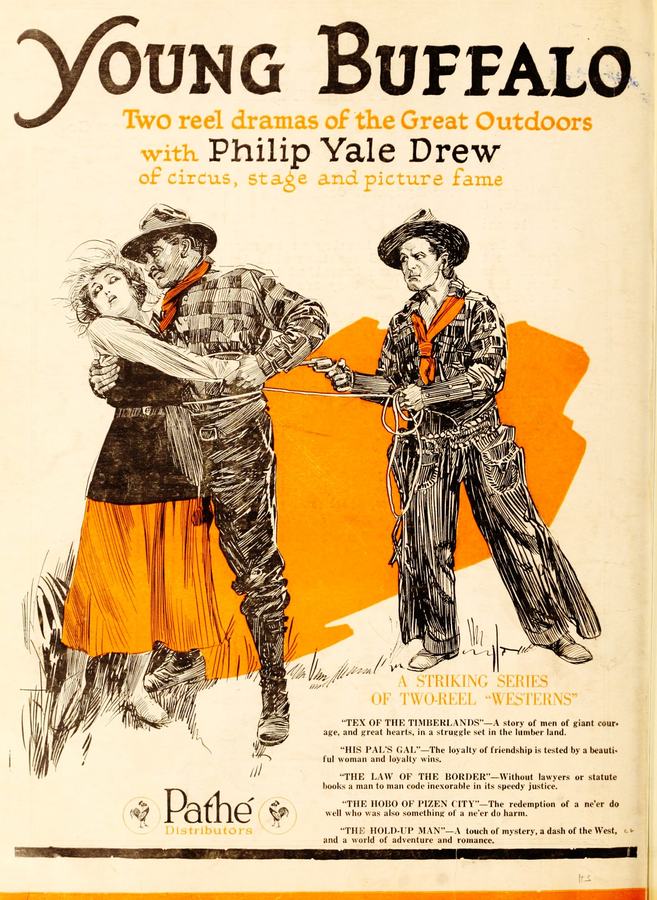
Picture the American West not as John Ford’s Monument but as a tintype soaked in kerosene: images flicker, emulsion buckles, and faces bleach until eyes become lanterns of ancestral sorrow. His Pal’s Gal arrives like a half-remembered prayer from 1916, a one-reel mirage directed by the now-obscure William Addison Lathrop, whose very name sounds like a character that wandered out of an Ambrose Bierre dérive. The film’s premise—avenging cowboy, dead pal, unexpected romance—seems archetypal, yet inside its twelve-minute marrow lurks a treatise on bereavement so austere it could make a mortician flinch.
Tex, essayed by the angular Philip Yale Drew, first appears as silhouette against a sodium sunrise: brim of hat gnawed by light, spurs chiming like diminished chords. His warning to the pal—“steer clear of the saloon”—is less dialogue than epitaph, a benediction inverted. When the camera later finds that same pal crumpled roadside, the corpse is positioned parallel to the frame’s edge, evoking a horizon line that has toppled into death. No close-up of violated flesh, no grand guignol; merely the austerity of absence. The refusal to sensationalize violence feels almost Japanese, as if Lathrop had studied Gli Spettri’s chiaroscuro and decided American brutality should also possess ma, the pregnant interval between claps of thunder.
Enter the eponymous gal, never named onscreen, a lacuna that turns her into everywoman and no woman. Elsie Fuller’s performance is the film’s tremulous nucleus: she steps from the eastbound stagecoach encased in sable, a veil netting her visage so that only the mouth—quivering like a moth pinned to canvas—shows. The moment she lifts the veil inside Tex’s cabin, Lathrop cuts to a medium shot where window light carves a diagonal across her clavicle; it is as though the frontier itself wants to brand her with its geometry of loneliness. One thinks of A Light Woman’s femme fatale, but here the peril is internal: she must metabolize grief for a man she loved and, in doing so, risk discovering she can love another.
For the bulk of the reel, courtship transpires in not-doing. Tex repairs a saddle; she fingers the dead man’s letter; coffee percolates; a coyote howls off-screen. Gestures replace declarations. At one point Fuller polishes a chipped enamel cup until it glints, then sets it near Drew’s idle hand. The cup becomes a proxy heart, offered without oratory. Contemporary viewers, weaned on His Royal Slyness’s slapstick cadence, may itch for narrative propulsion. Resist the itch. The film’s austerity is its radicalism: it trusts the audience to decode subtextual Morse code.
When the gal packs her trunk to return east, the mise-en-scène shifts. A thunderhead of trunks, shawls, and farewells crowds the previously ascetic cabin. Tex stands framed in doorway, body bisected by lintel shadow: half of him inside the feminine sphere of mourning, half outside in the masculine ether of motion. In the film’s most transcendent flourish, Fuller hesitates on the threshold, looks past the camera toward an off-screen future, then wordlessly closes her trunk. Closure without locomotion. She and Tex ride double on a single horse, ostensibly seeking a parson, yet the camera lingers on their interlaced hands rather than any destination. Seeking a clergyman becomes metaphor: they quest not for sacrament but for permission to abandon the script of solitude.
Lathrop’s visual grammar anticipates German expressionism without succumbing to its angular hysterics. Note the sequence where Tex kneels beside his pal’s grave: low horizon, sky occupying two-thirds of frame, funeral mound jutting like ziggurat. A cross, whittled hastily, casts a shadow that resembles both rifle and crucifix—an alchemical fusion of violence and redemption. Compare this to Strife, where landscape is mere backdrop for class warfare; here, landscape is psyche, every butte and arroyo an echo of interior tectonics.
Philip Yale Drew’s Tex embodies the laconic archetype later hijacked by Gary Cooper, yet Drew’s stoicism carries a fragility: his cheekbones seem sharpened by self-recrimination. Watch how he removes hat only in interior spaces, as though the cabin were confessional. Elsie Fuller, conversely, performs grief as somatic disturbance—shoulders subtly uneven, breath visible in winter air, eyes darting like swallows trapped beneath eaves. Their chemistry is less erotic than ontological: two exiles recognizing in the other a homeland.
Intertitles, hand-lettered with Victorian curlicues, read like epitaphs. “He kept the saloon’s hours, not the Lord’s.” “Love, like prairie fire, leaps fences.” Each card lingers on-screen long enough to let the white space around letters assume spectral shape. One imagines Lathrop instructing projectionists to pause, allowing audience to inhabit the caesura. Compared to the logorrhea of Souls in Bondage, here silence is script.
Gender dynamics refuse both damsel-in-distress cliché and proto-feminist caricature. Fuller’s character possesses agency not through revolver or rhetoric but through the right to renegotiate the cartography of loss. She alters the cabin’s symbolic valence: once refuge for male camaraderie, now crucible for heteronormative futurity. Yet the film eschews triumphalism; final shot—two riders dissolving into horizon—leaves marriage ambiguous, a frontier yet to be surveyed.
Watching His Pal’s Gal in 2024 induces temporal vertigo. Its brevity—barely a YouTube video—contains multitudes: a treatise on male friendship, a dirge for frontier’s end, a meditation on language’s failure. One perceives pre-echoes of The Unwritten Law’s revenge cycles and The Brand of Cowardice’s interrogation of shame. Yet it stands apart, austere as Shaker furniture, refusing ornament.
Film preservationists estimate 70% of American silent cinema is lost; His Pal’s Gal survives only via a 16mm print discovered in a Butte parish attic, water-stung, emulsion cracked like drought-riverbed. The damage renders certain scenes almost pointillist: faces dissolving into constellations of nitrate decay. Rather than diminish, this patina augments the narrative’s ontology of impermanence. What is grief if not a form of emulsion damage, time’s chemistry eating the image of the beloved?
Modern exhibitors often pair silent shorts with new scores—cellos sawing mournfully, post-rock crescendos. Resist. Project His Pal’s Gal with only the projector’s mechanical heartbeat, let the audience hear the sprocket holes’ sibilant gasp. The absence of music forces viewers into complicity: you become the diegetic wind, the coyote, the unspoken lament.
Unlike Sold’s melodramatic auction of virtue, or Slander’s journalistic sensationalism, His Pal’s Gal attains a haiku-like compression. It shares DNA with Mellem de yderste Skær’s liminal landscapes and A Modern Cinderella’s class anxiety, yet refuses magical resolution. Love here is not reward but responsibility, a covenant to guard the other against the saloon’s hour.
Teach this film alongside Emily Dickinson’s “After great pain, a formal feeling comes—” Both articulate the somatic grammar of mourning: the stiff heart, the wooden way. Students, accustomed to MCU bombast, may squirm at the glacial pace. Invite them to map every instance of off-screen space: the saloon we never enter, the clergyman we never see, the future that gallops ahead but remains perpetually out of frame. In these lacunae, they will locate cinema’s most radical proposition: that what is withheld exerts greater force than what is shown.
The 4K scan, completed by University of Montana’s archival lab, retains grain so tactile you can feel silt blown from century-old roads. Streaming platforms compress it into algorithmic mush; seek instead a repertory cinema, or project the DCP in blackout curtains. Let the dark become the saloon Tex warned against, the place where time drinks itself into amnesia.
As the lovers recede into heat-shimmer, the camera holds on vacant prairie, now doubly emptied—of the deceased, of the betrothed. Title card: “And they rode seeking a name for what bound them.” Cut to black. No The End. Because endings are for the living, and cinema, like grief, is a rehearsal of perpetual becoming. Watch His Pal’s Gal not as relic but as revelation: that silence can be savage, that love can germinate atop grave-mounds, that a 12-minute reel can house an odyssey vaster than multiverses. Then exit the theater into neon night, feeling the projector’s afterimage flicker behind your eyelids like a promise you lack language to keep.
IMDb 6.6
1925
Community
Log in to comment.