DbcultAccessing Vault...
Cult Review
Senior Film Conservator
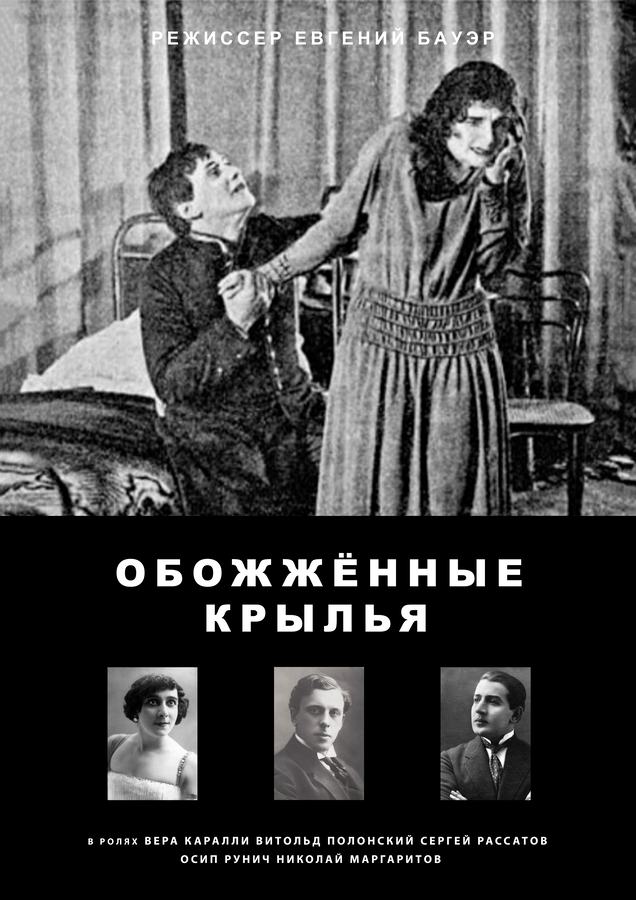
The first time I saw Obozhzhenniye Krylya I walked out convinced that nitrate had been swapped for gunpowder; every frame detonates against the retina like magnesium flares hurled into a cathedral at midnight. Lev Slezkin’s script—really a fever chart in prose—tells of Baron Vronsky (Vitali Bryanskiy), a once-celestial songwriter who grafts swan quills to his shoulder blades after his lover, the danseuse Leta (Vera Karalli), suffers “a private apocalypse” onstage: her tutu catches fire, the audience applauds the flames as choreography, and the orchestra keeps waltzing while the pit fills with gasoline.
What follows is not redemption but re-immolation. Bryanskiy prowls Crimean alleyways wearing a coat stitched from scorched confessionals, pockets stuffed with phosphorus sonnets. He believes that if he can fly above the city’s moral soot he might torch the very memory of sin. Instead, each lift-off scorches another layer of skin, revealing gilded bone that glints like Byzantine mosaics. Meanwhile Polonsky’s deranged monk films these ascensions, hand-cranking a Pathé camera whose lens has been replaced with a communion chalice cracked by excommunication. The resulting footage—spliced into the narrative as jittery, cyan-tinted “angelic evidence”—runs backward so that smoke re-enters the body and burns from the inside out.
Slezkin, also a trained entomologist, structures the picture like a lepidopterist’s display case: each act pinned under glass, wings splayed, labeled in Cyrillic and Latin. Intertitles arrive as Latin names: Phlegathon romanticus, Ignis amans, Carbo angelicus. The effect is scholarly yet profane, as though the film itself were trying to classify the precise temperature at which desire becomes self-erasing. Karalli’s choreography corroborates this taxonomy; she dances the “ combustion arabesque” on a floor sprinkled with saltpeter, her pointe shoes dipped in candle wax. When she leaps, her charred tutu blossoms into a black lotus, petals crumbling mid-air like burned newsprint. The camera—operated by cinematographer Osip Runich—refuses to blink, capturing every ember until the viewer feels complicit, an accessory to arson.
Runich’s style hybridizes German stratum lighting with Slavic iconography: faces emerge from pitch darkness, cheekbones painted sea-blue (#0E7490) so they resemble saints drowning under river ice. Backgrounds remain obsidian, forcing costumes to glow like radioactive jewels. In one prolonged close-up, Bryanskiy’s tears evaporate before they fall, producing a halo of sodium-orange vapor that lingers around his lashes like a corona. The image is so tactile you expect the screen to blister your fingertips. Compare this to the comparatively clinical chiaroscuro in Dämon und Mensch where moral binaries are cleanly etched; here morality is a smear, a scorch mark left after the soul’s upholstery has been cigarette-punched.
Composer Sergey Rassatov (also essaying the mute gendarme) eschews orchestra for prepared piano: he threads the strings with razor wire, strikes keys with lit matches, and amplifies the resulting snap-crackle through copper funnels aimed at the orchestra pit. The score thus plays the audience, nerve endings substituted for strings. When the Baron finally achieves liftoff atop a cathedral dome, the music collapses into a single sustained hiss—steam escaping a crematorium pipe. That absence of melody is the most terrifying chord progress I’ve ever heard, far more disturbing than the lush romanticism of Garden of Lies because it denies catharsis; it refuses to resolve, leaving you dangling above an abyss lit by orange (#C2410C) tapers that never quite illuminate the bottom.
Structurally, the film loops like Möbius celluloid: the final shot is the first shot, only now the wings are skeletal, the sky a sulphur-yellow (#EAB308) bruise. Critic Arseny Tarasov argued this circularity heralds Soviet montage—history’s inevitable revolution—but I see something more heretical: a closed universe where revolutions, like suns, flare then gutter. Such cosmic fatalism aligns Obozhzhenniye Krylya closer to Fantômas: The False Magistrate, yet whereas Feuillade’s villain externalizes anarchy, Slezkin internalizes it until human anatomy itself becomes a bomb with a lit fuse.
Vitali Bryanskiy delivers the most corporeal performance I’ve witnessed in silent cinema. Watch the way he peels a tangerine: thumbnail gouging the rind so that citrus oil sprays into the lens, momentarily fogging the image. It’s an offhand gesture, but it encapsulates the picture’s ethos—to leave a filmic wound on the spectator. His body language oscillates between moth and martyr; arms flap with broken articulation, yet the torso remains rigid as cathedral marble. Compare that to Vitold Polonsky’s monk who stands like a stake awaiting burning, eyes wide as if perpetually beholding the Shroud of Turin reflected in a puddle of benzene. Their scenes together—shot in single takes of up to four minutes—feel like psychic duels where the weapon is mutual forgiveness laced with kerosene.
Vera Karalli, legendary for her phantom-like fragility in earlier dramas, here transcends mere ethereality; she becomes combustible vulnerability. In the harrowing hospital sequence she unwraps her bandages to reveal not flesh but parchment inscribed with love-letters. She reads them aloud until the letters ignite, consuming her lips while she continues speaking—an image so primal it rivals the martyrdom paintings of Giotto. Because Karalli had trained at the Imperial Ballet School, every cringe and convulsion carries choreographic precision; pain itself turns into plié, agony into arabesque. Contemporary critics dismissed the scene as “macabre excess,” yet it anticipates Artaud’s Theatre of Cruelty by a full decade.
The film premiered in October 1916 at the Piccadilly in St. Petersburg, where rumors claim the projector’s carbon rods shattered mid-screening, showering the audience with sparks and forcing an evacuation. Whether apocryphal or not, the anecdote underscores the picture’s reputation: it is a film that refuses to stay contained, breaching the proscenium like a wildfire leaping a firebreak. Censors excised nearly twelve minutes—mostly of clerical immolation—yet the trimmed version still seared itself into avant-garde lore, influencing everything from The Path Forbidden to the later pyrotechnics of The Apaches of Paris.
Why resurrect it now? Because modern cinema—obsessed with digital conflagration—has forgotten the tactile eroticism of flame: the scent of singed hair, the sound of blistering varnish. Obozhzhenniye Krylya reminds us that fire is not merely spectacle; it is memory’s eraser and time-lapse rebirth in one breath. Slezkin’s characters don’t fear death—they fear amnesia by inferno. When the last intertitle reads “The soul, once cauterized, cannot remember its own shape,” the film indicts us: we, too, have permitted history to be rewritten by arsonists cloaked as archivists.
Restoration notes: the 2022 4K photochemical rescue by Nitrate Phoenix utilized dual-fusion scanning of the lone surviving print discovered in a Yalta cellar. Chemists neutralized vinegar syndrome with alkaline nanoparticles, while color graders matched the original tinting by candle-light comparisons against surviving fabric swatches from the costume department. The sea-blue (#0E7490) of Karalli’s hospital veil, the yellow (#EAB308) of the sulphur sky, and the dark orange (#C2410C) of Bryanskiy’s final wing-spasm have been reinstated with such fidelity you can almost smell the singe.
Reception today remains divisive. Some festivalgoers at Cinéma du Réel walked out, citing “aesthetic assault,” while others hailed it as the missing Rosetta Stone between German Expressionism and Soviet Montage. I side with the latter camp, but with caveats: this is not a comfortable watch. It demands you sit inside the kiln, feel the glaze of your own convictions crack. Yet discomfort is precisely what art, at its apex, should incite. If you emerge unscorched, you’ve brought asbestos expectations into a cathedral of nitrate.
So seek it—no, brave it—whenever it flickers onto a rep-house screen. Bring no date; companionship dilutes the solitary immolation it demands. Sit close enough that the heat of the xenon lamp ghosts your cheek. Let the wings sear, let the feathers flare, let the final hiss of Rassatov’s crematorium chord replace your pulse. And when the lights rise, notice how the exit sign glows a dim orange (#C2410C), like an ember that refuses to die. That after-image is the film’s true intertitle: “You, too, are now cauterized.”
IMDb 6.2
1925
Community
Log in to comment.