DbcultAccessing Vault...
4.8/10
Senior Film Conservator
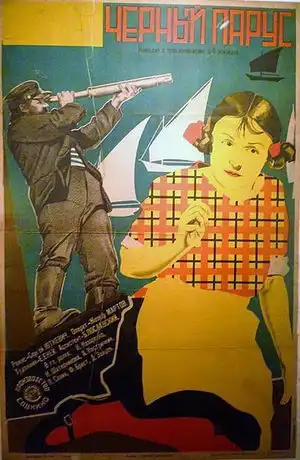
A definitive 4.8/10 rating for a film that redefined the boundaries of cult cinema. Chyornyy parus remains a cornerstone of transgressive art.
You should probably watch this if you’ve run out of the big-name Soviet classics and want something that feels a bit more raw and unfinished. If you’re the type who gets annoyed by silent films where people just stare at the horizon for three minutes at a time, you will probably hate this.
It’s 1929, and the Soviet film industry was basically a giant lab for people trying to figure out how cameras worked. Chyornyy parus (or Black Sail) doesn't feel like it's trying to change the world like the big masterpieces do.
It just feels like it wants to show you how cold the water is. I watched this late at night and the grainy footage actually made my eyes itch a little bit.
But in a cool way, like I was looking at something I wasn't supposed to find. The plot is supposedly about sailors and maybe some class struggle, but honestly, I stopped following the 'why' after about twenty minutes.
I was mostly just looking at the hats. The hats in this movie are incredible.
They look like they’ve been soaked in fish guts and salt for twenty years and then dried in the sun. Andrei Kostrichkin is the lead here, and you might know him from The New Babylon where he's much more animated.
In this one, he’s just... there. He has this way of looking at the camera like he knows you’re watching him from a hundred years in the future through a laptop screen.
It’s kind of spooky if you think about it too long. There is a scene where a guy is fixing a net that goes on for way too long.
I think I counted twelve different knots before I got bored and checked my phone for a second. But then the wind picks up and the editing gets all jumpy and weird, which is the best part.
The movie is called 'Black Sail' and when you finally see the sail, it’s actually kind of intimidating. The way the dark fabric cuts against the flat gray sky is really something.
I wonder how they even got the lighting to work on the water back then. It looks like liquid lead, heavy and thick.
Nina Shaternikova shows up too, but she doesn't have much to do. She mostly just looks worried near a window or a railing.
But she does 'worried' better than most modern actors do 'excited'. The writers, Georgi Zelondzhev-Shipov and K. Feldman, didn't give her many intertitles to work with.
Actually, there aren't many intertitles in general. You kind of have to guess what they are yelling about based on how much their neck veins are bulging.
I found a version with a modern piano score that didn't fit at all. I ended up muting it and just listening to the hum of my refrigerator.
It felt more authentic that way, honestly. The movie gets a bit confusing near the end when everyone starts running around the deck.
I wasn't 100% sure who was fighting who or if they were just excited about a fish. But the energy was there, and you can feel the desperation in the movements.
It’s not as polished as something like The Fall of the House of Usher from around the same time. That movie feels like art you'd see in a museum.
This movie feels like a document. Like someone just followed a bunch of grumpy guys around a boat and told them to act like they were starting a revolution.
There’s a moment where a character eats a piece of bread that looks like a literal rock. I almost felt my own teeth hurt watching him bite into it.
Also, there is a lot of smoke. It feels like every single person on that ship is constantly exhaling a cloud of tobacco.
The ending doesn't really have a big 'ta-da' moment. It just sort of stops, and the screen goes black, and you’re left wondering if they ever actually got to where they were going.
Maybe that's the point? Or maybe they just ran out of film stock. 🚢
It's worth a look if you like textures and old maritime vibes. Just don't expect a fast-paced thriller.
IMDb 6.3
1932
Community
Log in to comment.