DbcultAccessing Vault...
Cult Review
Senior Film Conservator
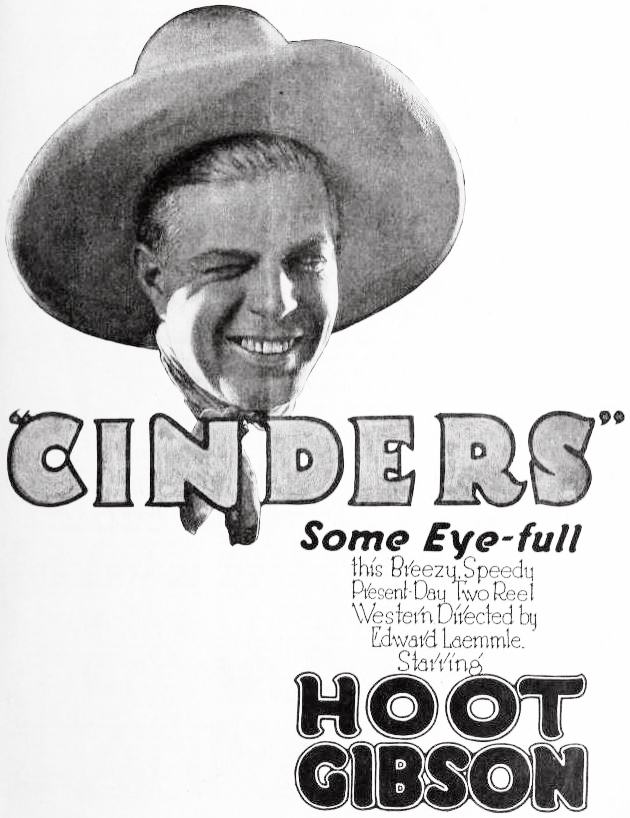
The 1920 short film Cinders emerges from the archives of silent cinema as a fascinating artifact of the Universal Film Manufacturing Company's prolific output. Directed and written by the formidable duo of George Hively and W.C. Tuttle, the film serves as a vehicle for the rising star power of Hoot Gibson, though he is flanked by the equally capable Jim Corey and Dorothy Wood. At its core, the film is a morality play dressed in the chaps and spurs of a Western, exploring the volatile intersection of male ego, romantic curiosity, and the unforgiving gaze of a small-town community. Unlike the rugged realism found in The Bargain, Cinders leans into a more lighthearted, yet socially biting, narrative structure that questions the stability of rural commitments when faced with the glittering promise of the urban unknown.
Hoot Gibson's presence in Cinders is a precursor to the charismatic, slightly mischievous screen persona that would eventually make him a household name. In this particular narrative, the cowboy protagonist is not fighting off outlaws or saving a town from corruption; rather, he is battling his own wandering eye. The subtlety of Gibson's performance—expressed through the tilt of a hat or a lingering look toward the railway tracks—conveys a profound sense of restlessness. This internal conflict is mirrored in other works of the era, such as The Simp, where the protagonist's social blunders drive the comedic engine. However, in Cinders, the stakes feel more grounded in the reality of human relationships. Dorothy Wood provides a necessary anchor as the sweetheart, her performance radiating a quiet strength that highlights the protagonist's folly. The chemistry, or lack thereof during the moment of betrayal, is captured with a technical proficiency that belies the film's short runtime.
In the visual language of the 1920s, the train was more than just a mode of transport; it was a symbol of relentless progress and the shrinking of the American distance. In Cinders, the locomotive acts as a disruptive force, a literal and figurative vessel of temptation that cuts through the static life of the ranch. When our protagonist engages in a flirtatious exchange with a lady on the train, he isn't just flirting with a person; he is flirting with the idea of 'elsewhere.' This theme of the disruptive outsider is a common thread in silent cinema, often seen in more dramatic iterations like The Valley of the Giants, where industry and nature collide. In Cinders, the collision is purely emotional, yet the devastation to the protagonist’s domestic tranquility is no less impactful. The train represents a world that moves faster than the horse-bound cowboy can ever hope to catch, making his flirtation a pathetic, albeit human, attempt to bridge the gap between his reality and a fantasy of high society.
"The cowboy's gaze toward the rail is not a look of travel, but a look of longing for a life he has been taught to admire but never to inhabit."
The cinematography in Cinders utilizes the natural lighting of the California landscape to create a stark contrast between the shadowed interiors of the ranch and the bleached, overexposed reality of the outdoors. This visual dichotomy reinforces the protagonist's sense of being trapped between two worlds. The wide shots of the train tracks stretching into the horizon evoke a sense of infinite possibility that stands in direct opposition to the claustrophobic social expectations of his sweetheart. We see similar environmental storytelling in Ingeborg Holm, where the setting dictates the character's tragic trajectory. While Cinders avoids the sheer melodrama of the aforementioned Swedish masterpiece, it utilizes its setting to underscore the cowboy's isolation. The dust kicked up by the passing train serves as a metaphorical 'cinder' in the eye of the protagonist, blinding him to the value of what he already possesses.
When examining Cinders alongside its contemporaries, one can see the evolution of the 'misunderstood hero.' In The Pinch Hitter, the protagonist must prove his worth through a singular act of bravery, whereas in Cinders, the hero must prove his worth through a singular act of restraint—one he initially fails to provide. The narrative complexity of a man caught in a web of his own making is also reflected in One Thousand Dollars, where financial stakes mirror the emotional stakes found here. However, Cinders remains unique for its focus on the 'small' moments—the wave of a hand, the frown of a girlfriend, the steam of an engine. It lacks the grand political machinations of The Governor's Boss or the international flair of Paz e Amor, but it gains a visceral intimacy by focusing on the fragility of the heart in a rugged world.
The screenplay by George Hively and W.C. Tuttle is a masterclass in economy. In a silent short, every gesture must carry the weight of a paragraph. The writers avoid the convoluted plotting found in Smashing the Plot, opting instead for a linear, character-driven arc. They understand that the audience's sympathy is a finite resource; by making the protagonist's flaw so relatable—the desire for a brief escape from the mundane—they ensure that his eventual 'trouble' feels earned rather than forced. The direction ensures that the pacing mimics the rhythm of a train ride: a slow buildup of tension, a high-speed flirtation, and a sudden, jarring halt when reality sets in. This rhythmic storytelling is also evident in An American Live Wire, though Cinders trades that film's frenetic energy for a more contemplative, atmospheric tone.
Cinders reflects a society in flux. The year 1920 was a threshold between the Victorian sensibilities of the past and the 'Roaring' liberation of the future. The 'lady on the train' represents the New Woman—mobile, independent, and perhaps a bit dangerous to the established order of the ranch. Our cowboy's sweetheart represents the traditional values that the protagonist finds himself chafing against. This tension between the old and the new is a recurring motif in films like The Sentimental Lady and The Iron Heart. Cinders manages to distill these massive cultural shifts into a single, localized conflict. It asks the viewer: is the allure of the unknown worth the destruction of the known? The film does not offer an easy answer, even as it resolves the immediate 'trouble' the cowboy finds himself in.
While Cinders may not have the historical weight of The Chimney Sweeps of the Valley of Aosta or the urban grit of The Empty Cab, its contribution to the Western genre is significant. it helped refine the 'Western Comedy-Drama' subgenre, proving that the frontier could be a place for emotional exploration as much as for gunfights. The film’s ability to generate humor from the protagonist's plight without stripping him of his dignity is a testament to the skill of Hively and the cast. In the grand tapestry of silent cinema, Cinders is a small but vibrant thread, illuminating the human condition through the lens of a dusty cowboy and a passing train. It remains a compelling watch for those interested in the roots of cinematic storytelling and the timeless nature of romantic folly.
Ultimately, Cinders stands as a reminder that the most dangerous frontiers are often the ones within our own hearts. As the dust settles on the final frame, the viewer is left with a sense of the fleetingness of beauty and the enduring consequences of a single, impulsive moment. It is a work that rewards close viewing, offering more than just entertainment; it offers a glimpse into a world that, while nearly a century gone, still speaks to our modern anxieties regarding fidelity, ambition, and the seductive power of the 'what if.'

IMDb —
1933
Community
Log in to comment.