DbcultAccessing Vault...
5.8/10
Senior Film Conservator
A definitive 5.8/10 rating for a film that redefined the boundaries of cult cinema. Cinq minutes de cinéma pur remains a cornerstone of transgressive art.
Is Cinq minutes de cinéma pur worth watching today? Short answer: yes, but only if you are willing to trade narrative satisfaction for a sensory workout. This film is for the visual purist and the student of historical avant-garde; it is definitively not for those who require a plot to stay engaged.
1) This film works because it isolates the basic building blocks of the medium—light, movement, and rhythm—and forces the viewer to acknowledge them as art in their own right.
2) This film fails because it lacks any emotional anchor, making it feel more like a technical exercise or a high-end screen saver than a human experience.
3) You should watch it if you want to understand the origins of music video editing and the 'visual first' philosophy that would later influence directors from Kubrick to Glazer.
The question of 'worth' regarding Henri Chomette’s work depends entirely on your definition of cinema. If you view film as a vessel for storytelling, then Cinq minutes de cinéma pur will feel like a waste of time. However, if you view film as a distinct art form that should be divorced from literature and theater, this is essential viewing. It is a brief, intense burst of creativity that asks: what is left when you take the story away? The answer is a haunting, mechanical beauty that survives nearly a century later.
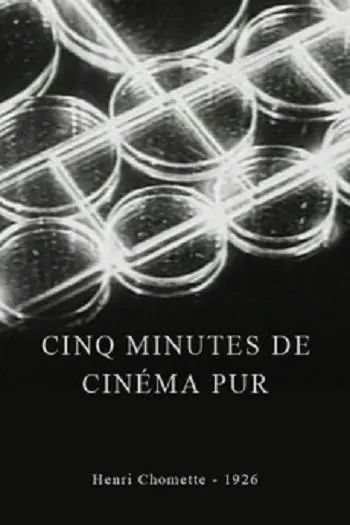
Henri Chomette was part of a movement that sought to liberate the camera. In 1926, cinema was still largely seen as 'filmed theater.' Chomette, along with his brother René Clair, wanted to break that mold. In Cinq minutes de cinéma pur, he uses prisms and reflections to create a world that doesn't exist in three-dimensional space. One specific moment involves the reflection of light on a rotating crystalline surface. It isn't 'about' anything. It is simply the movement of light. It is hypnotic.
This focus on form over function was a radical act. While films like The Devil's Cargo were busy building melodramatic tension through character arcs, Chomette was building tension through the speed of his cuts. He treats the film strip as a musical score. The pacing isn't dictated by the needs of a scene, but by the visual rhythm of the shapes themselves. It is a cold approach, certainly. But it is also incredibly honest.
Most films of the 1920s, even the greats like Such a Little Queen, were deeply rooted in the traditions of the stage or the novel. They relied on title cards and expressive acting to convey meaning. Chomette rejects this entirely. There are no faces here. There are no names. There is only the lens. By removing the human element, Chomette ironically makes the film feel more universal. A circle is a circle in any language.
However, this rejection comes at a cost. Without a human face to latch onto, the viewer can feel alienated. It’s a five-minute flex of technical muscle. It works. But it’s flawed. The flaw lies in its sterility. It is beautiful to look at, yet it leaves you feeling nothing but a slight sense of disorientation. This is cinema as a mathematical equation.
When we look at other experimental works of the era, such as Dziga Vertov's Kino-pravda no. 8, we see a similar fascination with the camera's ability to capture reality. But where Vertov used his camera to document and celebrate the Soviet state, Chomette uses his to escape reality altogether. Chomette isn't interested in truth; he’s interested in patterns.
If you compare this to the narrative-driven films like Hearts and Diamonds or the adventurous In the Days of Daniel Boone, the contrast is jarring. Those films use the camera to follow action. Chomette uses the camera to *be* the action. The movement of the frame is more important than whatever is inside it. This was a direct challenge to the commercial cinema of the time, which favored clarity and linear progression in films like A Thousand to One.
The cinematography in Cinq minutes de cinéma pur is a masterclass in lighting. Without modern digital tools, Chomette had to rely on physical mirrors, water, and glass to manipulate light. The way he captures the shimmering surface of water makes it look like molten silver. It’s a tactile experience. You can almost feel the texture of the light on the screen. This is 'photogénie' in its purest form—the idea that the camera can reveal a hidden beauty in everyday objects that the human eye normally misses.
The editing is equally impressive. In an era when long takes were common to allow actors to perform, Chomette’s rapid-fire montage was ahead of its time. He understands that the brain can process visual information much faster than we give it credit for. He doesn't linger. He shows you a shape, lets it pulse, and then cuts to the next. It’s a precursor to the 'MTV style' that would dominate decades later. It’s aggressive, unapologetic, and technically brilliant.
Pros:
Cons:
Cinq minutes de cinéma pur is a visual manifesto that remains as sharp as a razor. It is a reminder that cinema was born from science and light, not just from the desire to tell bedtime stories. While it lacks the emotional depth of contemporary dramas like Maternità or the social commentary of Yichuan zhenzhu, it offers something those films cannot: a glimpse into the soul of the machine. It is a five-minute flex of pure visual power. Watch it to see where the rules were broken before most people even knew what the rules were.
"Chomette doesn't just film objects; he films the act of seeing itself. It is a brutal, beautiful rejection of everything we think a movie should be."

IMDb —
1936
Community
Log in to comment.