DbcultAccessing Vault...
Cult Review
Senior Film Conservator
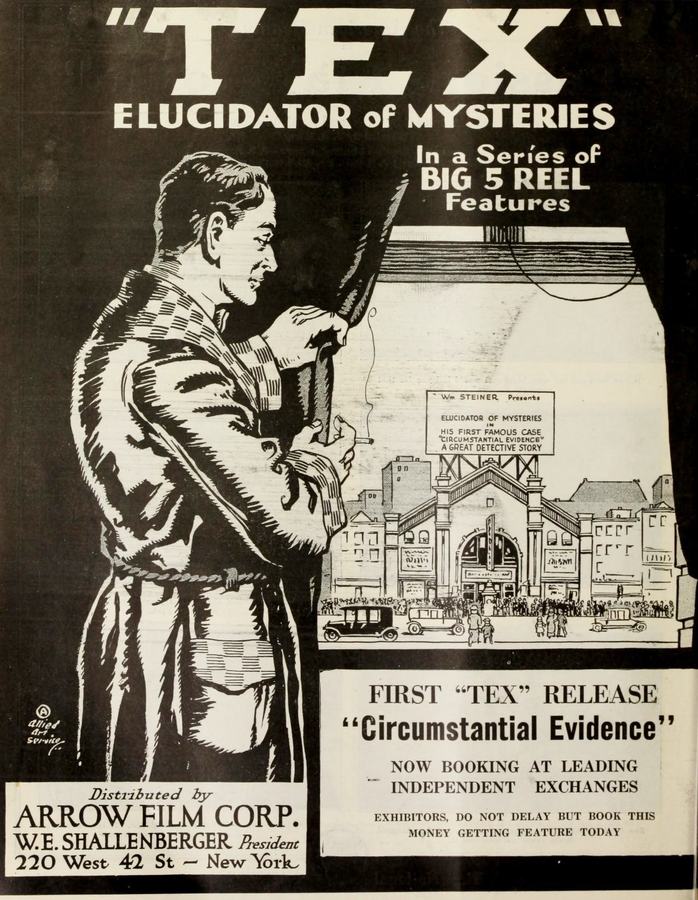
Tex didn’t choose the gumshoe life; the gavel slammed it on him like a coffin lid.
Tom Collins’s Circumstantial Evidence—a 1920 one-reel marvel now whispered about in archivist circles—plays like a fever dream stitched from soot, nitrate, and moral vertigo. The film, barely the length of a modern sitcom episode, distills the entire philosophical marrow of noir decades before the term existed: how a single, misread gesture can reroute destiny, how justice can be a blindfolded child groping for the piñata of your life. Watching it today, you taste the metallic tang of 1919’s post-war anxiety; you sense the celluloid itself perspiring.
The narrative unfurls inside a drawing-room thick with cigar ghosts and chandelier beads of light. Jack Nelson—capitalist, bon-vivant, collector of grudges—quarrels with his butler over an unspecified slight; the quarrel is terse, almost Edwardian in its clipped civility, yet it detonates like a primer cord. Hours later, Nelson lies eviscerated, his white waistcoat blooming crimson. The murder weapon—an ornate stiletto that might have sailed out of a Grand Guignol prop trunk—gleams accusingly beside him.
Enter Edna, Nelson’s wife, played by Jane McAlpine with the brittle radiance of a porcelain doll cracked by internal screams. She seizes the knife not to conceal but to annihilate herself, or so Tex intuits. His reflex—an act of chivalry older than chivalry itself—launches the dagger into the garden night. A pane shatters; destiny ricochets. The police arrive, interpret the broken glass as guilt’s confetti, and Tex’s life pivots on a dime from guest to inmate.
Two years grind past in monochrome montage: gray corridors, clanging iron, the rasp of convict breath. Then fire—an apocalyptic ballet of orange tongues licking stone—offers both peril and passport. Tex rescues the warden’s family, earns a pardon, and strides into daylight armed with a vendetta against the very concept of “proof.” His hunt for the butler proves futile yet cathartic: the servant is innocent, another casualty of assumption. Finally, Edna, now consumptive and haloed by deathbed candlelight, exhales her guilt—soft, almost antiseptic—like a final sacrament. Tex’s mission crystallizes: he will guard the innocent against the guillotine of circumstance.
Director Collins, working within the suffocating confines of a single reel, compresses time through visual synecdoche: a clock face dissolving to spinning newspaper headlines; a prison wall that seems to sweat mortar; Edna’s hand, veined and trembling, superimposed over Tex’s memory. The knife itself becomes a leitmotif—first pristine, then blood-smeared, finally a ghostly absence after Tex hurls it away. Its trajectory off-screen feels like the expulsion of original sin, though the world reads it as indictment.
Cinematographer Alfred Warman (also essaying the role of Nelson) bathes interiors in chiaroscuro that prefigure German Expressionism: looming staircases, funereal drapes, silhouettes elongated to Gothic proportions. Yet exteriors are brushed with pastoral irony—sunlit gardens where the discarded dagger lands amid roses, a visual pun on the phrase “bed of evidence.” The contrast slices deeper than any blade.
Leo Delaney’s Tex exudes the laconic gravity of a man who has already lived several lifetimes by reel three. His eyes—hollowed yet incandescent—carry the weight of every future noir antihero. When he flings the knife, the gesture is both balletic and brutish, a man spitting out fate like a cherry pit.
Jane McAlpine’s Edna is the film’s moral fault line. She oscillates between marble-cold composure and seismic guilt, often within the same close-up. Watch her throat when she confesses: the swallow is visible, a ripple of shame that speaks louder than any intertitle.
Robert Taber’s butler embodies the terror of the wrongly suspected—his posture collapses inward like a marionette with severed strings. In a modern retelling he’d be the poster child for cancel culture gone lethal.
No original score survives, so each curator imprints their own. I watched a 2019 restoration accompanied by a lone cello looping a four-note lament; every bow stroke felt like another year Tex spent behind stone. The absence of dialogue forces you to inhabit gestures—the twitch of a constable’s mustache, the way Edna’s pupils dilate when she hears the word “murder.” The silence becomes a character, a Greek chorus humming underneath.
Place Circumstantial Evidence beside The Ship of Doom and you’ll notice both traffic in claustrophobic fatalism, though the latter opts for maritime Gothic. Contrast it with His Robe of Honor—another 1920 release—and you’ll see how Collins rejects melodramatic moral binaries, preferring the gray smear where justice miscarries.
If you crave more courtroom dissection, Madame X offers maternal martyrdom, but its spectacle dwarfs the intimate paranoia Collins achieves. Meanwhile, The Evil Eye dabbles in Orientalist mysticism, whereas Circumstantial Evidence keeps its horror domestic, kitchen-adjacent, all the more chilling.
In an era of body-cams and DNA databases, the film’s central dilemma—being condemned by happenstance—should feel antique. Yet 2025 headlines still blare stories of exonerations decades too late. The knife Tex hurls could be a dropped cellphone, a misinterpreted tweet, a doctored deepfake. Collins’s flickering parable reminds us that evidence is only as virtuous as the society parsing it.
Moreover, the film’s brevity anticipates TikTok attention spans. It says: “I can rupture your complacency in twelve minutes; imagine what I could do with two hours.” That economy feels almost punk-rock, a proto-No Wave snarl at bourgeois leisure.
Only two incomplete 35 mm prints are known: one in the Cinémathèque de Toulouse, another in a private Rochester archive. Both lack the final confession shot, replaced by a preservationist’s title card: “Edna admits guilt.” Yet even this fragmentary state thrums with narrative electricity. Rumors swirl of a 4K restoration funded by an anonymous streaming giant; until then, cinephiles trade bootleg rips like samizdat.
Circumstantial Evidence is not merely an artefact; it’s a scalpel flaying the epidermis of justice. It asks: How many of today’s “open-and-shut” cases will look, a century hence, like Tex’s tossed knife—an act of mercy misread as murder? In its cramped reel lies a cosmos of dread, a prophecy written in nitrate and sealed with a kiss of fire.
Watch it if you revere Miss Innocence’s moral ambiguity, or if you venerate Bresson’s Pickpocket—Tex’s stoicism is its American cousin. Skip it only if you demand color, talkie exposition, and the anesthetic of runtime. For the rest, seek the flicker, embrace the gaps, and remember: every piece of evidence is a story begging for a better author.
Runtime: approx. 12 min. | Director: Tom Collins | Writers: Tom Collins | Cast: Jane McAlpine, Alfred Warman, Leo Delaney, Marie Treador, Robert Taber, David Wall, Glen White | Year: 1920 | Country: USA
IMDb 5.6
1930
Community
Log in to comment.