DbcultAccessing Vault...
6.4/10
Senior Film Conservator
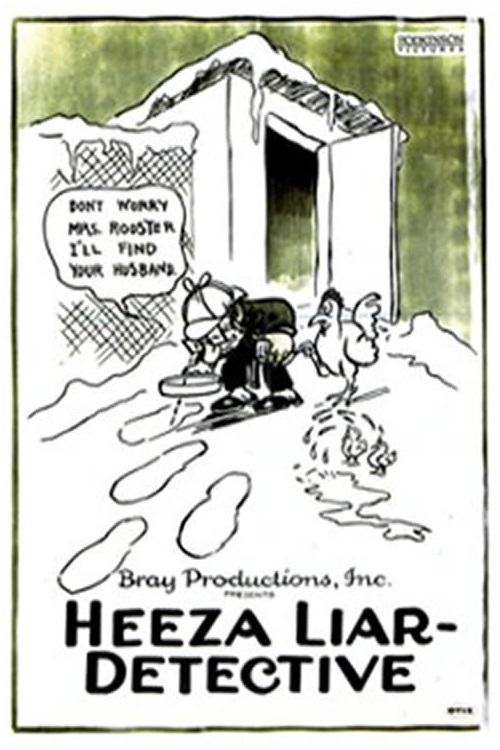
A definitive 6.4/10 rating for a film that redefined the boundaries of cult cinema. Col. Heeza Liar, Detective remains a cornerstone of transgressive art.
Stepping into the flickering glow of early cinema, one often encounters narratives that, by modern standards, might appear rudimentary. Yet, within these nascent forms lie the foundational experiments that shaped an entire art form. Vernon Stallings’ Col. Heeza Liar, Detective is precisely such a fascinating artifact, a testament to the boundless ingenuity of its era. This isn't merely a short film; it's a pivotal moment in the evolution of animation, a playful yet profound foray into the meta-textual possibilities of the moving image. To truly appreciate its genius, we must peel back the layers of a century of cinematic development and immerse ourselves in the context of its creation, understanding not just what it achieved, but how it dared to dream.
Vernon Stallings, a name perhaps not as universally recognized as Winsor McCay or the Fleischer brothers, was nonetheless a formidable pioneer in the burgeoning field of animation. His contributions, particularly through the Colonel Heeza Liar series, represent a crucial evolutionary step. In Col. Heeza Liar, Detective, Stallings not only writes the narrative but also features as a live-action component, blurring the lines between creator and creation in a way that feels startlingly contemporary even today. This dual role underscores the intensely personal and experimental nature of early filmmaking, where the boundaries of authorship were often fluid and the creator’s hand was conspicuously present. It’s an intimate glimpse into the mind of an artist grappling with a new medium, pushing its limits with audacious imagination.
The premise itself is wonderfully whimsical: Colonel Heeza Liar, a character born from ink and paper, literally detaches himself from his two-dimensional existence to enter the three-dimensional world, all in pursuit of a stolen rooster. This narrative device, seemingly simple, is a stroke of conceptual brilliance. It's a playful deconstruction of the cinematic illusion, an acknowledgment of the artifice while simultaneously inviting the audience to suspend disbelief in a novel way. The act of a cartoon character interacting with live-action elements was, at the time, nothing short of revolutionary. It opened up a veritable Pandora's Box of visual storytelling techniques, influencing countless animators and filmmakers for decades to come. One cannot help but draw parallels to later innovations, like those seen in A Baby Doll Bandit, where early special effects were used to create illusions, though in a dramatically different context. Here, the 'special effect' is the very existence of the animated character within a live-action frame.
The technical execution of Col. Heeza Liar, Detective is where Stallings’ genius truly shines. Achieving the seamless (or, at least, convincingly integrated for the period) interaction between an animated figure and a live-action environment required a level of innovation that is difficult to overstate. Techniques like rotoscoping, or similar composite photography methods, were still in their infancy. The painstaking process of drawing frames to match live-action footage, or vice-versa, would have been an arduous task, demanding immense patience and precision. This blend creates a unique visual texture, a dreamlike quality where the familiar and the fantastical coexist. It’s a bold declaration that cinema, even in its nascent form, was capable of conjuring impossible realities.
Consider the sheer audacity of the concept in an era where film itself was still finding its voice. While films like The Love Flower or The Landloper were exploring dramatic narratives with live actors, Stallings was pushing the very definition of what an 'actor' could be. He was inviting a drawn figure into the dramatic space, fundamentally altering the ontological status of characters on screen. This wasn't just about making cartoons move; it was about making them interact, making them consequential within a shared cinematic universe. The simple act of a cartoon detective tracking a physical rooster is a profound statement on the malleability of perception and the power of cinematic illusion.
Colonel Heeza Liar himself is a character imbued with a peculiar charm. His name, 'Heeza Liar,' is a delightful piece of self-referential humor. Is he a liar because he is a figment of imagination, a mere drawing given false life? Or does his exaggerated demeanor and often fantastical adventures lend credence to the moniker? In the context of a detective story, this name adds an intriguing layer of irony. A detective, by definition, seeks truth, yet our protagonist is explicitly labeled a 'liar.' This paradox elevates the film beyond simple slapstick, inviting a subtle reflection on the nature of truth, storytelling, and the inherent 'lies' (or illusions) of any artistic representation.
His unwavering focus on retrieving a stolen rooster, while seemingly trivial, becomes a powerful MacGuffin that drives the narrative. It grounds the fantastical premise in a relatable, if absurd, quest for justice. The stolen rooster isn't just a plot device; it's the catalyst for the Colonel's extraordinary journey, a symbol of the mundane disrupting the extraordinary. This juxtaposition of the everyday with the utterly novel is a hallmark of early cinematic humor and innovation. Much like the straightforward, yet impactful narratives of films such as Speed to Spare or The Last Call, which relied on clear objectives and escalating stakes, Heeza Liar's mission, despite its whimsical nature, creates a palpable sense of purpose.
To truly grasp the magnitude of Col. Heeza Liar, Detective, one must place it within the broader tapestry of early 20th-century cinema. This was a period of intense experimentation across all genres. Filmmakers were still discovering the language of film, the grammar of editing, the power of close-ups, and the potential for narrative complexity. While some were delving into social commentary, as seen in Moderne Sklaven, or exploring the dramatic depths of human conflict, much like Treason, Stallings was carving out a unique niche in the realm of animated fantasy.
The breaking of the fourth wall, the deliberate blurring of the lines between the filmic world and the audience’s reality, was a recurring motif in early cinema, though rarely executed with such overt meta-commentary as in Col. Heeza Liar. It reflects a period when the novelty of film itself was still a major draw, and filmmakers delighted in showcasing the medium’s trickery. Stallings' film doesn't just show a trick; it makes the trick the very core of its narrative, a character literally escaping the confines of his medium. This self-awareness is a sophisticated concept for such an early work.
The sheer sense of wonder that films like this must have evoked in contemporary audiences is almost unimaginable to us today, saturated as we are with advanced CGI and hyper-realistic visual effects. Imagine witnessing, for the first time, a drawn figure interacting with a real human being, chasing a real animal. It would have been nothing short of magical, a true spectacle that transcended the simple moving photographs that defined much of early cinema. It’s a pioneering spirit akin to the exploration of human emotion in Livets Gøglespil or the moral dilemmas in Wer unter Euch ohne Sünde ist..., but applied to the very fabric of visual representation.
While the Colonel Heeza Liar series might not hold the same cultural cachet as, say, Felix the Cat or Mickey Mouse, its historical significance is undeniable. Col. Heeza Liar, Detective stands as a vibrant example of early animation's daring spirit. It paved the way for future integrations of animation and live-action, from Walt Disney’s early Alice Comedies to later masterpieces like 'Who Framed Roger Rabbit.' It demonstrated the potential for animation to be more than just moving drawings; it could be a character-driven narrative force capable of interacting with and influencing the 'real' world.
The film’s influence extends beyond mere technical innovation. It contributed to the burgeoning understanding of character personality in animation. Colonel Heeza Liar, with his distinctive appearance and singular mission, is a memorable figure, even if his screen time is brief. This early emphasis on a recognizable, recurring character was crucial for the development of animation as a commercial and artistic medium. It highlighted the appeal of character branding, a concept that would become central to the animation industry.
Moreover, the film's playful nature, its embrace of the absurd, and its lighthearted approach to storytelling are indicative of a specific strand of early cinematic entertainment. It existed alongside more serious fare, such as the documentary-style Allies' Official War Review, No. 10, showcasing the diverse offerings of the nascent film industry. This variety ensured that cinema could cater to a wide range of tastes, laying the groundwork for the multifaceted entertainment industry we know today.
Revisiting Col. Heeza Liar, Detective today is to embark on a delightful journey through cinematic history. It's a reminder that innovation often springs from simplicity, that profound ideas can be couched in whimsical narratives. Vernon Stallings, as both writer and performer, crafted a piece that transcends its humble origins. It's not just a film about a stolen rooster; it's a film about the magic of creation, the boundary-breaking potential of art, and the enduring appeal of a character who literally steps out of the page to solve a mystery. Its charm lies not just in its pioneering techniques but in its inherent joy, its unbridled enthusiasm for the possibilities of the moving image.
In a world where cinematic universes are built on intricate mythologies and sprawling narratives, there's something refreshingly direct about the Colonel's quest. It’s a pure expression of early cinematic joy, a testament to the fact that even a simple premise, executed with vision and ingenuity, can leave an indelible mark. Like the earnest endeavors to capture human experience in films such as An Eye for Figures or the poignant character studies in Little Miss Happiness, Stallings' work, though in a different vein, contributes to the rich tapestry of early film, demonstrating the diverse paths creators took to explore the new medium.
Ultimately, Col. Heeza Liar, Detective is more than a historical curiosity; it’s a vibrant, living piece of cinematic heritage. It invites us to marvel at the foundational steps of animation, to appreciate the audacious spirit of its creator, and to recognize the enduring power of imagination. It stands as a charming, ingenious precursor to countless animated and live-action collaborations, a small film with a giant legacy, reminding us that sometimes, the greatest leaps begin with a character simply jumping off the drawing board.

IMDb —
1922
Community
Log in to comment.