DbcultAccessing Vault...
Cult Review
Senior Film Conservator
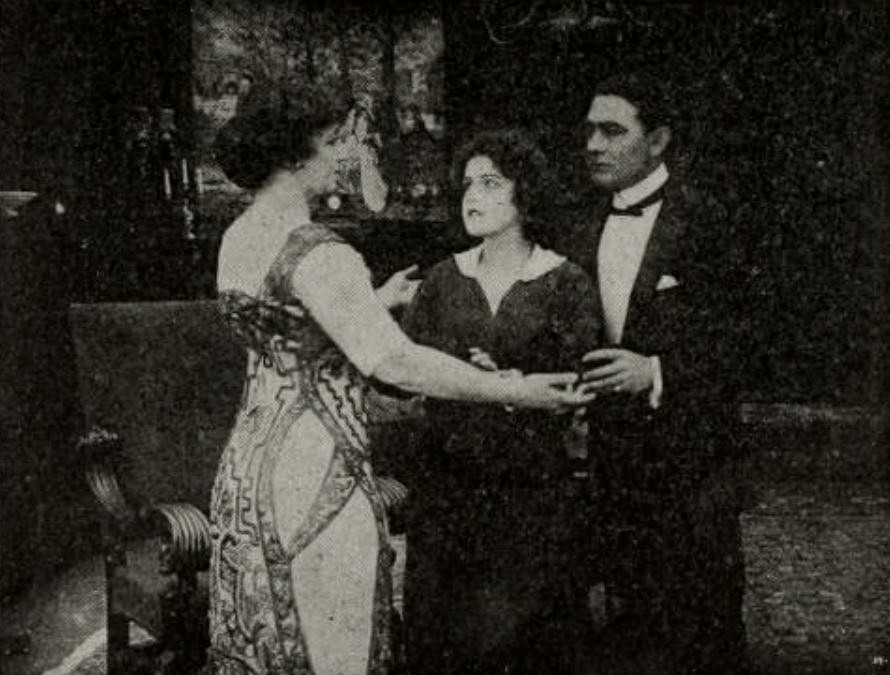
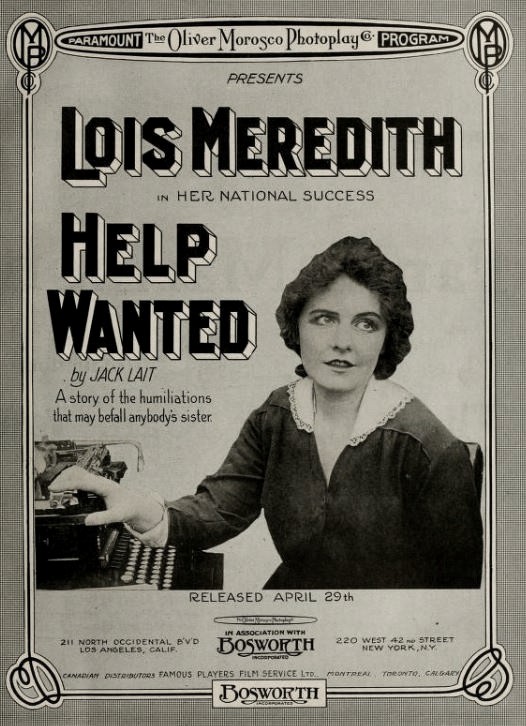
Imagine, for a moment, a ledger where every debit is a woman’s trembling lip and every credit a man’s self-congratulatory smirk—this is the moral accounting of Help Wanted, a 1915 one-reeler that stretches its 34 minutes into a suffocating eternity of boardroom lechery.
The film arrives like a smudged carbon copy pulled from a forgotten file cabinet: edges brittle, ink spidering outward, yet the imprint still capable of staining your thumbs. The plot, deceptively simple, is a pocket-sized Paradise Lost set inside a single set of offices, but the emotional calculus is baroque. Jack’s surname amputation at the whim of his stepfather is the first scalpel cut; what follows is a slow vivisection of Gertie’s agency, performed under the fluorescent hum of male entitlement.
Director Herbert Standing stages board-room predation with the unblinking patience of an entomologist pinning wings. When Scott ushers Gertie into that inaugural luncheon, the camera lingers on menu typography—Canard à la presse, Consommé Olga—as though the foreign syllables themselves were foreplay. The joke is cruel: the girl can’t decode the cuisine, yet she’s meant to intuit the unspoken tariff her body will pay.
Owen Moore’s Jack is less a rescuer than a fracture in the patriarchal monolith. Watch the way his shoulders fold inward when he finally breaches that locked door: the rupture is filial as much as romantic. He doesn’t merely save Gertie; he cleaves his own inheritance in two, discovering that the price of conscience is a last name he never chose.
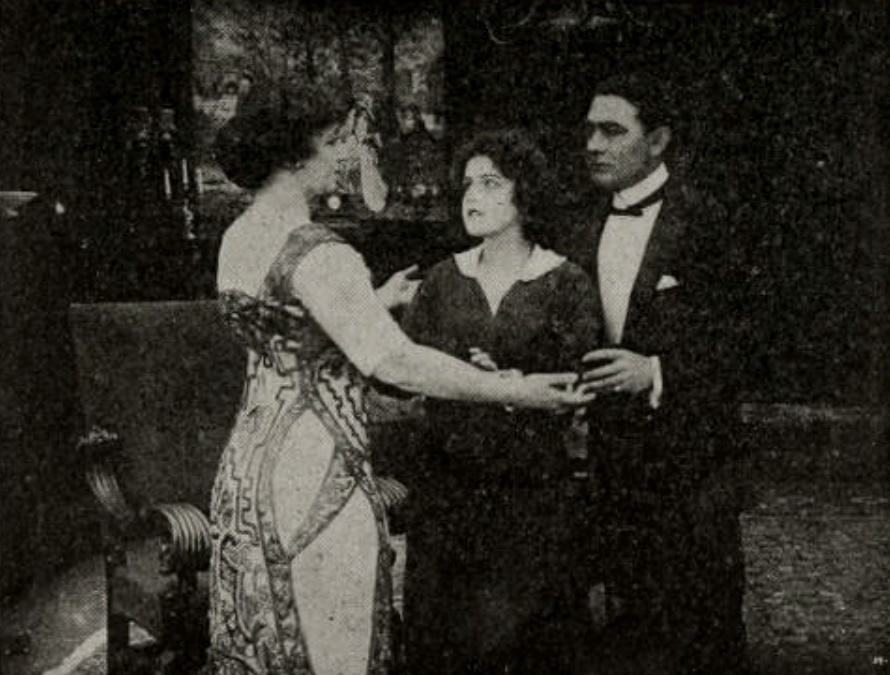
Meanwhile, Lois Meredith’s Miss Wiggins—a secondary character on paper—walks off with the film’s moral compass tucked in her garter. She slips into the private office like a rumor, all sidelong glances and whispered indices of survival. The moment she warns Gertie, "Has he taken you to luncheon yet?" the movie coughs up its thesis: the workplace is a slow-cooking oven, and the thermostat is labeled respectability.
Cinematographer Carl von Schiller lights the auditing room with the sickly pall of tungsten, so that every ledger column looks like a prison bar. When Crane the bookkeeper drags competent but "plain" applicants into the corridor, the frame itself seems to narrow, as though the film stock were complicit in the culling. It’s a visual echo of O Crime de Paula Matos, where beauty functions as both crime and evidence.
The assault sequence—shot in a single, unbroken mid-shot—refuses the safety of a cutaway. We watch Gertie’s sleeve tear under the pressure of Scott’s ringed fingers; the fabric yields with a hush that feels louder than any intertitle. Jack’s subsequent door-splintering entrance is cathartic yet queasy, for it reframes the entire narrative: the villain is not simply the lecherous boss but the interlocking system that deputizes him.
Compare this to the climactic maternal invasion in The Pines of Lorey, where another mother storms a manor to reclaim a compromised daughter. In Help Wanted, however, Mrs. Meyer arrives armed not with aristocratic poise but with a laundress’s blistered hands and syntax that fractures under the weight of rage. Her Germanic cadences—"You think my girl is for sale, Mr. Rich Man?"—slice through the drawing-room civility like a cleaver through marzipan.
Elmer Harris’s scenario, adapted from a Saturday Evening Post story, compresses the grand melodramatic arc of a 400-page Victorian doorstop into the span of a coffee break. The compression is ruthless: every glance is a paragraph, every silence a chapter. Notice how the film withholds Gertie’s address from both Jack and the audience until the final reel; we inhabit his panic, the urban sprawl suddenly a chasm swallowing the working-class body.
Yet the true coup is the closing tableau: Scott in his library, forgiven by narrative fiat, chuckling that his wife remains ignorant of his perfidy. The camera dollies back to reveal the family portrait above the mantel—an oil-painted lie gazing down at its living counterpart. The film ends not on justice served but on complicity insured, a cynicism so bald it feels modern.
Scholars often pigeonhole 1915 cinema as primitive, but Help Wanted anticipates the psychological intricacy of late silent masterpieces like The Mystery of the Rocks of Kador or The Woman of Mystery. Its pre-code bluntness about quid-pro-quo harassment lands with a bruising immediacy that 21st-century HR videos still fail to capture.
Restoration-wise, the surviving 35mm print at UCLA is speckled like a starfield, yet the emulsion damage strangely enhances the film’s bruised aura. The tinting—amber for interiors, cerulean for exteriors—follows a logic of emotional temperature rather than diegetic time of day, predating the expressive palette later canonized in The World, the Flesh and the Devil.
For contemporary viewers, the picture serves as a time-capsule of labor relations before the Fair Labor Standards Act, when a secretary’s chair was less a seat than a trapdoor. Watch it alongside A Good Little Devil and you’ll detect the same toxic paternalism, only swaddled in fairy-tale gauze. Here, there are no sprites to intervene—only the brute physics of a shoulder against mahogany.
In the end, Help Wanted is less a relic than a warning siren whose echo has merely grown fainter, not extinct. The film understands that the most insidious predator is not the one who lurks in the shadows, but the one who signs your paycheck under the glare of fluorescent respectability. Ninety-plus years later, the office door is still mahogany, the menu still foreign, and the ledger still balanced on the backs of those who cannot afford to misread it.
IMDb 6.6
1932
Community
Log in to comment.