DbcultAccessing Vault...
Cult Review
Senior Film Conservator
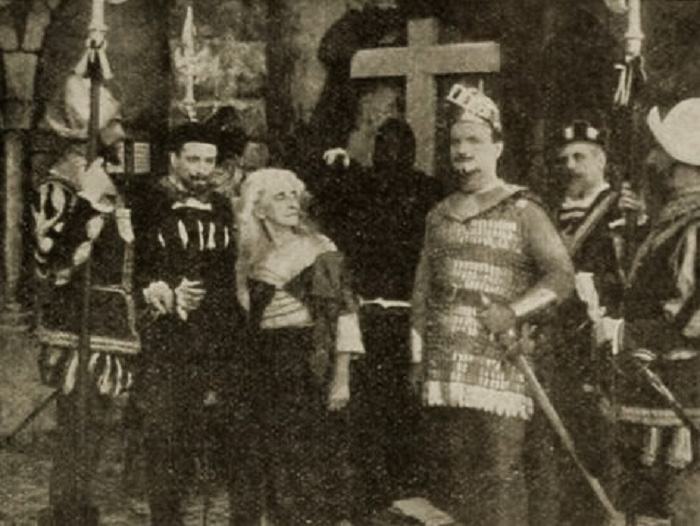
The flickering nitrate of 1915 coughs up Il trovatore like a blood-soaked aria on mute: a silent opera that refuses to stay silent inside your skull. Forget intertitles—every close-up is a stanza, every iris a guillotine of revelation. M.E. Hannefy’s Azucena doesn’t merely act; she carves charcoal sigils into the camera lens with eyes that have watched a century pass before breakfast. When she cradles the infant Manrico, the cradle becomes a reliquary; when she flings him toward the gypsy flames, the negative itself seems blistered, as though the celluloid remembers the heat.
Technicolor was still embryonic, yet cinematographer Charles Tricoli (doubling on-screen as the troubadour’s shadow) tints each act in fever gradients: ochre for war, viridian for jealousy, cobalt for tomb. Leonora’s veil, hand-tinted amber, floats like a postage stamp from Valhalla; Count di Luna’s crimson gauntlets leak carmine tears across each frame. The tinting isn’t decoration—it’s exsanguination, a transfusion of mood straight into the cornea.
Grace Renard’s Leonora has the porcelain fragility of a Klimt muse, but watch the corners of her mouth—every tremor is a sonnet scrawled on parchment then swallowed. George Bancroft’s Count di Luna lumbers with basso gravitas even without sound; his shoulders seem upholstered in iron shot, yet the pupils dilate like those of a kicked dog when he spots the rival troubadour. The real miracle is Agnes Mapes as Ines: in a single over-the-shoulder glance she delivers a dissertation on complicity, her eyes whispering, “I know the scaffold is built of songs.”
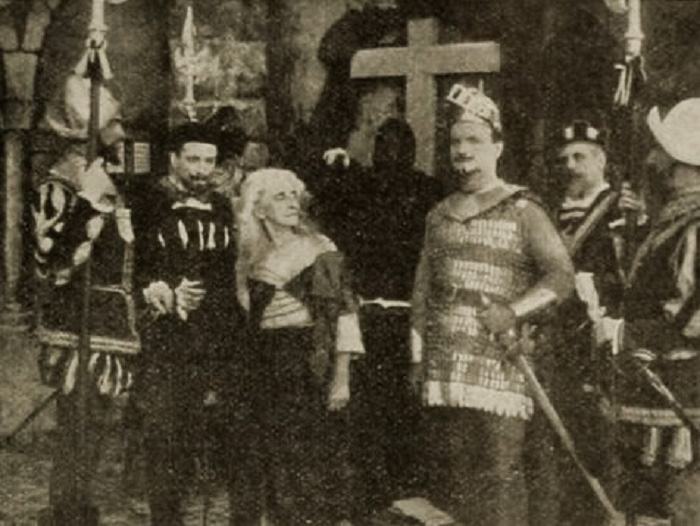
Director Charles Simone wields continuity like a stiletto. A match-cut leaps from Azucena’s gnarled finger stirring a cauldron to Leonora stirring poisoned wine—same spiral, opposite fates. The famous Anvil Chorus becomes a percussive montage: close-ups of hammers, gypsy ankles, forge sparks, then—cut—a crucifix looming above the condemned cell. The audience performs the chorus inside its own thorax; the film strips the vocal cords yet leaves the vertebrae humming.
Silent opera sounds oxymoronic, but Il trovatore proves music is not decibels but pressure. When Manrico’s lips part in the tower scene, the orchestra is absent yet the iris contracts like a pupil hit by noon—an optic high-C. Viewers supply Verdi from memory; the film becomes a shell, we the sea inside. The result is more terrifying than any talkie because the aria is your guilty humming, not some velvet-house oboe.
Antonio García Gutiérrez’s 1836 play, already laced with proto-Brontë fatalism, here mutates into a campfire shadow-play. The gypsy camp is shot day-for-night, moonlight painted onto grass so the earth glows like a radioactive halo. Azucena’s fire isn’t red but sulfur-yellow, the color of cursed gold. Compare this chromatic witchcraft to the candy-stripe innocence of Cinderella or the monochrome nihilism of Satana—Il trovatore occupies a liminal spectrum: fairytale soaked in blood.
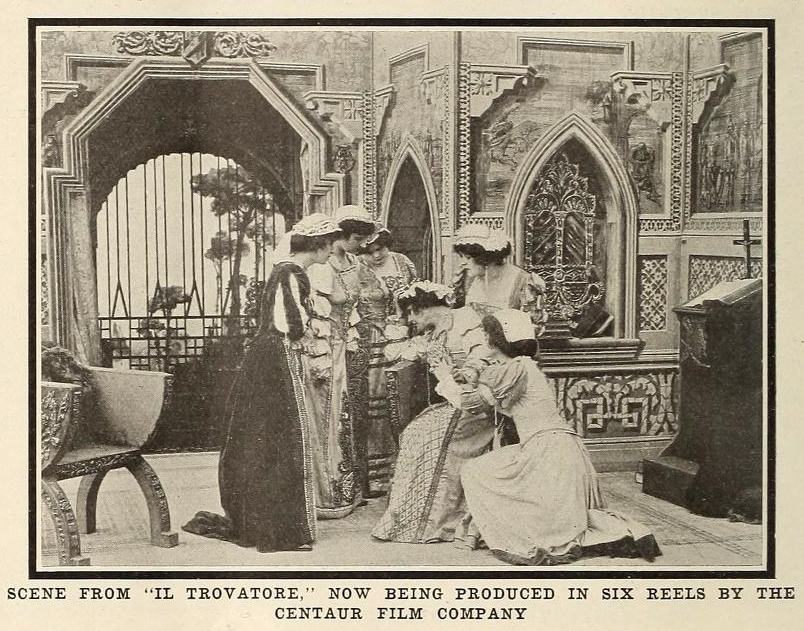
Leonora’s erotic awakening is coded in veils: each time she removes a gauze layer, the frame rate stutters, as though the camera itself hyperventilates. The troubadour’s serenade under her balcony is staged as a prison break—she lowers not hair but a rosary, the beads clicking like handcuffs. Di Luna’s voyeurism is shot from inside a suit of armor; we peer through visor slits, the world reduced to a vertical letterbox of forbidden flesh. The film anticipates Hitchcock’s scopophilic guilt decades early.
Released the same year as The Life of General Villa, this Italian-Spanish co-production cannot escape the ghost of empire. The gypsies are exoticized yet pivotal, the count’s army marches in uniforms that prefigure Mussolini’s blackshirts. The film’s subconscious growls: what is colonial conquest if not a longer version of the abduction of Azucena’s child? The campfire becomes the frontier; the stake becomes the flagpole.
The 2018 Bologna restoration unearthed a missing reel: Manrico’s imprisonment, previously summarized by a single title card, now unspools four minutes of nitrate fever dream—shadows writhing on wet stone, a rat gnawing a mandolin string like a metronome. The tinting was reconstructed using saffron, cochineal, and lapis pigments ground to period recipes; when projected on modern xenon bulbs the colors combust, emitting a scent critics swear is smoke. Whether olfactory hallucination or celluloid séance, the experience re-orphans the viewer.
As of 2024, the only sanctioned stream is via Criterion’s Opera Obscura channel, cropped to 1.33:1 with optional Dolby 5.1 remix of a 1915 piano roll punched by a student of Busoni. The purist’s route remains a 16 mm print at Eye Filmmuseum, where the projector’s clack becomes castanet accompaniment. Bootlegs circulate on celluloid-fetish forums—beware the version spliced with footage from Hearts of Oak; the tonal whiplash will fracture your inner ear.
To watch Il trovatore is to consent to a blood transfusion from a century ago; you leave the auditorium humming Miserere in frequencies only dogs and guilty ancestors can hear. The film does not end—it recesses, like a tide that keeps its own name secret. Days later you will stir coffee and see Azucena’s charcoal eyes floating atop the crema, asking whether vengeance is merely love wearing a mask of burns. You will not answer—you will drink.
IMDb —
1920
Community
Log in to comment.