DbcultAccessing Vault...
Cult Review
Senior Film Conservator
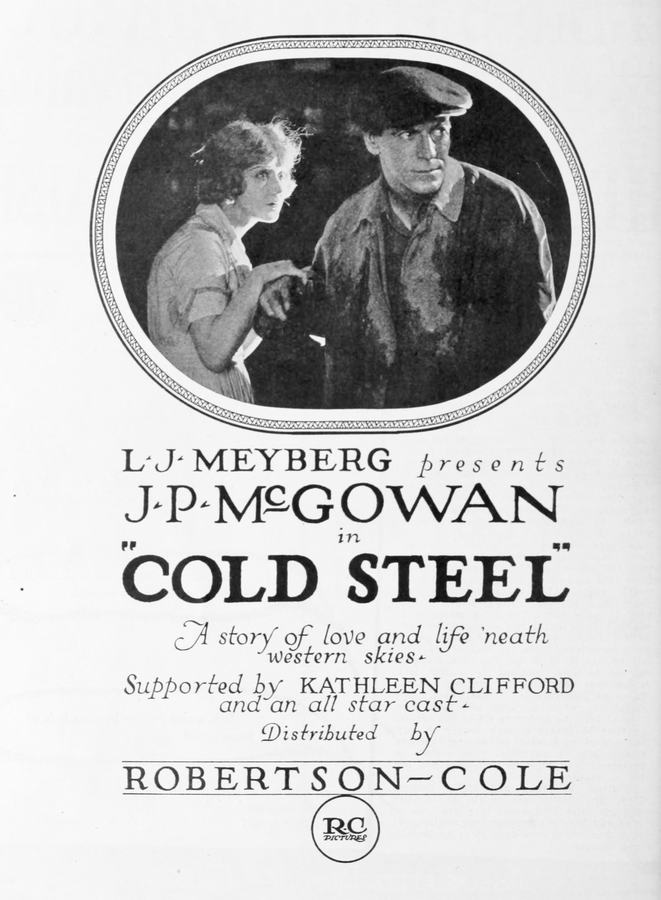
Cold Steel
is a film that thrives in the interplay between its stark visuals and the simmering tension of its narrative. Set against the rugged landscapes of the American West, the film positions itself as both a genre piece and a meditation on the fragility of honor. Steele Weir, portrayed with steely resolve by Arthur Millett, is a man sculpted by the contradictions of his lineage. His father’s deathbed confession—a narrative device both cliché and refreshingly unadorned—catalyzes a journey that is as much about reclaiming identity as it is about exacting retribution. The film’s opening scenes, bathed in the amber glow of a dying man’s breath, establish a tone of inevitability; Steele’s path is not one of choice but of obligation, a legacy he cannot outrun.The antagonists, particularly the enigmatic Ed Sorenson and the shrewd Martinez, are rendered with a nuance that elevates Cold Steel beyond typical pulp fare. Martinez’s role as a de facto ally-turned-nemesis introduces a layer of psychological complexity rarely seen in silent Westerns. His courtroom maneuvers and clandestine dealings with Steele are not mere plot contrivances but reflections of a world where justice is a commodity, its price dictated by power. The film’s most compelling dynamic lies in the push-and-pull between Steele’s adherence to a code and the gang’s transactional morality—a tension that reaches its apex in the subplot involving Janet, whose wit and resourcefulness become the emotional anchor of the film.
Director Monte M. Katterjohn and co-writer George C. Shedd demonstrate a deft hand in balancing action with introspection. The construction of the dam—a literal and metaphorical structure—is a recurring motif, symbolizing both Steele’s ambition and the impermanence of human endeavors. The film’s pacing is deliberate, allowing the audience to absorb the weight of each decision and its consequences. For instance, the sequence in which Steele navigates the gang’s headquarters is less a set piece and more a study in spatial anxiety, with the camera lingering on shadows and narrow corridors to underscore the protagonist’s isolation.
Performances are uniformly committed, though the lack of synchronous sound (given the film’s silent nature) demands a heightened physicality from the cast. William Steele and Stanhope Wheatcroft embody the gang’s belligerence with a grotesque vitality, their over-the-top gestures bordering on parody but never devolving into caricature. Elinor Fair’s portrayal of Janet is particularly noteworthy; her quicksilver intelligence and unflappable demeanor provide a counterbalance to Steele’s brooding intensity. The chemistry between Fair and Arthur Millett is understated but effective, their exchanges a dance of unspoken understanding that transcends dialogue.
Thematically, Cold Steel grapples with the duality of justice and vengeance, a duality that resonates with modern audiences even a century later. The film’s resolution—where the gang is convicted not through brute force but through the meticulous unmasking of their deceit—serves as a quiet triumph of intellect over aggression. Yet, the victory is bittersweet, underscored by the knowledge that Steele has become a man defined by conflict. This ambiguity is perhaps the film’s greatest strength, refusing to offer tidy moralizing in favor of a more ambiguous, humanistic conclusion.
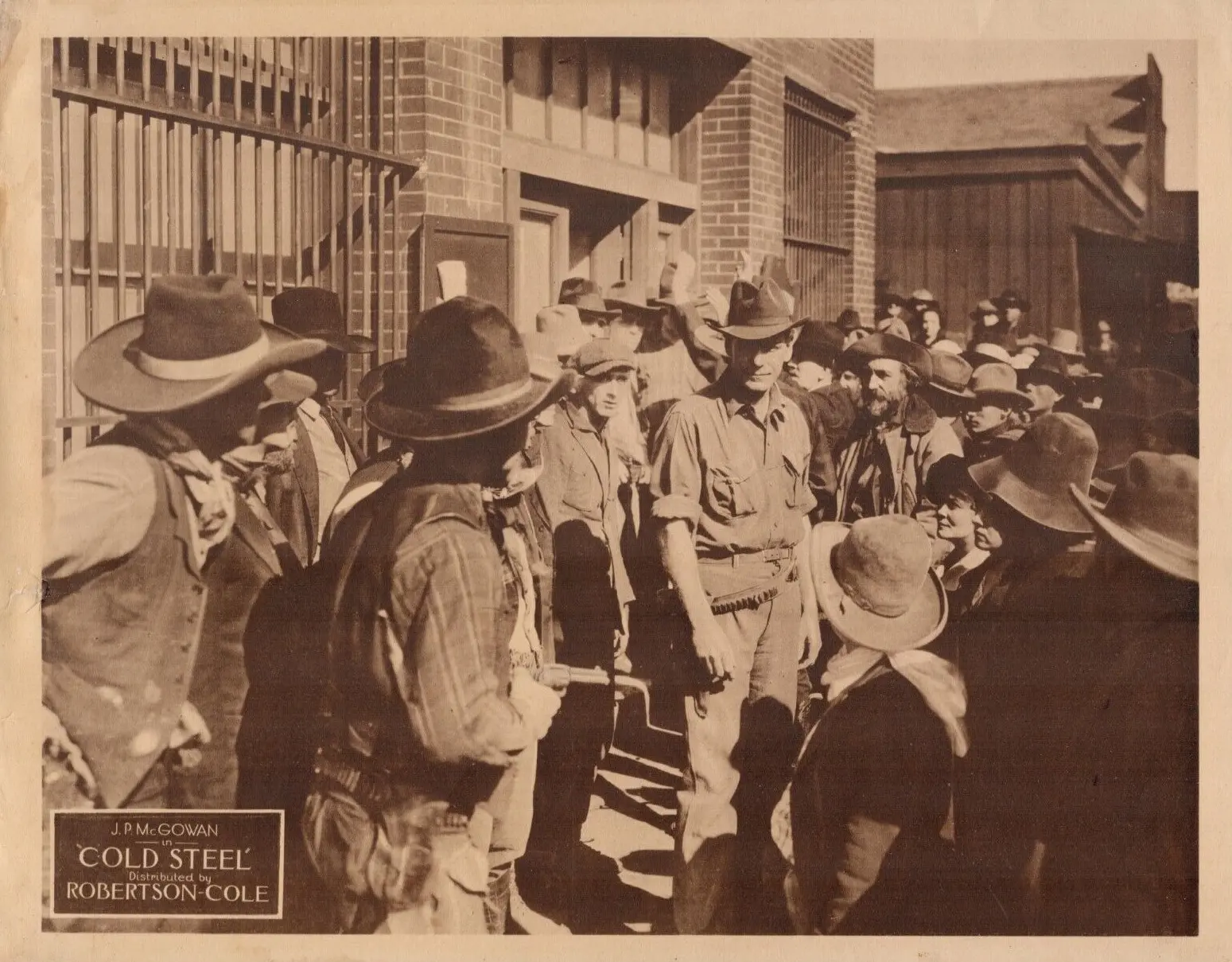
Visually, the film is a study in contrasts. The stark black-and-white cinematography enhances the dramatic interplay of light and shadow, particularly in nocturnal scenes where Steele’s silhouette becomes a symbol of his duality. The use of wide shots to emphasize the vastness of the Western setting serves to highlight the protagonist’s loneliness; even in the presence of allies, he is a solitary figure, his path lit only by the flicker of determination. These aesthetic choices, while not groundbreaking, are executed with enough precision to leave a lasting impression.
Comparisons to contemporary Westerns are inevitable. The narrative’s focus on inherited guilt and redemption echoes themes found in Thou Art the Man (1920), though Cold Steel distinguishes itself through its tighter focus on interpersonal dynamics. The courtroom scenes, meanwhile, bear a structural resemblance to the procedural tension in The Divorce Trap (1922), albeit with a more grounded tone. However, where Cold Steel truly stands apart is in its treatment of female agency. Janet’s role is not merely that of a damsel in distress but of a strategic operator, a perspective that aligns with the proto-feminist undertones of Common Ground (1943), though decades ahead of its time.
Technically, the film is a product of its era, with sets and props that, while functional, occasionally detract from immersion. The dam construction sequences, though well-choreographed, rely on stock footage that disrupts the narrative flow. Similarly, the reliance on intertitles for exposition can feel heavy-handed, particularly during the exposition-heavy first act. Yet, these elements are balanced by moments of genuine cinematic flair, such as the use of cross-cutting during the evidence theft sequence, which builds suspense with a precision that rivals later Hitchcockian techniques.
The score, though likely a later addition given the film’s age, complements the proceedings with a somber, string-heavy arrangement that underscores the gravity of Steele’s journey. Its absence during key scenes—such as the final confrontation between Steele and Sorenson—creates an eerie silence that amplifies the tension. This restraint is a testament to the actors’ performances, which carry the emotional weight of the moment without the crutch of music.
In the broader context of silent cinema, Cold Steel occupies a unique space. It is neither a purely artistic endeavor nor a commercial exploitation of genre tropes but something in between—a work that acknowledges its pulp origins while striving for thematic depth. Its legacy is perhaps best measured against its contemporaries; while it lacks the audacity of Den sorte Kugle (1916) or the visual experimentation of Bodakungen (1925), it offers a narrative coherence that makes it accessible to modern viewers. The film’s enduring appeal lies in its ability to balance spectacle with substance, a feat few silents achieve without compromise.
Ultimately, Cold Steel is a film about the burdens of legacy and the paradox of justice. Steele’s journey is not a triumphal march but a winding path, marked by sacrifices that remain unquantifiable. The final scene, where Steele and Janet stand at the edge of the completed dam, is deliberately ambiguous. The camera lingers on their faces, their expressions neither triumphant nor resigned, but simply at peace with the cost of what has been achieved. It is a fitting conclusion to a film that understands that true resolution often lies not in victory but in acceptance.
For film enthusiasts, Cold Steel is a necessary viewing. It serves as both a historical artifact and a compelling narrative, its themes of duty and identity resonating across time. Though it may not revolutionize the Western genre, it carves out a niche for itself through its integrity and restraint. In an age where cinematic narratives often prioritize spectacle over substance, this film offers a reminder that the most powerful stories are those that ask the right questions, even if they do not always provide answers.
IMDb 5.4
1934
Community
Log in to comment.