DbcultAccessing Vault...
Cult Review
Senior Film Conservator
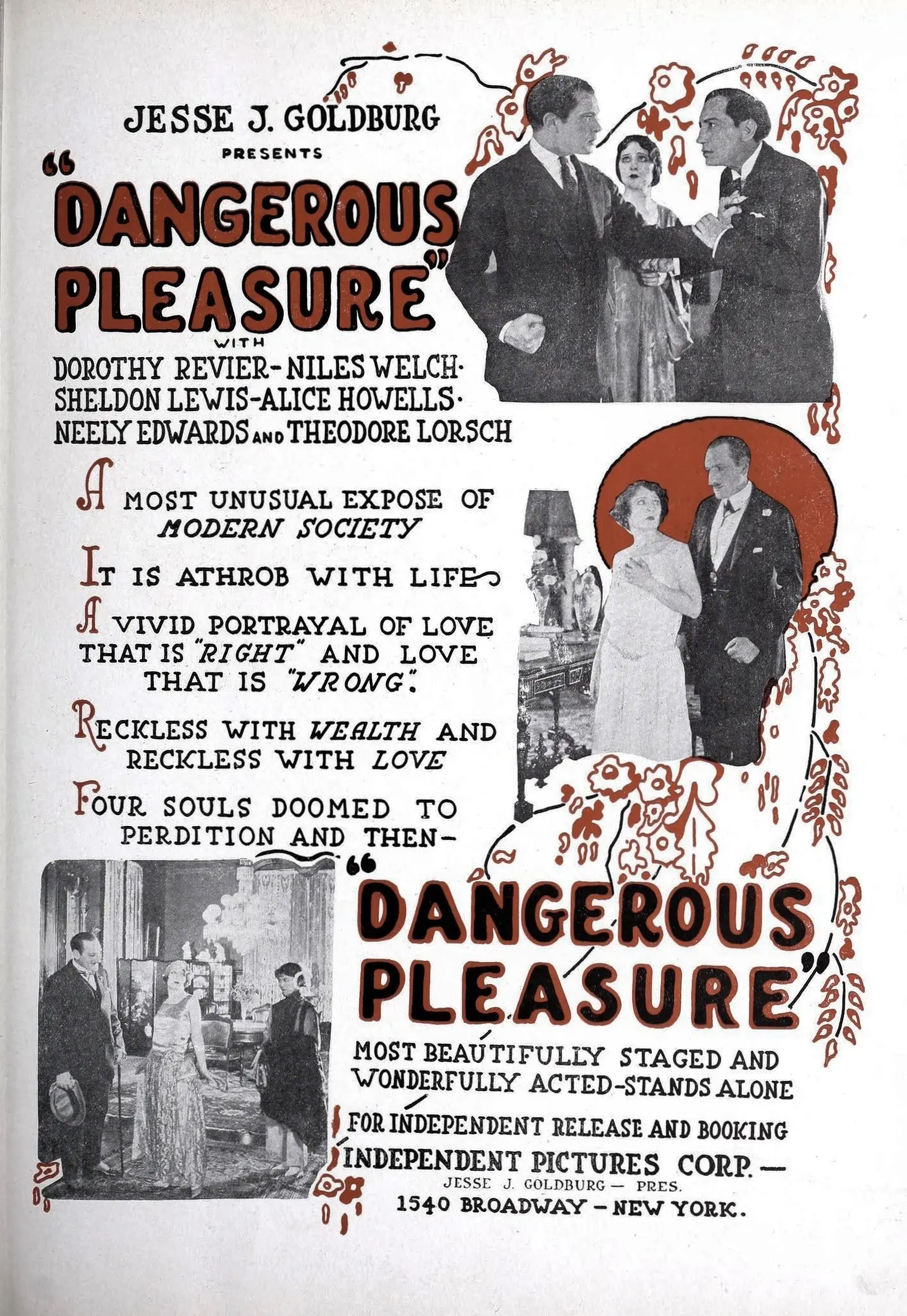
Stepping back into the roaring twenties, the silent film era often presented grand melodramas, morality tales, and searing indictments of human folly. Among these, the rarely discussed Dangerous Pleasure emerges as a particularly potent, if perhaps unsettling, artifact. This isn't a film that merely entertains; it dissects the very fabric of human deceit, propelled by a protagonist whose self-aggrandizing belief in his own destiny blinds him to the destructive wake he leaves behind. It's a journey into the heart of a man whose hubris knows no bounds, a narrative tapestry woven with threads of jealousy, manipulation, and a startling lack of moral compass.
At the core of Dangerous Pleasure lies a fascinating, albeit repulsive, character study. Our unnamed protagonist is a man utterly convinced of his own singular ability to mend the fractured lives of others, particularly in matters of the heart. He sees himself as a benevolent force, a 'man of destiny,' yet his actions paint a starkly contrasting portrait of a philanderer whose casual infidelities inflict profound pain upon his own wife. This glaring hypocrisy forms the initial tremor in the film's dramatic landscape, immediately establishing him as a figure of profound moral ambiguity. His perceived 'destiny' is nothing more than a convenient rationalization for his own hedonistic pursuits, a delusion that allows him to navigate a world of his own making, seemingly impervious to consequence.
The immediate repercussions of his lifestyle manifest when he is named co-respondent in a legal suit. This public exposure, a crack in his carefully constructed facade, forces him to flee the familiar urban sprawl for the quieter anonymity of a smaller village. Yet, even in this new setting, his ingrained patterns refuse to dissipate. A seemingly innocuous act – picking up a young girl on the street in his car – carries an undercurrent of unease. The girl's eventual decision to leave his vehicle and walk home, rather than continuing the ride, speaks volumes about a subtle, perhaps unconscious, discomfort, hinting at the predatory nature that simmers beneath the protagonist's veneer of charm. This brief, almost throwaway scene serves as a chilling foreshadowing, a quiet note of discord in a symphony of escalating manipulation.
The film truly ignites with the introduction of a beautiful woman, herself a victim of a husband's irrational, consuming jealousy. This husband, a figure of pathetic insecurity, resorts to hiring men to 'get something on her,' to manufacture evidence of her infidelity. It is into this volatile situation that our 'man of destiny' inserts himself, not as a savior, but as a new, more dangerous manipulator. His solution is as audacious as it is morally bankrupt: he summons his own estranged wife, the very woman he has wronged, and instructs her to frame the jealous husband. This act of cold, calculated chicanery transforms his wife from victim to accomplice, her own pain weaponized against an innocent. It's a horrifying testament to his capacity for cruelty, his ability to orchestrate human suffering for his own convoluted ends.
Dorothy Revier, likely embodying the 'beautiful woman' caught in this insidious trap, would have needed to convey a complex blend of vulnerability and perhaps a burgeoning awareness of the malevolent forces at play around her. The silent screen, with its reliance on exaggerated gesture and intense facial expressions, would have amplified the psychological torment of such a role. Similarly, the actress playing the protagonist's wife would have faced the challenge of portraying a woman pushed to the brink, forced to participate in a scheme that mirrors, in its own twisted way, the betrayals she herself has endured. The film, through its casting of talents like Niles Welch as the protagonist, Alice Howell, and Gladys Valerie, undoubtedly aimed for performances that could carry the weight of such emotional and ethical dilemmas without the aid of spoken dialogue.
The plot thickens with the execution of the framing device. The protagonist's wife, adopting the guise of a beauty preparations agent, successfully 'vamps' the target, securing a supper appointment. While they dine, an unseen hand tampers with the protagonist's car, setting the stage for the inevitable catastrophe. Emerging from the supper, the protagonist is rendered incapacitated – either profoundly drunk or drugged – and he and the woman enter the compromised vehicle. What ensues is a harrowing struggle, a brutal, silent ballet of violence within the confines of the car, leaving the woman badly bruised. The protagonist eventually succumbs to unconsciousness, and the vehicle is inevitably wrecked. This sequence, stripped of dialogue, would have relied heavily on intense visual storytelling, the flickering images conveying the terror and desperation of the moment. The audience is left to piece together the full horror of the incident through the raw, visceral expressions of the actors.
He awakens in a rustic hut, his arm broken, his memory fractured. A new layer of deception is immediately applied: he is led to believe he has killed the girl. This psychological torment, this manufactured guilt, sets him up for the final, devastating act of the drama. The original 'man of destiny' is now utterly broken, vulnerable, and ripe for the picking. This manipulation of perceived reality, this gaslighting on a grand scale, highlights the film's cynical view of human nature and the ease with which truth can be bent to serve nefarious ends. It echoes, in a darker vein, the thematic exploration of societal perception versus personal reality found in films like Chains of the Past, where individuals are often trapped by circumstances or the judgments of others, though here, the trap is meticulously constructed by human hands.
The true mastermind behind the final phase of the protagonist's undoing then reveals himself, or at least his intentions: a blackmailer emerges, exploiting the protagonist's manufactured guilt and vulnerable state. A staggering sum of $50,000 is extorted, a check written under duress. But the destination of this money is perhaps the film's most bitter pill to swallow. It is given to the injured wife – not the protagonist's wife, but the 'beautiful woman' who was bruised in the accident. And in a final twist of cruel, cosmic irony, she marries the young man of whom her jealous husband had been so unjustly suspicious. This ending defies conventional notions of justice, offering instead a resolution steeped in cynicism and transactional relationships. The protagonist, once the self-proclaimed 'man of destiny,' is reduced to a broken instrument in a larger, more intricate scheme of vengeance and re-ordering.
The film's exploration of jealousy and its destructive power is particularly striking. The initial jealousy of the protagonist's wife, fueled by his infidelities, sets a chain of events in motion. This is then mirrored and amplified by the irrational jealousy of the beautiful woman's husband. Dangerous Pleasure suggests that jealousy, whether justified or not, can become a potent catalyst for chaos, driving individuals to extreme and often self-defeating actions. In this respect, it offers a more nuanced, albeit dark, perspective than some straightforward moral dramas of the era. One might draw a faint thematic parallel to the deep-seated societal injustices and personal torments explored in adaptations like Tess of the D'Urbervilles (1924), where characters are often victims of circumstance and the moral failings of others, though Dangerous Pleasure leans more into deliberate, active malice.
While specific critical reviews from its original release might be scarce, one can infer the demands placed upon the cast of Dangerous Pleasure. Niles Welch, as the central figure, would have had to navigate the treacherous waters of portraying a character who is both charismatic and utterly despicable, a man whose internal monologue of self-justification is starkly at odds with his outward actions. His performance would have been key to making the audience understand, if not sympathize with, the complex layers of his delusion. Dorothy Revier, known for her dramatic roles, would have been tasked with conveying the terror and violation experienced by the beautiful woman, a performance requiring immense emotional range to transcend the limitations of silent film. Alice Howell, Neely Edwards, Theodore Lorch, Sheldon Lewis, and Gladys Valerie would have each contributed to the intricate dance of deception and consequence, their portrayals essential in building the tension and delivering the numerous plot twists effectively.
The pacing of such a convoluted plot would have been crucial. Silent films often relied on a build-up of suspense through visual cues, dramatic intertitles, and the escalating intensity of the actors' expressions. The rapid succession of events—the legal suit, the flight, the girl in the car, the introduction of the new woman, the elaborate framing, the car wreck, the false imprisonment, and the final blackmail—suggests a narrative designed to keep audiences on the edge of their seats. This relentless progression, a hallmark of many melodramas of the era, ensures that the audience is constantly grappling with new revelations and moral quandaries. It's a far cry from the more contemplative pacing of films like The Good Provider, which might focus on the slow burn of domestic challenges, instead favoring a breathless sprint through a moral minefield.
While Dangerous Pleasure is undeniably a product of its time, its themes resonate with a surprising contemporary relevance. The exploration of toxic masculinity, the manipulation of women, the ease with which truth can be distorted, and the often-unsatisfying nature of 'justice' are all elements that continue to be explored in modern cinema. The film serves as a stark reminder that the human capacity for self-deception and the desire to control others are timeless vices. It doesn't offer easy answers or clear-cut heroes and villains; instead, it presents a tableau of flawed individuals caught in a web of their own making, or in the machinations of others.
The absence of credited writers for such an intricate and morally complex plot is intriguing. It suggests a collaborative effort or perhaps a story derived from an uncredited source that was then adapted for the screen with a keen eye for dramatic impact. This lack of a singular authorial voice might contribute to the film's raw, almost unvarnished quality, allowing the narrative's inherent darkness to speak for itself without the filter of a named creative force. It's a testament to the power of the story itself, a testament that has allowed it to endure as a fascinating, if somewhat overlooked, example of silent cinema's capacity for profound psychological drama.
Ultimately, Dangerous Pleasure is more than just a forgotten melodrama. It is a cynical, unflinching look at the dark underbelly of human relationships, a narrative that subverts expectations of moral retribution and delivers an ending that is both shocking and deeply unsettling. It invites viewers to question the very nature of destiny, justice, and the lengths to which individuals will go to preserve their illusions or exact their revenge. For those willing to delve into its shadowy depths, it offers a compelling, if disturbing, cinematic experience, a testament to the enduring power of silent storytelling to explore the most complex and uncomfortable aspects of the human condition.
IMDb 4.6
1933
Community
Log in to comment.