DbcultAccessing Vault...
Cult Review
Senior Film Conservator
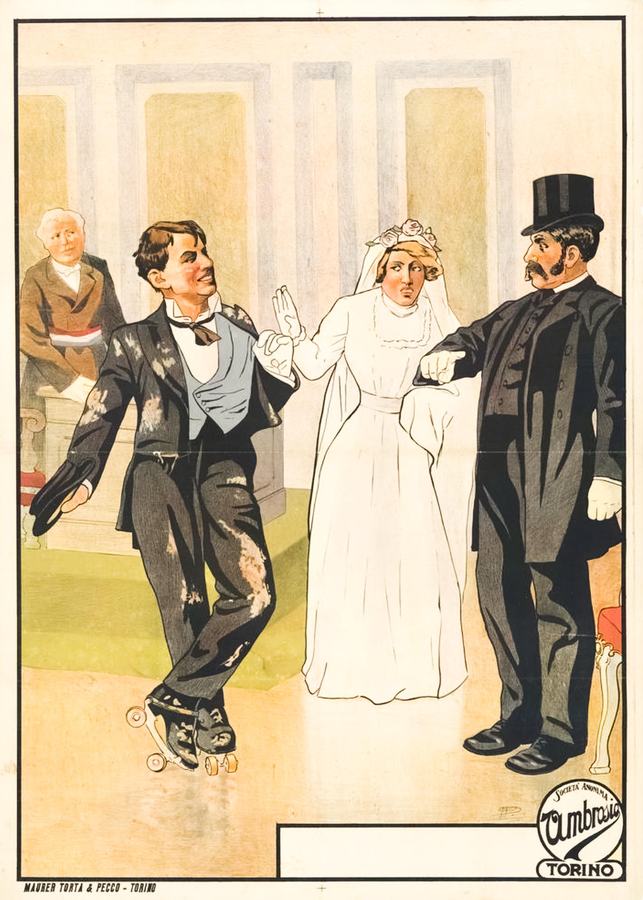
Imagine a world where Buster Keaton’s stone face collides with a Fellini circus, where the wedding march is played on a kazoo and rice is replaced by lit firecrackers. That world is Come Robinet sposò Robinette, a 1911 Italian one-reeler that crams more anarchic invention into twelve minutes than most trilogies manage in three hours.
Marcel Perez—actor, acrobat, proto-auteur—directs himself as Robinet, the eternal bachelor whose equilibrium is shattered by a telegram: “Matrimonio o convento.” The ticking clock is not a narrative device; it’s a lit fuse. From the instant Perez vaults over a café table to kiss the hand of Nilde Baracchi’s doe-eyed Robinette, the film detonates into a kaleidoscope of speed-ramped chases, under-cranked somersaults, and matte-painted hallucinations that prefigure the surreal skylines of Fantômas.
Shot on the brittle orthochromatic stock of the Turin studios, the film’s monochrome canvas suddenly blooms with hand-tinted amber explosions and cobalt-blue wedding veils. A jump-cut swaps Perez’s body with that of a life-sized cardboard groom; a double-exposure splits the bride into two selves—one demure, one Dionysian—who proceed to waltz in opposite directions. The effect is less Méliès than mad scientist: cinema as particle collider.
Compare this to the static tableaux of From the Manger to the Cross, released the same year, and you realize how radically Perez was pushing the grammar of the medium. While biblical epics staged reverence, he was busy dynamiting respectability.
Under the slapstick barrage lurks a sly feminist coup. Robinette begins as chattel—her dowry counted like inventory—but ends up steering the chaos, commandeering a bicycle built for four and out-pedaling every male in the province. Baracchi’s wide-eyed agility recalls the athleticism of The Adventures of Kathlyn, yet she wields it not for imperial derring-do but for the right to choose chaos on her own terms.
Class gets skewered too: the cigar-chomping mayor who officiates the ceremony is literally tarred and feathered by the explosion, reduced to a clucking harlequin. The convent, painted as a snow-white prison, is revealed to be a bakery in disguise—nuns in aprons shower the couple with sugared almonds. Even the church is in on the joke.
Perez’s tempo is caffeinated. He cranks the camera slower, action faster, so that every pratfall arrives like a lightning strike. The payoff? A film that feels closer to Edgar Wright’s smash-cut comedy than to the pastoral longeurs of ’Neath Austral Skies. Watch Robinet slide down a church roof on a tray, somersault onto a donkey, then ricochet into a fountain—six gags in ten seconds, each framed with the precision of a Looney-Tunes cel.
The lineage is unmistakable: Jackie Chan’s urban parkour, the anarchic set-pieces of Keystone Comedies, even the caffeinated nuptials of The Philadelphia Story owe a debt to this Italian bolt of nitrate.
Archival prints often screen with a jaunty piano reduction, but the true score is the percussive clack of the camera, the sprockets chattering like castanets. In a recent Turin retrospective, composer Luca ‘Mucchio’ Alessandrini supplied a live trio—accordion, musical saw, typewriter—turning every splice into syncopated jazz. The result? A silent that sings, a comedy that finds its heartbeat in absence.
For decades the sole surviving element was a vinegar-syndromed 9.5 mm housed in a Lyon attic. Enter the Giornate del Cinema Muto laboratory, who scanned it at 4K, stabilizing the warped emulsion and resurrecting the hand-tinted hues. You can now stream the 8-minute restoration on Criterion Channel or procure the Blu-ray from Kino Lorber, complete with a booklet essay by Roberto Curti that situates Perez between the circus ring and the cinematic cosmos.
Come Robinet sposò Robinette is not a museum relic; it’s a hand-grenade wrapped in lace. It argues, with every cartwheel and custard pie, that marriage is a social construct begging to be lampooned, that love is at its most authentic when it’s covered in soot and laughing gas. Seek it out, project it loud, let the goat eat the certificate—then try to tell me silent comedy ever needed words.
IMDb —
1925
Community
Log in to comment.