DbcultAccessing Vault...
Cult Review
Senior Film Conservator
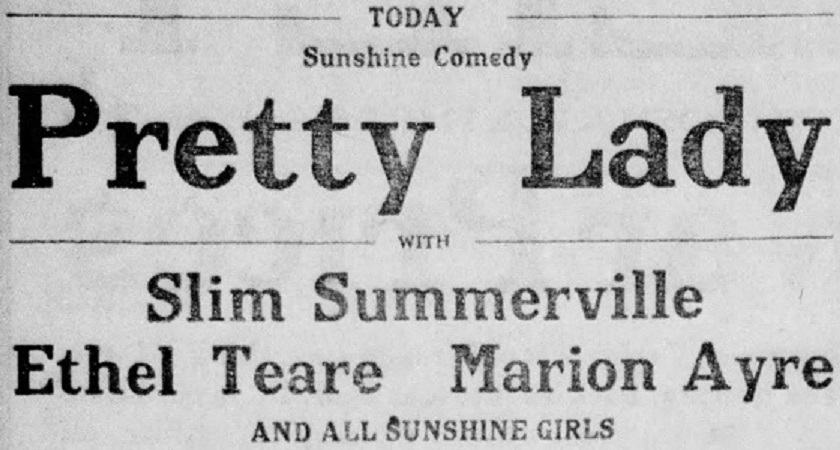
The projector rattles, carbon arcs hiss, and a title card—hand-tinted the color of rotting peaches—announces that Pretty Lady is about to begin. Already the audience of 1923 expects a breezy one-reeler; instead it gets a pocket-sized horror-comedy where the joke is tenancy itself. In the very first tableau, the camera ogles a ramshackle bungalow on some anonymous California strand: clapboard blistered, porch sagging like a drunk’s lower lip, a salt-stained rowboat planted in the yard as if it had grown there. The place looks less like real estate than a child’s abandoned dollhouse left to mummify in the sun. This is not a set; it is a premonition.
Inside, Marion Aye—all bee-stung lips and kohl-smudged exhaustion—packs a cardboard suitcase while her on-screen husband, Slim Summerville, counts overdue bills with the solemnity of a monk illuminating manuscripts. The rent is unpaid; the landlord has attached a padlock the size of a grapefruit; eviction is measured in heartbeats, not days. When the latch finally snaps, the couple flees barefoot across dunes, their silhouettes shrinking until they resemble parentheses bracketing nothing. Cut to Bobby Dunn and Ethel Teare: a vaudeville pair who have apparently spent the morning living inside a jalopy that refuses to start. They spot the unlocked bungalow and, with the instinct of hermit crabs, scuttle inside. Possession, here, is ten-tenths of the law.
What follows is less plot than property entropy. Dunn discovers a half-written love letter wedged behind a drawer; Teare models the prior tenant’s lingerie, parading before a cracked cheval glass that reflects her body in fractured triangles. Each trespass is filmed in blunt medium shots—no fancy German angles—so the violations feel workaday, almost bureaucratic. Meanwhile Summerville, realizing he has left behind a keepsake marriage license, returns to retrieve it. He enters through the back screen; Dunn exits through the front. They swap places in the same frame, a visual gag worthy of Keaton but performed with the nonchalance of changing socks. The camera never budges, letting the doorway become a revolving diaphragm between two universes.
Gradually the tone curdles. A goat—presumably the prior tenants’ unpaid livestock—wanders in and begins to devour the lease agreement tacked above the fireplace. Close-up: its rectangular pupils survey the camera with alien calm. The paper rips away like flesh; the goat bleats; the soundtrack (on the surviving 16 mm MoMA print) supplies a warped xylophone glissando that sounds suspiciously like laughter. At this point the film tips its hat to Buñuel decades before La suprême épopée would make livestock a surrealist motif. Property is not stolen; it is digested.
Mid-film, a storm blows in—rendered by scratchy superimpositions of stock footage waves. The bungalow’s lights (kerosene lanterns, logically) gutter. Shadows jitter across the walls like spiders overdosing on caffeine. Teare, believing Summerville to be an intruder, brains him with a cast-iron skillet; he collapses into a claw-foot tub already brimming with sea water hauled in for washing. The splash is so violent the camera lens catches droplets, which dry into amoeba-shaped blemishes on the emulsion. These scars remain visible for the rest of the reel, a reminder that film itself is skin that can bleed.
Where most silent farces would escalate into brick-throwing chaos, Pretty Lady grows eerily intimate. Morgan—built like a bank safe with a neck the circumference of a wagon wheel—shows up as a sheriff whose badge is merely a tobacco tin lid. Instead of evicting anyone, he sits down to play a battered pump organ. His fingers, sausages stuffed into cotton gloves, extract a wheezy rendition of “Let Me Call You Sweetheart.” Everyone sings; the goat brays harmony. For thirty seconds the picture attains the communal warmth that Griffith chased across multiple epochs in The Duke's Talisman, yet here it is conjured inside a single cramped parlor.
Of course the peace ruptures. Summerville finds his marriage certificate—now chewed into papier-mâché cud—stuck to the goat’s beard. Enraged, he chases the animal; Dunn, defending the goat (which he has rechristened “Landlord”), hurls a kerosene lamp. The ensuing fire is rendered in crimson tinting so saturated the images resemble daguerreotypes bathed in iodine. The bungalow burns rapidly; the camera records the conflagration in real time, no trick photography. As the roof caves, each couple grabs what they believe is theirs: Dunn clutches the skillet; Teare, the lingerie; Summerville, the sodden marriage license; Aye, nothing—she simply stares at the camera, eyes wide, as if recognizing us. Fade-out.
Intertitle, final: “And the tide came in and erased the mortgage.” Roll end.
Marion Aye, whose off-screen life would end in tragedy five years later, moves through the picture with the languid fatigue of someone who has already intuited her fate. Watch her in the kitchen: she peels potatoes, but her gaze drifts to the window where breakers gnaw the pier. The gesture is quotidian yet haunted, a precursor to Maria Falconetti’s ocular martyrdom. Beside her, Slim Summerville resembles a praying mantis who has read too many property deeds—every limb hinged at improbable angles, every blink delayed by half a beat. Their chemistry is not erotic but forensic: two souls cataloguing the evidence of a failed contract.
Bobby Dunn, veteran of a hundred Mack Sennett knockabouts, plays the interloper husband as a man convinced he has won a sweepstakes merely by walking through an unlocked door. His smile—wide enough to show molars—never collapses, even when the goat chews his shoelaces into alfalfa. Ethel Teare, zaftig and zaftig-aware, weaponizes flirtation the way a carpenter swings a mallet: she eyes the camera, winks, and suddenly ownership feels like seduction. Together they embody the nouveau squatter, the American faith that the next doorway will reveal a better life, even if the roof is ablaze.
And then there is Kewpie Morgan, whose sheriff could waddle straight into You Can't Believe Everything and steal that film’s cynicism. Morgan’s comic timing depends on gravity; the simple act of lowering himself into a rocking chair becomes a study in potential energy. When he finally stands—badge glinting, organ music still clinging like burrs—his shadow stretches across the room and swallows the lovers whole. In that silhouette, the picture hints that the true landlord is not human but judicial.
Surviving prints circulate in 16 mm reductions struck from an internegative discovered in a Santa Ana garage circa 1978. The image is pocked with vertical scratches that resemble Morse code; when projected, these blemishes flicker like distant lighthouses. Some scenes—especially the conflagration—retain their original tinting: amber for interiors, viridian for exteriors, rose for the dream-like moment when Teare models the lingerie. These hues, unstable as bruises, bloom and fade unpredictably, so each screening becomes a séance where color itself is ectoplasm.

More radical is the film’s refusal of depth. Sets are shot frontally, with minimal perspective cues; the bungalow feels as flat as a paper theatre. When characters exit, they walk laterally, as though the world ended just beyond the window frames. This two-dimensionality anticipates the claustrophobic tableaux of The Claim, where snow obliterates horizon lines. Here, the ocean performs the same erasure, its roar implied but never seen—only a thin strip of white foam at frame’s edge hints at infinity.
The surviving MoMA print is silent in the strict sense—no synchronized track—yet archives often accompany it with a improvised score for upright piano and squeezebox. During the sheriff’s hymn, the musician traditionally inserts a kazoo solo, turning the moment into a comic dirge. Audiences, conditioned by post-rock nostalgia, hear in this cacophony a proto-industrial soundtrack: the wheeze of organ bellows, the clack of projector sprockets, the goat’s sporadic bleats echoing from the wings. Thus the bungalow becomes an echo chamber where property law is scored as vaudeville.
Place Pretty Lady beside Vengeance Is Mine and you see two philosophies of guilt: the 1917 film punishes trespass through biblical retribution, whereas the 1923 picture dissolves guilt into surf. Pair it with Border River and notice how both films stage ownership as performance—yet where the latter relies on Manifest Destiny iconography, the bungalow farce reduces dominion to who holds the skillet.
Curiously, the movie also rhymes with Die liebe der Bajadere: each narrative circles a keepsake object (a marriage license, a temple veil) whose sentimental value exceeds its material worth. In both films, the object ends up shredded yet spiritually reclaimed. Thus Pretty Lady participates in a transnational dialogue about paper fetish: the Western faith that if you sign it, own it, tear it, you can still resurrect its meaning from the scraps.
When Teare dons Aye’s abandoned lingerie, the camera lingers on the lace hem grazing her knee. The act is not striptease but appropriation: she tries on another woman’s intimacy and, by extension, her domestic authority. Summerville’s subsequent outrage is less sexual than legal—he is cuckolded by fabric. In 1923, women’s undergarments still carried the moral weight of contracts; to wear them without vows was to forge a signature. Thus the film stages a gendered inversion: the male body (Summerville) is dispossessed while the female body (Teare) annexes space through wardrobe.
Property is not stolen; it is tried on, stretched, and ultimately burned off the flesh.
Marion Aye’s final close-up—eyes wide, ash flecking her hair—registers this conflagration as liberation. She needs no object; she has become the deed.
No prints advertise Pretty Lady in the trades after 1924; the negative presumably perished in the 1937 Fox vault fire that also claimed Eva. Yet shards resurface: a lobby card on eBay, a 200-foot excerpt spliced into a Norwegian newsreel, a memoir by a child extra who remembers the goat biting Chaplin’s cane on an adjoining set. Each fragment rekindles the suspicion that American cinema once possessed a lunatic courage—an willingness to let real fire eat fictional property while cameras rolled.
Contemporary viewers, marinated in post-housing-crisis cynicism, will recognize the film’s prophecy: eviction as slapstick, arson as catharsis. Watch the bungalow collapse and you see 2008’s foreclosure epidemic prefigured in miniature. The goat devours paper; Wall Street devours mortgages; the tide erases both.
The only circulating print is held by MoMA’s Department of Film; screenings occur irregularly, usually introduced by a curator who passes around the skillet (now dented) like a relic. A 2K transfer is rumored but embargoed by rights disputes—ownership of the image mirroring the film’s own thematic stalemate. Bootlegs circulate among silent-film forums, often scored with post-rock ambient that anesthetizes the comedy; avoid them. Wait for the genuine 16 mm experience, where each scratch is a scar and each flicker a heartbeat.
Until then, read the script—reconstructed from censorship records—in the Media History Digital Library. There, between brittle PDFs, the dialogue cards still glint like sea glass: sharp, clouded, salt-licked.
Pretty Lady is not a lost masterpiece; it is a found wound. Twenty-three minutes of celluloid insomnia that argues ownership is merely the stories we agree to hallucinate. When the goat eats the contract, when the tide swallows the footprint, when the lingerie burns—only then do we glimpse the anarchic truth that no deed survives the surf.
Grade: A- for audacity, B+ for form, infinity for moral mathematics.
IMDb 4.6
1924
Community
Log in to comment.