DbcultAccessing Vault...
Cult Review
Senior Film Conservator
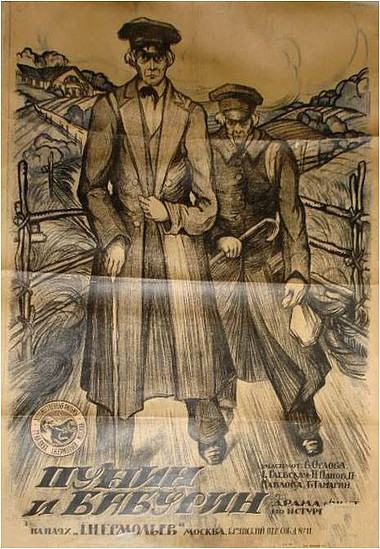
In the annals of pre-revolutionary Russian cinema, few works achieve the atmospheric density and psychological precision found in the 1915 adaptation of Punin i Baburin. This isn't merely a translation of Ivan Turgenev’s prose to the silver screen; it is a profound exploration of the Russian soul at a crossroads, captured through the lens of a medium still discovering its own linguistic potential.
While contemporary Western audiences might be more familiar with the kinetic propaganda of later Soviet montage or the slapstick vigor of Get-Rich-Quick Wallingford, the Russian school of the mid-1910s specialized in a lingering, almost claustrophobic intimacy. Punin i Baburin exemplifies this aesthetic. The film eschews the broad theatricality often associated with early silent cinema, opting instead for a nuanced portrayal of interiority. Boris Tamarin, as the titular Punin, delivers a performance of heartbreaking fragility. His Punin is a man out of time, a relic of a romantic era whose only defense against the harshness of reality is a desperate adherence to the poetic and the ephemeral.
Contrast this with Nikolai Panov’s Baburin. Where Punin is fluid and soft, Baburin is granite. The film masterfully utilizes the physical presence of these two men to illustrate the ideological chasm widening within the Russian intelligentsia. Baburin’s refusal to yield to the whims of the landowning class provides the film with its moral spine. Unlike the more overt social critiques found in Her Bitter Cup, the politics here are personal, woven into the very fabric of the characters' interactions and the shadows that dance across the meticulously designed sets.
The visual language of Punin i Baburin is one of deep focus and deliberate blocking. The director—likely working under the heavy influence of the legendary Yevgeni Bauer—uses the frame to create a sense of inevitable destiny. Characters are frequently positioned in doorways or framed by heavy Victorian drapery, suggesting their entrapment within social hierarchies. This visual sophistication rivals the operatic intensity of Assunta Spina, yet it maintains a distinctly Slavic restraint.
The scene in which the trio is forced to leave the manor is a masterclass in silent storytelling. The camera lingers on the objects left behind—the tangible remnants of a discarded life. This focus on the 'materiality of loss' is a recurring theme. Much like the narrative weight carried by the setting in Obryv, the environment in this film acts as a silent witness to the slow decay of the protagonists' hopes.
Vera Orlova’s portrayal of Musa is perhaps the most modern element of the production. In many films of this era, such as The Antics of Ann, female characters are often relegated to archetypes of innocence or mischief. Orlova, however, imbues Musa with a complex agency. Her journey from a child of the household to the emotional anchor of the exiled men is handled with remarkable subtlety. She represents the bridge between Punin’s nostalgic idealism and Baburin’s rigorous duty. Her performance captures the 'quiet strength' that would become a hallmark of Russian cinematic heroines, a far cry from the more exaggerated distress seen in The Footlights of Fate.
The chemistry between the three leads is palpable, even across a century of celluloid degradation. There is a specific rhythm to their interactions—a cadence of shared glances and heavy silences—that suggests a lifetime of unspoken history. This depth of characterization is what elevates the film above mere melodrama. It is a study in the endurance of human bonds under the pressure of external societal collapse.
When placed alongside international contemporaries, the unique qualities of Punin i Baburin become even more apparent. While American cinema was beginning to lean into the documentary-style realism of America Goes Over or the lighthearted escapism of A Twilight Baby, the Russian industry was perfecting the art of the psychological portrait. There is a somber dignity here that contrasts with the more theatrical adaptations of the time, such as the various takes on Othello. The film doesn't aim for the grand gesture; it aims for the truth of the moment.
Even when compared to European dramas like Hans Faders Ære or the passionate intensity of Maria Rosa, the Russian approach feels more internal, more concerned with the philosophical implications of the narrative. It shares a certain DNA with Her Greatest Love in its exploration of sacrifice, but it replaces the latter's sentimentality with a cold, almost clinical observation of the characters' fates.
One cannot discuss this film without acknowledging the sophisticated use of chiaroscuro. The lighting in Punin i Baburin is not merely functional; it is emotional. In scenes of Punin’s despair, the shadows seem to lengthen and deepen, threatening to swallow his frail form. Conversely, the scenes involving Baburin’s political awakening are often lit with a starker, more egalitarian light. This intentionality in cinematography predates many of the techniques that would later be celebrated in German Expressionism.
The pacing, too, is noteworthy. In an era where many films were rushing toward the next plot point, this production allows its scenes to breathe. It understands that the impact of a character's realization is often found in the seconds *after* the words have been spoken (or, in this case, shown on an intertitle). This patience is a quality shared with The Man Who Found Himself, though applied here to a much more tragic canvas.
While the film is ostensibly a personal drama, it is impossible to ignore the simmering tension of the era in which it was produced. 1915 was a year of immense turmoil for Russia, and the themes of exile and the clash between the old guard and the new thinkers resonate with a prophetic power. Baburin’s exile to Siberia is not just a plot point; it is a reflection of the lived reality for many of the film's viewers. Unlike the comedic social commentary found in Hustling for Health, the stakes in Punin i Baburin are existential.
The film poses a difficult question: what is the value of a 'good man' in a broken system? Punin is 'good' in his kindness and his love of beauty, but he is ultimately useless against the tide of history. Baburin is 'good' in his conviction and his willingness to suffer for his principles, but his rigidity causes pain to those he loves. This moral ambiguity is what keeps the film relevant. It doesn't offer easy answers, much like the challenging narrative of Greater Love Hath No Man.
To watch Punin i Baburin today is to gaze into a mirror of a vanished civilization. The manor houses, the specific etiquette of the peasantry, and the burgeoning radicalism of the cities are all captured with a fidelity that feels almost documentary-like, despite the fictional source material. The film stands as a testament to the sophistication of the pre-revolutionary film industry—an industry that was often more artistically adventurous than the state-controlled cinema that would follow it.
In conclusion, this adaptation of Turgenev is a vital piece of cinematic history. It showcases a mastery of visual storytelling, a deep understanding of human psychology, and a fearless engagement with the social issues of its time. For those seeking to understand the roots of Russian cinematic excellence, Punin i Baburin is an essential, if haunting, experience. It lingers in the mind long after the final frame fades to black, a poetic reminder of the enduring power of the human spirit in the face of inevitable change.
A hauntingly beautiful artifact that bridges the gap between the 19th-century novel and the 20th-century image.
IMDb 5.1
1929
Community
Log in to comment.