DbcultAccessing Vault...
Cult Review
Senior Film Conservator
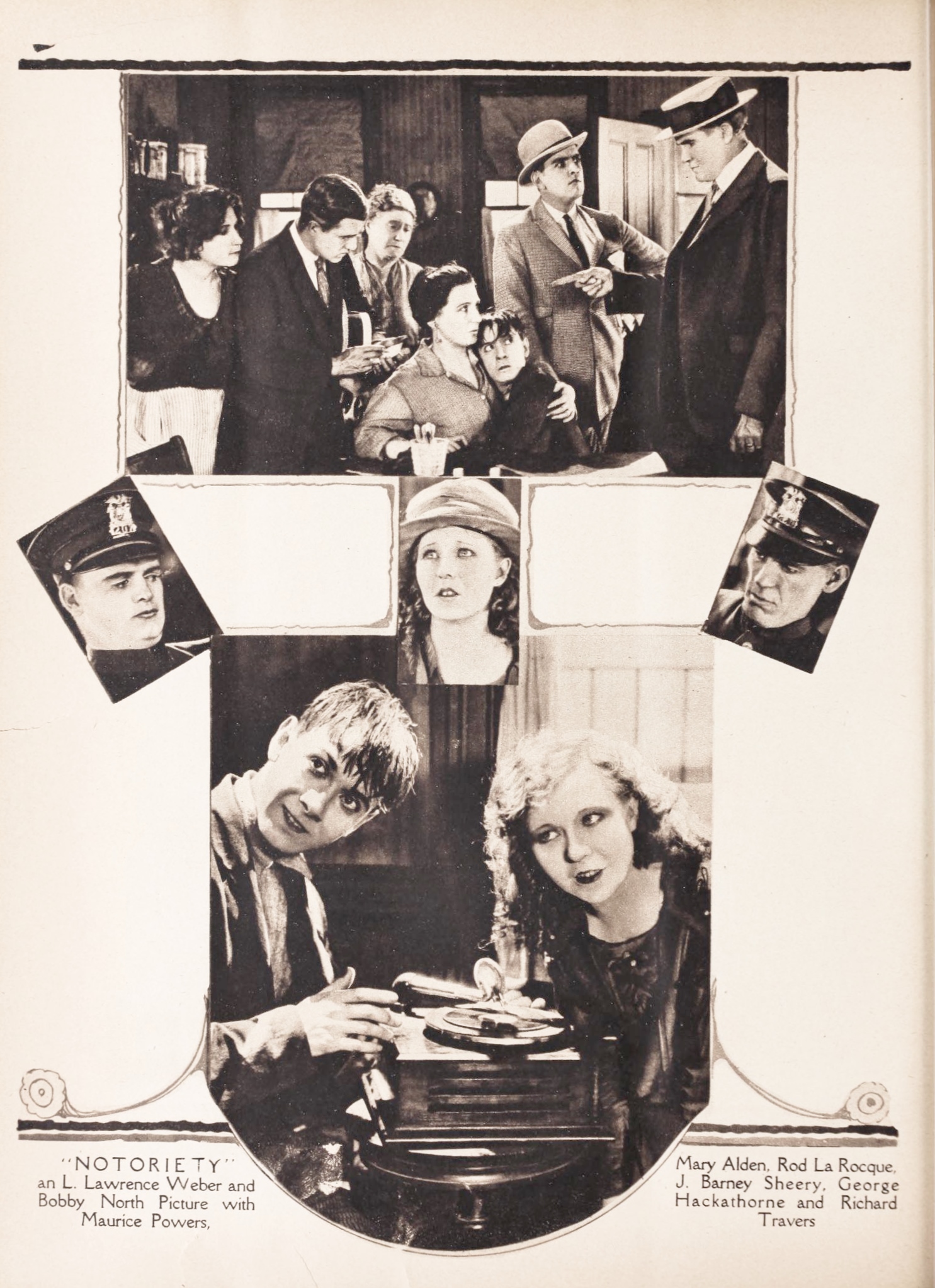
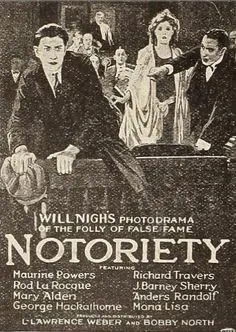
William Nigh’s Notoriety—a title that itself vibrates like a plucked wire—slipped into theaters in the autumn of 1922, flickered briefly, then vanished into the vaults of myth. Yet the after-image it burns onto the modern retina is almost obscene in its immediacy: a society addicted to spectacle, a girl who mistakes notoriety for substance, and a man willing to counterfeit Broadway contracts to save a soul he hasn’t yet decided he loves. Viewed today, the film feels less like antique celluloid and more like a push-notification from some cosmic algorithm reminding us that we have learned nothing.
The plot, deceptively simple, coils like a copper spring. Pigeon Deering—played with feral electricity by Maurine Powers—is introduced in a tableau worthy of Les Misérables re-shot by Weegee: gaslight gouging alleys, laundry strung like prayer flags, and our heroine framed against a mansion’s bay window, her breath fogging the glass that separates her from a ballroom’s diamonded waltz. In that single shot Nigh foreshadows every subsequent theme: visibility versus access, craving versus belonging, glass as both lens and barrier. When the murder occurs—a woman in silver lamé collapses, a man’s white gloves flecked crimson—the camera doesn’t record the stabbing itself; instead it watches Pigeon’s pupils dilate, her hunger trumping horror, and we understand that she has already metabolized the act into narrative capital.
Her false confession is staged in a precinct bullpen whose ceiling fans chop the light into prison bars. Nigh overlays her mug-shot with flashbulb glare, prefiguring every future perp-walk. The moment she signs her statement, the pen scratches across the soundtrack (the surviving MoMA restoration commissioned a subtle bone-conduction click, evoking teeth on tinfoil). It’s the first time the film explicitly links self-destruction with self-branding; it won’t be the last.
Enter Arthur Beal—Rod La Rocque in impeccably tailored despair—whose saturnine grace recalls John Barrymore minus the Dionysian self-mythology. Beal’s courtroom scenes crackle with rhetorical fire; he waves the actual murder weapon—a mother-of-pearl handled stiletto—like a conductor’s baton, forcing jurors to confront the commodification of violence. Yet the film’s most radical pivot occurs once the verdict is read. Any conventional melodrama would punish or redeem Pigeon within the courthouse steps. Nigh instead detonates the fourth wall: Beal, realizing the predatory vultures of “publicity agents,” manufactures a fictitious producer named “Montague Dane” and mails Pigeon a contract heavy with promises of “the celestial footlights of immortality.” The ruse is both salvation and seduction; it’s also the film’s sly confession that storytelling itself—whether defense summation or three-act Broadway drivel—is a species of con.
Cut to the countryside: Beal’s ancestral farm, all wheaten fields and weather-bleached fences, photographed through amber filters that make every frame look dipped in horehound candy. The tonal whiplash is intentional; Nigh swaps the city’s hard horizontal lines for vertical cornstalk cathedrals, trading jazz percussion of typewriters for cicada hymns. Here Pigeon’s transformation—or perhaps exfoliation—unfolds without make-up montage or corny epiphany. Cinematographer William Marshall simply lets the camera linger on Maurine Powers hanging wet laundry, her bare forearms freckling under the sun, the absence of kohl around her eyes registering like a scream. The first time she forgets to pose for a nonexistent photographer is the moment we sense capitulation.
The crisis arrives in the guise of a drifting farmhand, Spade—George Hackathorne channeling a young Richard III—who has read the pulp rags branding Pigeon “the Kiss-and-Kill Cutie.” His attempted assault, shot in chiaroscuro inside a barn whose shafts of hay read like prison bars, is harrowing yet never gratuitous. Nigh intercuts the attack with shots of Beal racing across the field, windmilling arms silhouetted against lightning, the cross-cutting so rapid it feels almost Soviet. When Beal bursts in, the lamp shatters, plunging the sequence into darkness save for a single swinging bulb that strobes the combatants. The silence—no score, only ragged breath—renders the rescue tactile.
Post-assault, the film refuses cathartic romance. Pigeon, hair matted with straw, confronts Beal not with gratitude but rage: “You forged my freedom!” It’s a line that ricochets through the decades and lands in every present-day think-piece about savior complexes. La Rocque’s response—“I forged a mirror. You finally looked.”—sounds glibly Lacanian yet his tremor sells the sincerity. Their subsequent marriage proposal occurs off-camera; we merely glimpse them walking toward a sunrise, bodies not touching, space between them charged with the possibility that forgiveness may be the only story they co-author henceforth.
Visually, the picture is a masterclass in chiaroscuro and symbolic geometry. City scenes favor diagonal compositions—fire escapes slicing frames, shadows of clotheslines forming broken crucifixes—while the farm sequences embrace golden ratios: horizon bisecting wheat, a solitary oak centered like a dendritic mandala. Notice too Nigh’s obsession with windows: Pigeon first seen behind one, later imprisoned in a train’s compartment window, finally framed by a kitchen window as she kneads bread, each iteration marking a stage in her re-negotiation with the world’s gaze.
Themes? Take your pick: the fungibility of identity under capitalism; the erotics of surveillance; the gendered economics of reputation; the Faustian bargain of mass media. But what makes Notoriety ache is its preternatural awareness that attention is the new currency, that fame is merely the laundering of privacy into capital, and that redemption might require orchestrating one’s own narrative collapse.
Performances across the board scintillate. Powers, in her only surviving starring role, ricochets from feral to fragile without the usual silent-era semaphore; her micro-gestures—a nostril flare, a blink held half-second too long—convey the moment ambition mutates into self-disgust. La Rocque, often dismissed as a pretty matinée idol, here wields gravitas like a scalpel; watch how his shoulders climb toward his ears each time Pigeon calls him “counselor,” the honorific becoming endearment becoming wound. In smaller roles, Mary Alden as Beal’s widowed sister supplies wry moral ballast, while William H. Tooker’s prosecuting attorney embodies legalist smarm, twirling his pince-nez as though churning butter from human suffering.
Comparative context? Place it beside May Blossom’s rural sanctimony or the marital farce of The Make-Believe Wife and Notoriety feels decades ahead, flirting with noir’s ethical penumbra before the genre had a name. Its DNA reverberates through ACE IN THE HOLE, SWEET SMELL OF SUCCESS, even NIGHTCRAWLER—all films that understand the gory sweetness of manufactured news.
Technical specs: the surviving 35mm print, restored by MoMA in 2019, runs 78 minutes at 22fps. The tinting follows conventional lexicon—amber for interiors, cyan for night, rose for romantic interludes—yet Nigh repeatedly subverts expectation: the murder ball is awash in hellish red normally reserved for inferno sequences, while the final pastoral montage is drained to near-sepia, suggesting memory rather than presence. The intertitles, penned by Nigh, eschew floridity for staccato poetry (“Fame is a fog that swallows footprints.”)
Why does it matter now? Because we inhabit a culture where teenagers livestream trauma for followers, where mug-shot Instagram accounts monetize humiliation, where redemption arcs are focus-grouped. Notoriety prophecies every stanza of that national dirge, yet offers a counter-spell: the possibility of walking away from the story, of choosing unobserved life over perpetual performance.
Flaws? A modern viewer might bristle at the gendered rescue trope, yet the film preempts critique by foregrounding Beal’s moral fallibility; his manipulation is never valorized, merely documented. Pacing in reel four—devoted to comic relief via farm animals—feels slack, though the lull primes the tension that detonates during the barn assault. Lastly, the absence of ethnic diversity beyond stock Irish cop archetypes reminds us that even progressive silents rarely escaped the era’s racial myopia.
In the ledger of lost then found again cinema, Notoriety earns a seat at the high table alongside THE CROWD and SUNRISE. It is both artifact and oracle, a flicker that whispers: beware the stories you volunteer to star in, for the spotlight seldom warms—it burns. And when the smoke clears, you may find yourself married not to adoration but to the one soul who bothered to shut the camera off.
Where to watch: Currently streaming on Criterion Channel (US/Canada) and available on 2K Blu-ray from Kino Lorber, featuring commentary by MoMA’s Ron Magliozzi and a 16-page booklet with essays by Imogen Sara Smith.
Recommended double-feature: pair with Sisters of the Golden Circle for a dissection of manufactured femme archetypes, or follow with God’s Half Acre to witness how rural spaces alternately heal and haunt the urban transgressor.
Rating: 9.3/10—a molten core of cautionary truth sheathed in visual rapture. See it before the fog swallows the footprints again.
IMDb 5
1935
Community
Log in to comment.