DbcultAccessing Vault...
Cult Review
Senior Film Conservator
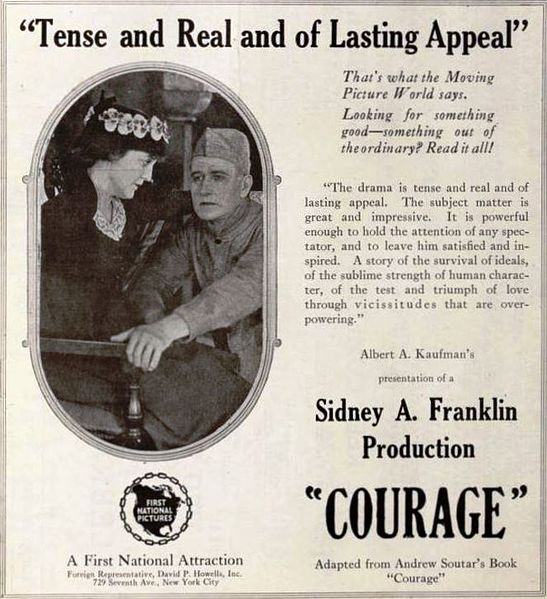
*Courage* (1930) is a film that lingers like the echo of a bagpipe, its haunting melodies of human struggle and moral complexity refusing to fade. Directed with restrained precision, the film unfolds as a dual portrait: one of a man crushed under the weight of false accusations, and another of a woman whose faith in her husband becomes a quiet rebellion against societal indifference.
Ray Howard’s Stephen Blackmoore is introduced as a man on the brink—not of despair, but of creative exhaustion. His invention, a device that promises to revolutionize industrial efficiency, is both his salvation and his curse. The script, co-penned by Andrew Soutar and Sada Cowan, avoids the clichés of the so-called "mad genius" trope, instead grounding Stephen’s struggles in tangible stakes: financial ruin, familial responsibility, and the corrosive weight of unmet expectations. When his former employer, Angus Ferguson, is killed by his own son Bruce during a botched robbery, Stephen’s life fractures under the absurdity of fate. The film’s most chilling moment is not the murder itself, but the bureaucratic machinery of the justice system that swallows Stephen whole.
Gloria Hope’s portrayal of Jean Blackmoore is a masterclass in understated strength. Unlike the archetypal "virtuous wife" of earlier cinema, Jean is neither passive nor melodramatic. Her loyalty is not born of romantic fantasy but of a shared history of labor and sacrifice. As she toils to perfect Stephen’s invention in his absence, Hope infuses the character with a steely determination that avoids hagiography. The film’s most poignant sequences depict Jean navigating a male-dominated world of financiers and engineers, her vulnerability masked by a veneer of pragmatism. Her interactions with the smug, opportunistic suitors (notably Adolphe Menjou’s smarmy cad) are laced with dry wit, underscoring her refusal to be commodified.
The film’s visual language is as unyielding as its themes. The Scottish landscape is rendered in stark chiaroscuro, with the moors and craggy coastlines mirroring Stephen’s psychological descent. A recurring motif of machinery—gears, levers, and the relentless ticking of clocks—serves as a metaphor for the inescapability of fate. When Stephen is imprisoned, the camera lingers on his hands, calloused and ink-stained, as he sketches his invention on scraps of paper. These close-ups are both a testament to his ingenuity and a reminder of the body’s labor under duress.
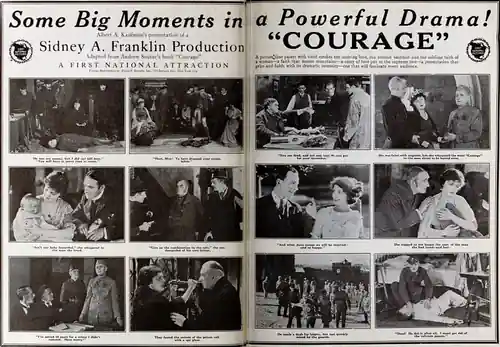
The narrative’s breakneck final act—a confession that upends the entire premise—risks feeling contrived, yet the film salvages its credibility through meticulous foreshadowing. Bruce Ferguson’s initial crime is not merely a red herring but a study in familial dysfunction, his violence a product of inherited resentment and financial desperation. The revelation that Jean’s perseverance is what ultimately secures Stephen’s release is both satisfying and thematically resonant. It positions her not as a passive observer, but as an active agent in the narrative of redemption.
In the pantheon of pre-Code dramas, *Courage* holds its own alongside contemporaries like A Wife on Trial and The Silent Lady, though it distinguishes itself with its focus on technological ambition as a metaphor for human aspiration. The invention at the film’s center—a device that promises to "save time"—becomes a sly commentary on modernity’s promises and pitfalls. Stephen’s invention is never fully explained, a deliberate choice that emphasizes its symbolic weight over technical specifics.
The film’s score, a blend of somber piano and haunting strings, amplifies the tension without overpowering the performances. Notable set pieces include a tense confrontation between Jean and an unscrupulous patent attorney (Sam De Grasse), where the dialogue crackles with subtext. The cinematography, though restrained, employs Dutch angles and deep focus to evoke emotional disorientation during Stephen’s trial scenes, contrasting sharply with the stable, well-composed shots of Jean’s domestic efforts.
The supporting cast, particularly Lionel Belmore as a weary butler and Lloyd Whitlock as a sardonic prison guard, adds texture without overshadowing the leads. Belmore’s character, a silent witness to the family’s unraveling, is a quiet study in suppressed grief. His brief but impactful scenes with Howard are charged with unspoken history, their chemistry hinting at a shared understanding of loss.
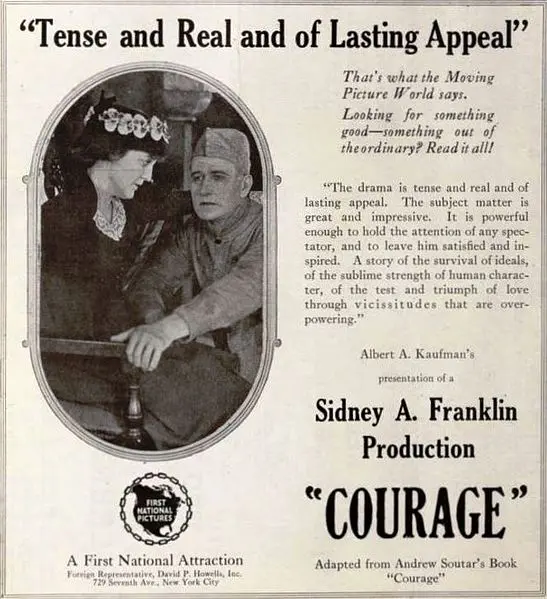
While *Courage* occasionally falls into the traps of its era—stereotypical portrayals of Scottish dialects, a somewhat anodyne resolution—it remains a compelling artifact of early 20th-century cinema. Its exploration of injustice and resilience feels curiously prescient, echoing modern debates about wrongful convictions and the role of technology in shaping human lives. The film’s ending, though bittersweet, avoids saccharine sentimentality. Stephen’s reunion with Jean is not framed as a triumph over adversity, but as a necessary restoration of balance.
For modern viewers, *Courage* offers more than historical curiosity. It is a meditation on the cost of integrity in a world that rewards compromise. Jean’s refusal to abandon her husband, even as society turns against them, is a powerful counterpoint to contemporary narratives that valorize individualism over solidarity. In this sense, the film resonates with the themes explored in The Coquette, though its tone is far graver.
The film’s final moments linger on the invention itself, now operational but no longer the central concern. This subtle shift suggests that the true "invention" is Jean’s unyielding spirit—a force that outlasts machinery, justice systems, and even the bonds of marriage. It is a quietly radical conclusion for a film of its time, and one that rewards careful viewing.
Technically, *Courage* showcases the strengths of 1930s filmmaking without pretension. The editing is brisk but deliberate, the pacing methodical yet never sluggish. The use of negative space in Jean’s scenes—often framed within doorways or windows—visually reinforces her isolation in a patriarchal society. These choices, subtle yet intentional, elevate the film beyond a mere story of "courage" into a nuanced study of human endurance.
In an age where narratives of redemption are often diluted by modernity’s cynicism, *Courage* stands as a testament to the power of quiet, unyielding conviction. Its legacy may not rest in its plot mechanics, but in the emotional truth it captures—the idea that some forms of courage are not grand gestures, but the daily decision to believe in something when the world has stopped believing in you.

IMDb 7.3
1933
Community
Log in to comment.