DbcultAccessing Vault...
6.8/10
Senior Film Conservator
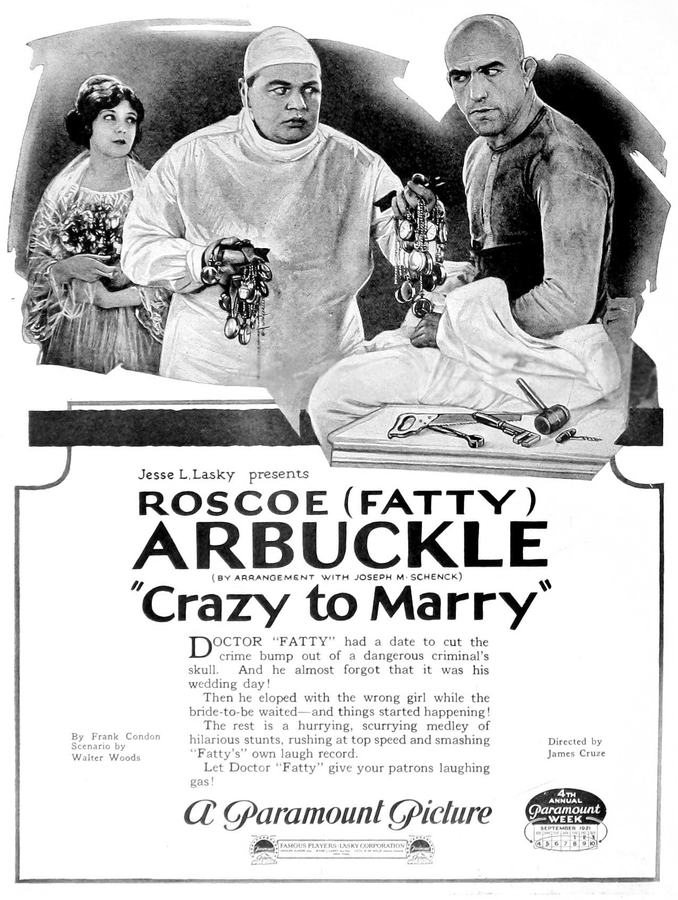
A definitive 6.8/10 rating for a film that redefined the boundaries of cult cinema. Crazy to Marry remains a cornerstone of transgressive art.
In the annals of early cinematic escapism, few films capture the sheer, unadulterated spirit of silent-era farce quite like 1921's Crazy to Marry. This delightful confection, a testament to the period's penchant for intricate plots and rapid-fire comedic timing, whisks audiences into a world where scientific hubris, romantic entanglements, and accidental road trips converge in a crescendo of charming chaos. It's a testament to the ingenuity of filmmakers Frank Condon and Walter Woods that such an outlandish premise could be woven into a narrative so utterly captivating, demonstrating the potent allure of cinema before the advent of synchronized sound.
The film commences with a premise so delightfully absurd it instantly hooks the viewer: Dr. Hobart Hupp, a man whose intellectual ambition seemingly outstrips his practical judgment, believes he can surgically excise the very essence of criminality from an individual. This audacious theory forms the foundation of his work, culminating in an experimental procedure performed upon a character known only as Dago Red. The stakes are profoundly high for Red, who has been promised nothing less than his freedom should the doctor's radical intervention prove successful. This opening gambit immediately distinguishes Crazy to Marry from its contemporaries, injecting a layer of pseudo-scientific intrigue into what swiftly evolves into a romantic comedy of errors. It’s a bold narrative choice, echoing a fascination with progress and human perfectibility that permeated the early 20th century, though here, it's clearly played for laughs rather than earnest scientific inquiry. The ethical implications, while lightly touched upon, serve primarily to propel Red's character into an unexpected role later in the narrative, a clever subversion of audience expectations. This initial setup, with its blend of high-minded aspiration and low-brow execution, provides a robust springboard for the ensuing comedic escapades, setting a tone that is both playful and profoundly whimsical.
Dr. Hobart Hupp, brought to life with a compelling blend of earnestness and oblivious charm by Edwin Stevens, embodies a peculiar strain of early 20th-century scientific optimism – one that often bordered on outright hubris. His conviction in the power of surgery to reform the criminal mind is presented with an almost childlike sincerity, making his character both endearing and inherently ludicrous. Dago Red, the recipient of Hupp’s experimental scalpel, becomes the unwitting canvas for this bold, if ethically questionable, endeavor. The promise of freedom dangles tantalizingly before Red, transforming him from a mere patient into a pivotal player in the unfolding drama. This narrative thread, while serving as a comedic catalyst, also subtly touches upon themes of redemption and societal rehabilitation, albeit through a highly unconventional lens. One might draw a faint parallel to the moral quandaries explored in films like The Prodigal Son, where characters grapple with their pasts and the possibility of a clean slate, though Hupp's method is decidedly more… invasive. The film does not dwell on the scientific plausibility, instead leveraging it as a fantastic premise to unleash a torrent of comedic situations. Red’s eventual role as Hupp’s unexpected savior is a delightful payoff, showcasing the film's commitment to turning conventions on their head. It reminds us that even in the most serious of scientific pursuits, the human element, with all its unpredictability, often dictates the true outcome. The character of Dago Red, despite his initial predicament, emerges as a surprisingly resourceful figure, proving that a 'cure' for criminality might manifest in ways entirely unforeseen by the good doctor.
The film's central comedic engine ignites as Dr. Hupp, oblivious to the emotional tempest brewing around him, sets off for his wedding. His fiancée, the socialite Estrella De Morgan (Lila Lee, radiating a delightful blend of sophistication and secret longing), is, in a classic romantic irony, deeply in love with another man, young Arthur Simmons (Charles Ogle). This clandestine affection forms a delicious counterpoint to Hupp's own unwitting journey into unexpected romance. It’s a familiar trope, certainly, but rendered with a fresh vivacity that prevents it from feeling stale. The brilliance of the screenplay lies in its ability to simultaneously develop multiple romantic subplots, each with its own brand of comedic tension and emotional stakes.
Enter Annabelle Landis (Laura Anson), a character whose spirited independence and charming impetuosity immediately captivate. Her mistaken identification of Hupp as her chauffeur is the catalyst for the film's most expansive and pivotal sequence: a 300-mile road trip that irrevocably alters Hupp’s trajectory. This extended journey is a masterclass in silent film comedy, relying on physical gags, nuanced expressions, and the sheer absurdity of the situation to convey evolving emotions. Hupp, initially exasperated, gradually finds himself drawn to Annabelle’s vivacious spirit, prompting an internal struggle: should he desert his waiting bride for this spontaneous, unforeseen connection? The car ride becomes a metaphor for his own life’s unexpected detours, a journey of self-discovery disguised as a simple drive. It’s during these moments that the film truly shines, allowing the audience to witness the subtle shifts in Hupp’s demeanor, his growing affection for Annabelle, and the nascent realization that his pre-arranged life might not be the one he truly desires. This narrative arc, reminiscent of the whimsical journeys found in films like Bobby's Baby, elevates the story beyond mere slapstick, imbuing it with a genuine romantic heart. The burgeoning chemistry between Stevens and Anson is palpable, transforming a simple misunderstanding into the foundation of a compelling, if unconventional, romance. The road trip is not merely a plot device; it is the crucible in which Hupp's character is forged anew, his prior scientific detachment slowly giving way to a more human, impulsive side. It’s a beautiful illustration of how unforeseen circumstances can utterly reshape one's destiny, a theme that resonates throughout the entire film.
Annabelle’s arrival home brings a swift return to the societal pressures that often defined romantic narratives of the era. Her parents, embodying the rigid expectations of the time, immediately intercept her, demanding she acquiesce to a pre-arranged marriage of their choosing. This familiar trope, where individual desire clashes with familial obligation, provides a compelling counterpoint to Hupp’s own burgeoning freedom from his engagement. It's a situation that would resonate deeply with audiences familiar with the constraints placed upon young women in society, a theme often explored in melodramas like Love's Prisoner or Her Great Hour. However, Crazy to Marry approaches this with a distinctly comedic touch, setting the stage for Annabelle’s spirited defiance rather than her passive acceptance.
It is at this critical juncture that Dago Red, whose earlier surgical 'cure' might have been a source of anxiety, emerges as an unlikely hero. His intervention, orchestrated with a surprising flair for dramatic rescue, is one of the film’s most satisfying narrative turns. Red’s presence, now transformed from patient to accomplice, underscores the film's playful subversion of expectations. He orchestrates an escape, spiriting away Hupp and Annabelle, along with a conveniently available minister, to a secluded island. This act of liberation, facilitated by the very man Hupp sought to 'cure,' adds a layer of delightful irony to the proceedings. The island setting itself becomes a symbolic space of freedom, a haven where societal norms can be temporarily cast aside, allowing for authentic desires to surface. It’s a classic cinematic device, used to great effect to isolate characters and force their true feelings to the forefront. The sudden appearance of the minister, almost as if conjured by the sheer narrative necessity, perfectly encapsulates the film’s commitment to accelerating the comedic momentum, ensuring that the path to matrimony, however convoluted, is always within reach. This sequence brilliantly ties together the seemingly disparate plot threads, demonstrating the interconnectedness of Hupp’s initial experiment and his ultimate romantic destiny.
The secluded island, initially conceived as a sanctuary for Hupp and Annabelle’s burgeoning romance, quickly transforms into a nexus of converging destinies. In a stroke of narrative brilliance, it is here that they stumble upon Estrella, Hupp's jilted fiancée, who has already eloped with her true love, Arthur. This simultaneous revelation of both romantic pairings on the same remote patch of land amplifies the farcical elements to their zenith. The sheer improbability of such a coincidence is precisely what makes it so uproariously funny, a testament to the script’s commitment to escalating absurdity. The island becomes a crucible for all the tangled relationships, forcing a definitive, if chaotic, resolution.
The subsequent arrival of Annabelle’s exasperated parents, hot on the trail of their runaway daughter, adds another layer of comedic tension. Their shock and dismay upon discovering not one, but two impromptu weddings, encapsulates the delightful disarray that defines the film's climax. The parents, who had sought to enforce their will, are confronted with a fait accompli, their plans utterly undone by the whims of fate and youthful rebellion. The final tableau, with Hobart married to Annabelle and Estrella happily united with Arthur, provides a satisfying, if utterly improbable, resolution. It’s a testament to the film's lighthearted spirit that such a convoluted series of events can culminate in such a joyous, albeit unexpected, conclusion for all involved. The film, in its final moments, champions individual happiness over societal expectation, a theme that resonates even today. The chaotic island scene is a masterclass in ensemble comedy, with each character’s reaction contributing to the overall comedic tapestry. It’s a powerful reminder of how silent films, through expert staging and expressive performances, could convey complex emotional and comedic beats without uttering a single word. The film’s ability to orchestrate such a grand, multi-layered climax speaks volumes about the sophisticated narrative craftsmanship prevalent in the silent era, providing a satisfying sense of closure while maintaining its distinctive whimsical tone.
The success of Crazy to Marry hinges significantly on the caliber of its cast, who navigate the intricate comedic choreography with remarkable precision. Edwin Stevens, as Dr. Hobart Hupp, delivers a performance that balances his character's intellectual pretensions with a growing, almost accidental, charm. His physical comedy, often subtle in its initial exasperation and progressively broader in his embrace of the absurd, is a cornerstone of the film’s humor. Lila Lee, as Estrella De Morgan, brings a necessary elegance to her role, but also imbues Estrella with a quiet determination to pursue her true affections, making her character more than just a jilted bride. Her expressive eyes convey volumes, a common necessity in silent cinema, and she perfectly captures the delicate balance between social decorum and personal desire.
Laura Anson's portrayal of Annabelle Landis is particularly noteworthy. She injects Annabelle with an infectious vivacity and independent spirit that makes her an instantly likable and compelling figure. Her spontaneous nature is the perfect foil to Hupp's initial rigidity, and their evolving chemistry is a joy to behold. The film also features the inimitable Roscoe 'Fatty' Arbuckle in a role, though not central, that adds a layer of historical intrigue. Arbuckle, a comedic titan of his era, brings his characteristic physical prowess and nuanced facial expressions, even in a supporting capacity. His presence alone speaks to the film's standing within the comedic landscape of the early 1920s, a period marked by his significant, albeit controversial, influence. The ensemble cast, including Clarence Burton as Dago Red and Charles Ogle as Arthur Simmons, works in perfect synchronicity, each actor understanding the precise comedic timing and exaggerated gestures required for silent film acting. Their performances are a masterclass in conveying emotion and intent without dialogue, relying instead on finely tuned expressions, body language, and the artful use of intertitles.
The direction and cinematography, while perhaps not groundbreaking for the era, are highly effective in maintaining the film's brisk pace and clear narrative. The use of varied camera angles, particularly during the road trip and the chaotic island scenes, helps to amplify the comedic effect and keep the audience engaged. The intertitles are concise and witty, serving not only to advance the plot but also to punctuate the humor, often delivering punchlines with perfect timing. This careful balance of visual storytelling and textual guidance is a hallmark of successful silent filmmaking, and Crazy to Marry exemplifies this art form with considerable skill. The film’s ability to create such a vivid and engaging world without spoken words is a powerful reminder of the unique strengths of silent cinema, a medium that demanded a different kind of audience engagement and artistic expression. It's a delightful example of how narrative complexity could be achieved through purely visual means, a testament to the creative ingenuity of the time. The film showcases how subtle glances, exaggerated movements, and well-placed comedic beats could convey a narrative with as much, if not more, impact than a dialogue-heavy production.
Beyond its undeniable comedic value, Crazy to Marry subtly explores several enduring themes that resonate even with contemporary audiences. At its core, the film is a vibrant meditation on the nature of choice and destiny, contrasting the rigidity of societal expectations with the unpredictable currents of personal desire. Dr. Hupp’s journey, from a man committed to a pre-arranged life and a dubious scientific theory to one swept away by spontaneous affection, is a powerful affirmation of individual agency. Annabelle’s defiance of her parents’ wishes, and Estrella’s clandestine elopement, further underscore this theme, celebrating the pursuit of genuine happiness over dutiful compliance. This emphasis on individual freedom and authentic connection gives the film a timeless quality, preventing it from feeling merely like a period piece. It's a narrative that champions the heart's true compass, even when it leads one down the most improbable of paths. The film also playfully critiques scientific hubris, gently satirizing the belief that complex human conditions can be reduced to a simple surgical fix. This satirical edge, while never heavy-handed, adds a layer of intellectual depth to the film's otherwise lighthearted narrative. One might even draw a comparison to the subtle social commentary found in films like Money Magic, where societal pressures and individual aspirations often collide with surprising results.
The film also showcases the enduring appeal of mistaken identity and accidental romance, tropes that have captivated audiences for centuries and continue to be staples of romantic comedies. The 300-mile road trip, born of a simple misunderstanding, becomes the catalyst for a profound personal transformation, proving that sometimes the greatest discoveries are made when one is utterly lost. This narrative device allows for a natural, organic development of romantic feelings, making Hupp and Annabelle’s eventual union feel earned despite its chaotic origins. The sheer joy and inventiveness of the physical comedy, coupled with the expressive performances, ensure that the film remains engaging and entertaining. It's a testament to the power of visual storytelling that such complex emotions and intricate plot points can be conveyed so effectively without a single spoken word. The film’s ability to balance its comedic elements with genuine character development and thematic resonance is a hallmark of its quality. It speaks to a universal human experience of navigating life's unexpected turns, finding love where least expected, and ultimately, choosing one's own path despite external pressures. The movie offers a delightful glimpse into the comedic sensibilities of the early 20th century, proving that laughter is indeed a timeless language, capable of transcending eras and technological advancements. Its narrative inventiveness and charming execution make it a film well worth revisiting for anyone interested in the rich history of cinema and the enduring power of a good, madcap story.
In conclusion, Crazy to Marry stands as a vibrant and thoroughly entertaining example of silent-era comedy. Its audacious plot, engaging characters, and expertly executed physical humor combine to create a cinematic experience that is both historically significant and remarkably enjoyable. From Dr. Hupp’s misguided scientific endeavors to the chaotic, yet ultimately blissful, resolution on a secluded island, the film is a masterclass in comedic storytelling. It reminds us of the ingenuity and charm of early cinema, where elaborate narratives were spun through expressive performances and clever staging, long before the advent of dialogue. For enthusiasts of classic film, or anyone seeking a delightful escape into a world of whimsical absurdity, Crazy to Marry is an absolute must-see, a testament to the enduring power of laughter and love in the most unexpected of circumstances. Its intricate plot, though initially driven by a fantastical scientific premise, quickly blossoms into a multifaceted romantic comedy, showcasing the various forms love can take and the lengths to which individuals will go to find their true match. The film’s ability to weave together multiple character arcs into a cohesive and satisfying whole is a testament to its strong screenplay and dynamic direction. It captures a moment in time when cinema was still defining its language, and in doing so, created a work that continues to charm and entertain audiences almost a century later. The film’s legacy lies not just in its humor, but in its ability to tell a compelling human story through the unique artistry of the silent screen. It’s a delightful journey into a bygone era of filmmaking, offering a fresh perspective on timeless themes of love, freedom, and the delightful chaos of life itself. Its distinct blend of scientific folly, romantic misadventure, and farcical resolution ensures its place as a memorable entry in the canon of silent cinema, a true gem that continues to sparkle with wit and charm.
IMDb 6.9
1930
Community
Log in to comment.