DbcultAccessing Vault...
Cult Review
Senior Film Conservator
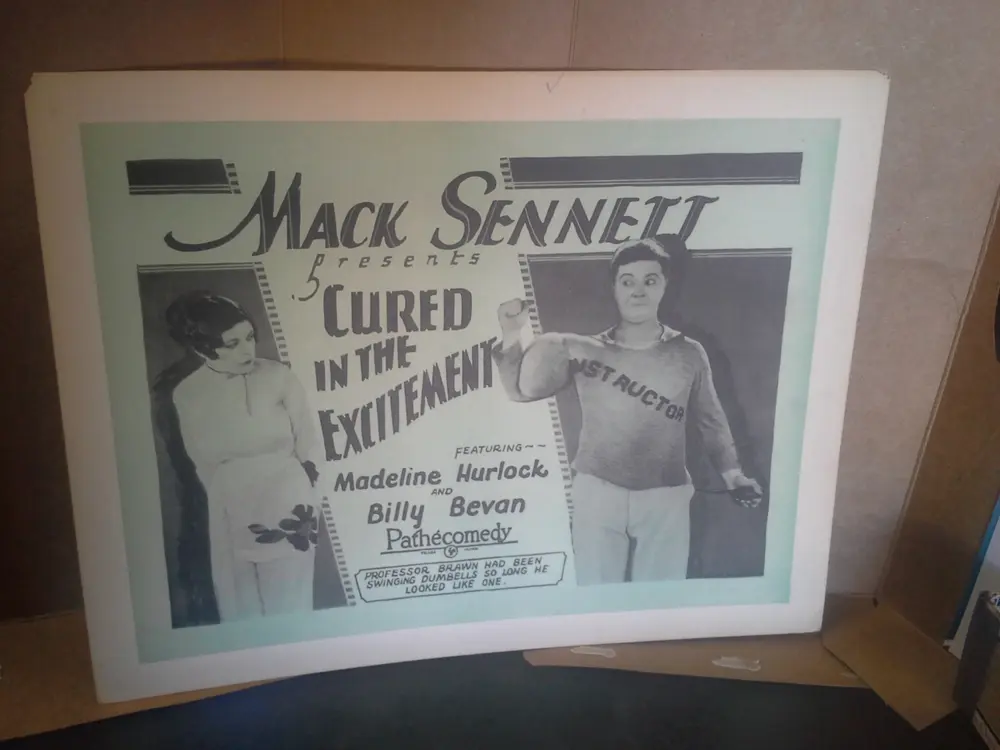
Is this film worth watching today? Short answer: yes, but only if you approach it as a frantic time capsule of 1920s energy rather than a cohesive narrative. This film is for silent comedy enthusiasts and historians who want to see the Mack Sennett factory at its most efficient; it is NOT for those who require emotional depth or a plot that makes a lick of sense.
This short is a relic of an era where cinema was less about 'storytelling' and more about the raw, kinetic power of the human body in motion. It works. But it’s flawed. It captures a specific moment in the evolution of humor, right before the talkies arrived to slow everything down with dialogue. In Cured in the Excitement, the silence is deafeningly loud with the sound of breaking props and falling bodies.
1) This film works because the physical timing between Vernon Dent and Billy Bevan is surgically precise.
2) This film fails because the narrative logic evaporates the moment the first prop is broken, leaving the audience breathless but occasionally confused.
3) You should watch it if you value the evolution of physical comedy and want to see how the 'Sennett style' influenced everything from Looney Tunes to Jackie Chan.
To answer the question directly: yes, for the craft alone. While many silent films of the era, such as The Awakening, were leaning into the burgeoning language of dramatic close-ups and psychological depth, Cured in the Excitement remains unashamedly low-brow. It is a film that understands its purpose: to make you laugh through the sheer audacity of its stunts.
If you have seen The Lion and the Souse, you know the rhythm of a Sennett short. It’s a rhythmic bombardment. The gag isn't just the punchline; it's the setup, the double-take, and the inevitable fallout. In this film, the medical setting provides a fertile ground for 'treatments' that look more like torture, and the cast handles the abuse with a grace that modern actors would struggle to replicate without a stunt double and a heavy insurance policy.
The pairing of Vernon Dent and Billy Bevan is the film's secret weapon. Dent, with his more grounded and often exasperated presence, provides the perfect foil for Bevan’s surrealist energy. Bevan’s mustache alone deserves its own billing—it twitches with a comedic timing that seems to precede his actual facial expressions. In one specific scene involving a chaotic examination, Bevan’s ability to move his entire body in a state of 'controlled falling' is a masterclass in physical control.
Contrast this with the more somber tones found in contemporary features like Souls Enchained. While the latter deals with the weight of the human spirit, Cured in the Excitement is obsessed with the weight of the human body hitting the floor. It is a visceral, rather than intellectual, experience. The comedy is derived from the subversion of expectation—you expect a cure, you get a catastrophe.
The direction here—credited to the collective brain trust of writers like David Weissman and Carl Harbaugh—is invisible in the best way possible. The camera is rarely the star; it is a static observer of the madness. This is a sharp contrast to the urban experimentation seen in The City (1926), where the camera itself became a character through movement and editing. Here, the frame is a stage, and the actors are the athletes.
The pacing is relentless. There is a specific moment halfway through the film where a minor misunderstanding escalates into a full-scale riot. The way the editors (likely working under Sennett’s direct supervision) cut between the reaction shots of Thelma Hill and the escalating destruction is a precursor to the modern action movie. It’s about building pressure until the only possible resolution is an explosion of movement.
With five credited writers, one might expect a 'too many cooks' situation. However, in the 1920s, this usually meant a 'gag room' where ideas were thrown at the wall until the funniest ones stuck. The influence of Al Giebler and George Jeske is evident in the film's darker, more cynical edges. The comedy isn't 'nice.' It’s mean-spirited in that classic, harmless way where no one actually gets hurt despite falling off a building.
The film shares a certain DNA with Kids and Kidlets in its use of ensemble chaos. It’s not just about the lead; it’s about how every person in the frame—from Madeline Hurlock to Stanley Blystone—contributes to the atmosphere of impending doom. It’s a collective effort of absurdity.
While the film lacks the high-contrast artistry of Wild Primrose or the atmospheric dread of The Grip of Evil, its cinematography is functional and bright. The lighting is flat, designed to ensure that every single movement is visible. In slapstick, shadows are the enemy. You need to see the foot slipping on the floor; you need to see the precise moment the hand misses the handle.
There is a brutal simplicity to the visual storytelling. In one sequence, the camera tracks a chase through a series of interconnected rooms. The geometry of the set is used to create a 'loop' effect, making the pursuit feel infinite. It’s a technique that would later be perfected in cartoons, but seeing it done with live actors and physical sets is a reminder of the sheer labor that went into these 'throwaway' shorts.
To truly appreciate Cured in the Excitement, one must look at what else was happening in 1927. While films like Chickie were exploring the social lives of modern women, and international films like Die Claudi vom Geiserhof or Nuit de carnaval were pushing the boundaries of European aestheticism, Sennett was sticking to his guns. He knew that a man falling into a tub of water was a universal language.
Even when compared to other shorts like Wanted: A Baby or the more adventurous Desert Driven, this film stands out for its purity of purpose. It doesn't want to be a drama. It doesn't want to be a romance. It just wants to be a riot. There is something admirable about that level of focus, even if the result is a bit shallow.
One surprising element is the underlying anxiety about technology and modern medicine. The 'machines' used in the film are terrifying contraptions of gears and belts. In a way, Cured in the Excitement is a proto-critique of the industrialization of the human body. We laugh because the machine is malfunctioning, but the underlying fear is that the machine is in charge. It’s a subtle layer that elevates the film slightly above its peers like A Haunted Heiress.
Cured in the Excitement is a loud, messy, and brilliant example of late-silent-era slapstick. It doesn't have the poetic soul of a Keaton film or the heart of a Chaplin feature, but it has more energy in its twenty minutes than most modern comedies have in two hours. It is a film built on the sweat and bruises of its performers. While it may not be a 'masterpiece' in the traditional sense, it is an essential piece of the puzzle for anyone trying to understand why we find the spectacle of failure so inherently funny. Watch it for Bevan, stay for the chaos, and ignore the lack of a coherent ending. It’s a wild ride that proves, sometimes, the best cure for boredom is a little bit of controlled excitement.

IMDb 6.3
1930
Community
Log in to comment.