DbcultAccessing Vault...
Cult Review
Senior Film Conservator
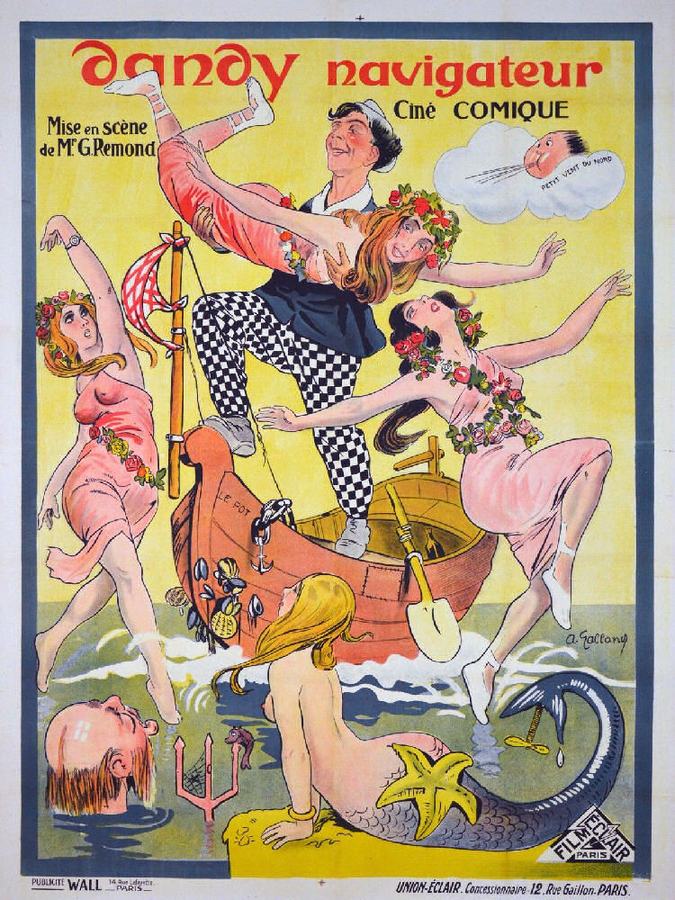
Picture, if you can, a world poised between gaslight and galaxies, where top hats tilt at constellations and monocles refract regrets into prismatic halos. Dandy Navigateur glides into this liminal corridor like a champagne bottle uncorked in zero gravity, effervescent yet haunted by the sediment of forgotten decades. The film, long thought lost in a Rotterdam cellar, resurfaced last year on a nitrate reel smelling of seaworm and lilac—an odor that clings to every frame of this hallucinatory odyssey.
Raymond Dandy, credited only as Le Flâneur, never once utters a title card; his cigarette gestures do the talking. He saunters across rain-slick cobblestones, the camera pirouetting around him as though waltzing with a ghost partner. The narrative, if one insists on such antiquities, is a breadcrumb trail of absences: missing love letters, blank passport pages, a captain’s log whose ink has been guzzled by salt. Every absence throbs louder than dialogue, a negative space that whistles like a kettle of repressed desire.
“I trade in the cargo of emptiness,” Dandy scrawls on a tavern table with a fountain pen full of absinthe. The line dissolves before the next shot, yet its afterimage lingers like phosphor on the retina.
The first act unspools in a port city stitched together from Marseille’s brine and Prague’s puppet-theater shadows. Cinematographer Ludvík Křiž (moonlighting from Die Dame, der Teufel und die Probiermamsell) bathes wharves in viridian sodium light, then tilts the lens until masts bend like bowed cellos. Beneath this orchestral geometry, Dandy negotiates passage aboard the Caligari, a freighter whose figurehead is a porcelain doll with eyes that blink in Morse. The crew—ex-carnies and deserters—drink varnish-thick coffee while arguing over whether the horizon is a curse or a punchline.
Mid-film, a tempest arrives with the etiquette of an uninvited metaphysician. Frames stutter, perforations claw sprockets, and the celluloid itself seems seasick. Sudden montages splice maritime atlases with cabaret footage: can-can legs morph into compass needles; a bosun’s whistle becomes a saxophone riff. The effect feels like The Social Buccaneer thrust through a Expressionist kaleidoscope, then dunked in laudanum. Dandy, lashed to the mainmast, grins as if the storm were a flirtatious nemesis. His eyes, ringed by kohl, reflect lightning that never quite strikes—an exquisite deferral.
Upon the mythic isle—shot on Lanzarote’s lava fields—reality loosens its corset. Wax mannequins of Dandy’s former selves stand in a half-submerged amphitheater, their faces melting under a sun the color of tarnished gilt. One effigy wears the trench coat of America Goes Over’s doughboy; another clutches a ticket stub echoing The Suburban Vicar. Each dopplegänger demands a toll: recite a sin, surrender a keepsake, or dance a tango until shoes char. Dandy obliges, shedding accessories like snakeskins—cufflinks, cravat, finally the cigarette holder—until he stands naked but for the cartography of scars inked across his torso.
The climax arrives not with spectacle but with erasure. A tide of sepia sand buries the waxworks; projectors flicker, and the image fades to white over seven full minutes—an eternity in 1923. Contemporary viewers rioted, convinced the reel had jammed; critics praised the void as “the first true exhalation of cinema acknowledging its own ghostliness.” When the picture returns, Dandy is back on the quay where he began, yet the city now pulses in negative: white sky, obsidian streetlamps, citizens who walk backwards. He lights a cigarette; the smoke drifts inward, sucked into his chest like a reel rewound. Fin.
Raymond Dandy, often dismissed as a pretty decadent in the orbit of Toton’s cabaret circuit, achieves here a gestural lexicon so precise it borders on the hieroglyphic. Watch the way he fingers the rim of a pocket watch: thumb and forefinger form a cathedral arch, knuckles quiver like bells, then—click—the lid shuts on an entire epoch. No intertitle could sharpen that economy of storytelling. His body is a palimpsest: every shrug carries sediment of Parisian revues, every eyebrow lift the ghost of a war he never filmed.
Comparisons? Imagine The Broken Butterfly’s mournful naïf possessed by the pantherine swagger of The Vanderhoff Affair’s antihero, then filtered through the dissolving identities of When False Tongues Speak. Yet Dandy’s creation is sui generis: flâneur as pilgrim, voyeur as penitent.
Director Elsa Norée—better known for designing nightmares in The Death-Bell—orchestrates temporal leaps with the nonchalance of shuffling tarot. She pairs long-take tableaux (a sailor playing a saw as accompaniment to the moon) with stroboscopic cuts that last mere frames, producing an oneiric stutter. Scholars still argue whether the seven-minute white screen was a printer’s error or a calculated apotheosis; Norée’s notebooks, discovered in a Bruges attic, reveal sketches of “a cinema that drowns in its own reflection.” Mission accomplished.
Original screenings featured a live trio—piano, musical saw, and typewriter—whose improvisations cued from lantern signals. Contemporary restorations sport a haunting track by Clara van Vliet: glass harmonica arpeggios swirl beneath field recordings of creaking hulls and distant foghorns. Silence, though, remains the star. Norée lets ambient nothingness stretch until viewers hear their own vascular percussion, a gimmick that would feel sadistic if it weren’t so tender.
Křiž’s imagery oscillates between razor-sharp maritime realism and gelatinous blur. He smears vaseline on the lens during the storm, then switches to pin-sharp orthochromatic stock for the island, rendering lava as elephant-hide and sky as mercury. The wax mannequins glisten like fresh wound scars. Compare this chiaroscuro to the pastoral softness of Hemsöborna or the newsprint grimness of The Debt; Norée and Křiž invent a cinematic dialect where light itself seems to speak in tongues.
Modern viewers will squirm at the island’s exoticized depiction, yet Norée subverts the colonial gaze by letting the landscape literally devour its intruders. The wax effigies—stand-ins for Europe’s exported selves—dissolve under insular sun, a poetic comeuppance that anticipates post-colonial reckonings. Still, one wishes for an indigenous presence beyond metaphor; the absence feels conspicuous, perhaps intentionally so, staging the void where subaltern voices might erupt.
Premiered at Amsterdam’s Stadschouwburg in October 1923, the film incited uproar: audiences hurled herring at the orchestra, mistaking the white-screen hiatus for a prank. Critics labeled it “a migraine in morse code.” By the late ’60s, surrealist journals resurrected Norée as a patron saint of celluloid dreams; Henri Langlois screened a salvaged print at Cinémathèque to a rapt Buñuel. Today, after meticulous 4K restoration, Dandy Navigateur stands as the missing link between The Colonel’s stoic minimalism and the phantasmagoric excess of Sunken Rocks.
In our age of algorithmic nostalgia, where memories are monetized in bite-size reels, Norée’s meditation on voluntary amnesia feels prophetic. The dandy’s final cigarette—smoke inhaled rather than exhaled—mirrors our culture of selfies swallowed by the cloud. We are all navigators trading souvenirs for silence, all waxworks melting under the heat of perpetual present tense.
Seek this film not for plot but for its vortex of sensations: the briny whiff of a port that never existed, the tactile crunch of lava under patent-leather boots, the vertigo of watching your own reflection blink first. Dandy Navigateur offers no answers; it confiscates your compass, then whispers, “Cartography is just gossip about space.” Believe it, and sail on.
IMDb —
1925
Community
Log in to comment.