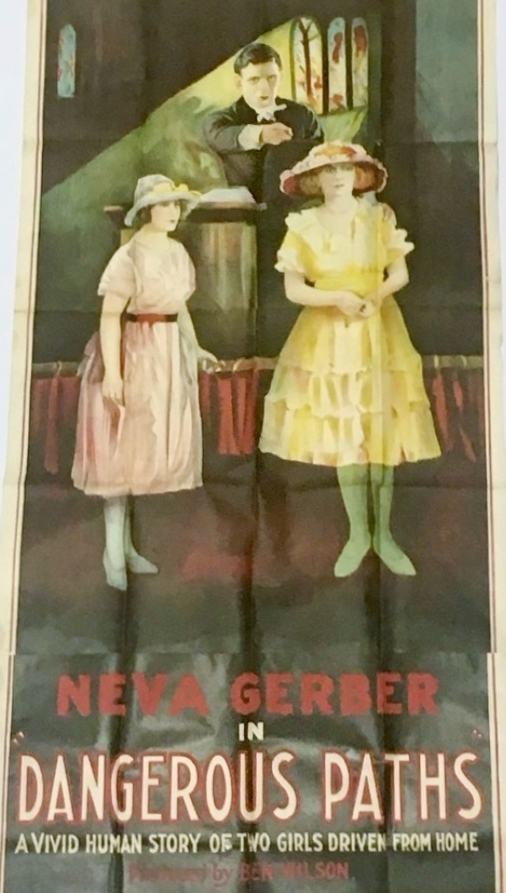
The first image Joseph W. Girard gives us is a silhouette of Ruth—Neva Gerber’s profile cut like obsidian against a livid dusk—hoisting a carpet-bag so small it might contain only her name. That bag, swinging like a pendulum, is the entire twentieth-century womanhood in miniature: property, portability, peril. One cut later, we are inside the Hammond farmhouse where Helen Gilmore’s stepmother orchestrates a betrothal with the glee of a butcher weighing lamb. The camera, stationary yet merciless, lets the candlelight carve trenches of greed on her face; every flicker is a contract signed in bloodless ink.
Newton as Predatory Capital
Henry Van Sickle’s Silas Newton never enters a room—he manifests, top-hat first, like a black pillar of entitlement. Girard refuses him the courtesy of a close-up until minute thirty-two, a delay that renders his eventual intrusion grotesque. When that lens finally lunges forward, Newton’s grin is revealed as a currency counting device: teeth like minted coins, eyes that appraise Ruth’s hips as acreage. The film’s most chilling flourish arrives when he spreads slander through the village: intertitles morph into handwritten whispers, the letters jittering like spider legs across the screen, a visual rumor that contaminates even the negative space.
City versus Country: A Dialectic of Light
Girard’s mise-en-scène weaponizes illumination. The countryside is swathed in over-exposed noon, a whiteness that erases shadows and therefore choices; the city, by contrast, drips with tungsten pools and cigarette-stained murk where a woman might vanish or re-invent. Note the hotel corridor where Ruth ejects Newton: the wallpaper’s damask pattern, shot in low angle, resembles bars of a jail turned sideways—freedom as merely another orientation of prison. Violet Benson, in cloche hat and eyes lacquered with defiance, becomes the urban Charon, ferrying Ruth across the river of electric signage that spells ROOMS in letters tall as commandments.
Pastor Emerson’s Sermon: A Detonation of Morality
Ben F. Wilson’s cleric is no frail pacifist. When he ascends the pulpit, Girard cuts to an extreme low-angle—Emerson looms like a granite wave about to crash upon the congregation. The intertitle card, famously scorched at the edges (a visual effect achieved by literally flashing the negative), reads: “He who brands a woman’s name has already sold his soul at the cheapest market.” The camera pans across faces flickering between shame and arousal; one expects the church rafters to combust under the weight of exposed guilt. In that moment Dangerous Paths transcends melodrama and enters the realm of civic sermon, a precursor to Dreyer’s Day of Wrath minus the pyre.
Performances: The Flesh beneath the Archetype
Neva Gerber’s Ruth is no wilted lily; her tremulous lower lip might suggest fragility until you notice how often her hands—knuckles white—grip the edges of tables as if to rip reality open. Watch her in the hotel eviction scene: she twists the door-handle so violently the metal seems to scream, a sonic impression achieved without synchronized sound. Edith Stayart’s Violet provides the film’s jazz heartbeat, sauntering through frames with the kinetic sass of a Josephine Baker understudy, yet her final glance at Ruth carries a bruised tenderness that complicates any easy sororal solidarity.
Visual Lexicon: Shadows, Bags, and Windows
Girard repeats three visual leitmotifs: the carpet-bag (freedom as luggage), the window (surveillance or escape), and the shadow that detaches from its owner like a moral reprimand. When Newton is finally expelled, his silhouette remains on the hotel wallpaper for two frames—a ghost of entitlement even absence cannot erase. The stepmother’s redemption, filmed in a single dusk shot, shows her opening the farmhouse door; light spills outward forming a diagonal that bisects the screen, a secular annunciation suggesting forgiveness is merely a re-angled threshold.
Feminist Cartography
In 1923 women gained the vote yet lost bodily autonomy in the backrooms of courthouse clubs; Dangerous Paths charts that contradiction. Ruth’s journey is not from hearth to heart but from chattel to citizen. The film’s refusal to punish her for fleeing, and its vilification of the male creditor class, places it alongside The Traitress and Kitty Kelly, M.D. as proto-feminist salvos. Yet Girard complicates: Violet’s city-girl autonomy is undercut by economic reliance on male patrons, reminding us liberation is a staircase, not a door.
Comparative Echoes
Where Fighting Fate externalizes destiny through boxing rings, Dangerous Paths interiorizes it as social inscription on female skin. The Golem’s clay terror shares DNA with Newton’s mineral gaze—both are constructs of masculine hubris. Meanwhile the pastoral scandal of The Talk of the Town feels genteel compared to Girard’s septic rumor-mill; here gossip is not chatter but acid rain that rots barns and backbones alike.
Cinematic Austerity and Its Rewards
Shot on a budget that wouldn’t cover the corset allowance of a DeMille epic, the film embraces parsimony as ethos. Sets are recycled from Cupid the Cowpuncher, re-dressed with shawls of darkness; day-for-night cinematography is achieved by under-cranking and filtering the lens with coffee. Resultantly, the image bears a grainy volatility, as though each frame were developed in river-mud, giving the melodrama a documentary sear.
Sound of Silence: Music as Second Screenplay
Surviving prints contain no original cue sheets, yet contemporary exhibitors reported using “ragtime fugues” for city scenes and muted organ for the village, a sonic dialectic matching the visual chiaroscuro. Modern festivals often commission scores that overstate; resist them. The film demands a single piano, its sustain pedal nailed halfway so chords bloom then decay like reputations.
Restoration and Availability
A 4K restoration by Eye Filmmuseum in 2021 salvaged a Dutch distribution print; the tinting—amber for interiors, cyan for exteriors—has been digitally approximated. Stream on Criterion Channel or purchase via Kino’s dangerous-paths Blu-ray which includes a commentary track dissecting the rumor intertitles. Bootlegs on video-sharing sites suffer from PAL speed-up and excise the sermon scene; avoid.
Verdict: A Lantern in the Fog
Dangerous Paths is less a relic than a warning flare. Its narrative of a woman rewriting her coordinates without male cartography feels contemporaneous with #MeToo testimonies. Girard, criminally unheralded, anticipates the feminist westerns of the seventies and the social thrillers of the nineties. See it for the performances that pirouette on the knife-edge between archetype and artery; see it again for the realization that the path, dangerous then, remains only partially paved today.