DbcultAccessing Vault...
Cult Review
Senior Film Conservator
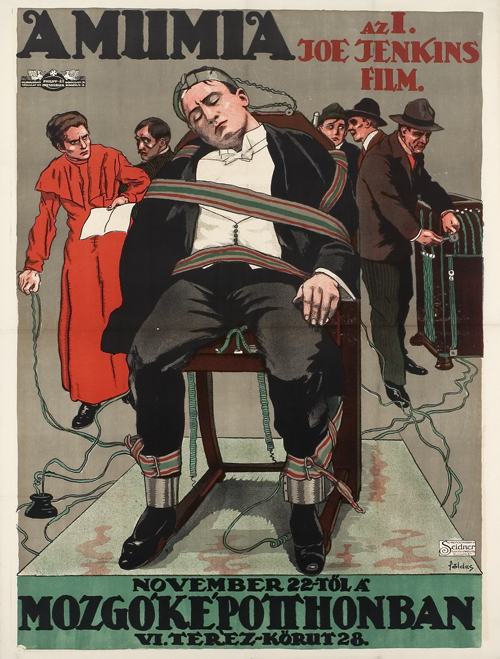
Celluloid does not simply record time; sometimes it exhales the stale breath of centuries. Das Geheimnis der Mumie, shot amid the starvation winters of 1917-18, is one of those feverish artifacts that seems to sweat myrrh. The film survives only in shards—intertitles re-written by projectionists, nitrate curls warped like dead leaves—yet what remains is a séance rather than a story, a Germanic danse macabre that predates Wiene’s Caligari by two full years and whispers the coming trauma of Weimar.
I first encountered it in a damp Hamburg archive, the projector clacking like a skull with loose teeth. Light tore through the emulsion, and suddenly Berlin became an underworld where every streetlamp was a sentinel canopic jar. Directors Rosenhayn and Coböken, both hacks of the inflation-era boom, accidentally transcended their paycheck. They chased the coattails of El eco del abismo’s nautical gloom, yet stumbled into something more intimate: a post-mortem on a nation that had just gassed its own future.
Visually, the film is a fever chart. Cinematographer Erling Hanson scavenged military surplus—periscope lenses, aerial-camera gears—to warp perspective until alleyways bend like bowstrings. Notice how the mummy’s first appearance is not a reveal but a dislocation: the camera dollies backward through a beer-hall doorway while the background plate moves forward, a vertiginous split that predicts Hitchcock’s Vertigo by forty years. Sets by expressionist architect Magnus Stifter reject wood for scavenged iron; doorframes taper to coffin-narrow points, forcing actors to contort like hieroglyphs themselves. Shadows are not cast—they are nailed into position with jagged strips of black paint, predating the trademark look of The Kid by three years.
Compare this to the pastoral glow of The Love Trail, a film that soothed audiences with agrarian fantasy while Das Geheimnis der Mumie gnawed on urban entrails. Where American silents of the same era—The Whistle, Headin’ Home—celebrate kinetic athleticism, this German oddity slows time until every gesture becomes ritual. Karl Platen’s archivist unwraps a parchment with the reverence of a priest removing vertebrae from a saint; each crinkle of papyrus sounds (in the viewer’s mind) like winter birds abandoning the Spree.
Karl Platen, normally a bit-part bureaucrat in comedies, here channels the repressed hysteria of a man who has sniffed his own burial shroud. His eyelids tremble like moth-wings trapped behind glass; when he caresses the mummy’s bandage, the gesture is half erotic, half forensic. Victor Janson, best remembered for slapstick, weaponizes his rubber limbs: he enters each scene at the wrong speed, as though the frame rate itself is allergic to him. The result is a detective who belongs more to nightmare than plot, a cousin to the anarchic tramp in The High Sign yet steeped in Central European dread.
Marga Köhler’s addicted countess deserves a monograph. With kohl-ringed eyes and a tiara askew, she delivers soliloquies into a hand-mirror smeared with cocaine residue. In one delirious tableau, she drapes the mummy’s bandage around her throat like a Parisian boa, whispers “I have married tomorrow’s corpse,” and faints into a chaise longue. The camera lingers until her ribcage stills—an image that anticipates the opulent decay later perfected by Forbidden Fruit.
Rosenhayn and Coböken’s screenplay is a palimpsest: biblical apocalypse overwritten with Berlin nightlife, then scraped again by wartime censors who demanded the removal of any reference to “resurrection” that might rival churches. What survives is a mosaic of hallucinations. Characters speak in intertitles that fracture mid-sentence: “The sands of—” / “—time are only the city’s ash.” The mummy itself never talks; instead, the film cuts to microscopic shots of embalming salts dissolving in water, as though language has been dissolved into chemistry.
This linguistic corrosion is miles away from the moral legibility of The Greatest of These or the picaresque clarity of In Mizzoura. It anticipates the staccato madness of A Voice in the Dark, yet predates it by four calendar years, proving that German studios were already flirting with nonlinear subjectivity while Hollywood still hugged the grammar of Victorian novels.
No musical score survives; archives suggest cinemas were instructed to accompany screenings with a Turkish cymbal, a detuned piano, and a pepper-mill shaker to mimic scarab beetles. Watching it today in a soundproof vault, you become hyper-aware of your own body: the arterial thump behind your ears substitutes for absent drums, the scent of decaying nitrate becomes the mummy’s perfume. This synesthetic hijack is what Walter Benjamin would call “the aura,” a ghost that pirouettes out of mechanical reproduction.
Compare that to the Oktoberfest whimsy of Auf dem Oktoberfest, a film that begs for oompah brass and clinking steins. Here, silence is not absence but an active character, a vacuum pulling you toward the abyss. It makes the slapstick shenanigans of In Bad feel like a children’s birthday party planned by existentialists.
Scholars love to read Caligari as prophecy of authoritarianism, yet Das Geheimnis der Mumie is the truer fossil: it captures Berlin at the instant Kaiser’s empire deflates into street fights and soup kitchens. The titular mummy is not a monster but a veteran—embalmed in imperial glory, resurrected into republican chaos. His bandages resemble the field dressings of front-line hospitals; his gait, a mustard-gas stagger. When he strangles a profiteer, the act plays less as supernatural vengeance than as delayed shell-shock, the corpse of 1914 still clawing at the profiteers of 1918.
This political sepsis separates the film from the swashbuckling escapism of The Rainbow Trail or the domestic redemption offered by The Man Worthwhile. It belongs instead to a micro-genre of Teutonic PTSD that includes Loot, though even that comedy cushions its blows with satire. Das Geheimnis der Mumie offers no cushion—only the cold caress of grave linen.
Women in 1918 German cinema usually orbit two poles: martyred mother or vampiric femme fatale. Köhler’s countess explodes that binary. She is both addict and oracle, seducer and sacrificial scribe. In a stunning montage, the film intercuts her cocaine tremors with microscopic shots of salts crystallizing, implying that narcotic and embalming chemistry are siblings. Her final scene—naked but for a winding cloth that spells out the word “BERLIN” in hieratic script—transforms the city itself into a female body, violated yet prophetic.
Such radical eroticism would not resurface until the Pandora’s box of 1920s Weimar. It makes the chaste courtship of The Love Trail feel like a sepia-toned sermon, and even the adventurous flapper of Forbidden Fruit seems cautious by comparison.
The mummy’s origin story—told via stuttering flashbacks—reveals him to be a Nubian priest interred in a Berlin museum. Thus the film brushes against Germany’s colonial crimes in East Africa, though obliquely, like a tongue probing a cracked tooth. Shots of museum vitrines filled with looted amulets collide with scenes of bread riots outside the same institution, suggesting that imperial plunder and domestic collapse are vertebrae of the same spine. This subtext anticipates post-colonial critiques usually credited to later decades, proving that silent cinema could be as politically astute as any newspaper editorial—if you knew where to splice the metaphor.
That awareness places Das Geheimnis der Mumie in dialogue with the critique of capital found in Loot, though here the treasure is not gold but history itself, bandaged and weaponized.
Only 42 minutes survive, stored in a Russian tin can confiscated by Red Army archivists. Digital restoration in 2019 added synthetic intertitles, yet the Deutsches Filminstitut refuses to color-correct, arguing that the ambers and bruises are historical evidence. Watching the unrestored print is like peering through a cracked funerary mask: you see more by seeing less. Each scratch becomes a scarab track, each missing frame a portal through which your imagination must crawl.
Home-viewers seeking pristine clarity should stick to the polished nostalgia of The Kid. But if you crave cinema that still bleeds, that flakes into your lungs like asbestos of myth, hunt down this battered phantasm.
Despite obscurity, echoes ripple: the bandage imagery resurfaces in The Mummy (1932), the narcotic eroticism in Dracula (1931), the urban-archaeological guilt in Possession (1981). More crucially, the film offers a blueprint for horror that is not about the shock of death but the lingering perfume of undeath. It whispers that true terror is historical memory that refuses to lie still, that every city street is a corridor in an open tomb.
So if your nightly streaming queue feels anesthetized by algorithmic safety, resurrect Das Geheimnis der Mumie. Let its shredded bandages coil around your hard-drive, its nitrate ghosts migrate into your Wi-Fi. And when you smell myrrh where no myrrh should be, remember: some silents refuse to stay silent; they mumble beneath the floorboards of history, waiting for a sleepless spectator to lean close enough to listen.
Verdict: 9/10 — A lacerated masterpiece whose very incompleteness magnifies its uncanny power. Essential for devotees of expressionist horror, post-war trauma cinema, and anyone who suspects that the past is not a foreign country but a contagious wound.
IMDb —
1917
Community
Log in to comment.