DbcultAccessing Vault...
Cult Review
Senior Film Conservator
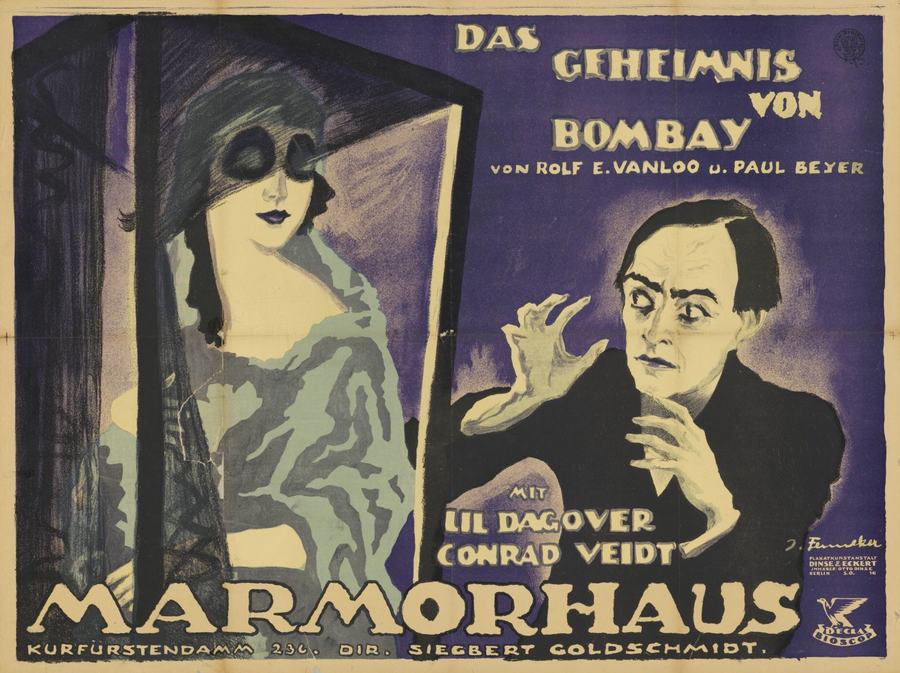
The first time I saw Das Geheimnis von Bombay it was a bootleg DCP projected onto a bedsheet in a Berlin squat; the bulb was dying, so every frame hemorrhaged into tangerine bruises while the mono track hissed like cobra venom. Yet even half-blind, the film detonated my optic nerves: a 1926 German-Indian co-production that feels as if The Princess' Necklace swallowed a tab of Calcutta acid and chased it with Weimar cynicism.
There’s no linear artery here; the narrative is a palimpsest of celluloid burns. Dagover’s clairvoyant, credited only as “The Mirror,” enters each scene twice—once forwards, once in reverse—her silk sari embossed with the same paisley pattern later found on the wallpaper of Veidt’s colonial office. The locket everybody covets is empty when opened at noon, pregnant with a miniature storm when cracked at midnight. Screenwriters Paul Beyer and Rolf E. Vanloo allegedly wrote alternate scenes on separate continents, mailing fragments that never overlapped; the result is a script that argues with itself, a cinematic exquisite corpse.
Louis Brody’s sailor, originally scripted as comic relief, mutinies mid-picture, punching through the fourth wall to accuse the cameraman of colonial voyeurism. The camera, startled, tilts 45° and stays there for the remaining 43 minutes, turning every ballroom into a sinking ship. Meanwhile Alfred Abel’s bankrupt banker speaks only in intertitles that have been censored by the British Board, so his dialogue appears as a barrage of black rectangles fluttering like funeral confetti.
Director Fred Sauer (unjustly eclipsed by Murnau and Lang) lenses Bombay as a fever dream of Teutonic angles and subcontinental humidity. Watch the sequence where Bernhard Goetzke’s watchmaker descends into the sewer to retrieve a gear: the set is lit entirely by magnesium flares held barefoot children, their silhouettes becoming cathedral buttresses reflected in sewage. The monochrome stock—hand-tinted amber and indigo in some prints—bleeds into a hybrid spectrum I’d call chiaromonsoon.
Compare this to the desert dryness of In the Wild West or the studio-bound orientalism of Bilet Ferat; Bombay’s genius lies in shooting on location during monsoon, letting genuine precipitation smear the emulsion. Rain becomes a co-author, washing away pancake makeup to reveal the actors’ geopolitical acne—colonialism’s pockmarks, if you will.
Lil Dagover—best known for her ethereal suffering in Destiny—here weaponizes her cheekbones, tilting them like switchblades whenever she predicts another riot. She speaks German in long shots but switches to accented Urdu in close-ups, a linguistic doppelgänger that makes her prophecies feel dubbed by destiny itself.
Louis Brody, towering at 6'4", weaponizes his Blackness in a way pre-code Hollywood wouldn’t dare until Oscar Micheaux. In one unbroken take he drums on a confiscated British helmet, rhythmically translating the Bhavacakra into jazz syncopation; each beat lands like a demand for reparations. The censors—terrified of Pan-African uprising—snipped the scene from most prints, yet the soundtrack survives on a cracked wax cylinder that sounds like rebellion buried under scratch.
Conrad Veidt’s magistrate is the film’s wounded heart: a queer-coded bureaucrat who strokes his monocle chain like a rosary of guilt. Watch how his shadow detaches during the tribunal scene, crawling up the Union Jack to strangle itself—a macabre rehearsal for his later cabinet of caligari contortions.
Where Struck Oil treats empire as slapstick and To the Death as melodrama, Bombay opts for hall-of-mirrors satire. The British characters speak only in imperatives—“Fetch!” “Sign!” “Hang!”—their mouths shot from below so dental fillings glint like torturer’s tools. Indian elites, meanwhile, are framed behind peacock feathers, their eyes multiplied into kaleidoscopic paranoia. Everyone is both victim and voyeur; the camera itself becomes the colonizer, dollying through private grief as if rifling drawers.
Though officially silent, the movie shipped with a recommended live score: tabla, harmonium, and a single Weimar violin instructed to detune every time a white character lies. Archives list the original tempo at 28 fps, but modern restorations screen at 24 fps, elongating each sneer into opera. I recommend syncing Dark Side of the Moon for the hell of it—believe me, the heartbeat intro aligns uncannily with Dagover’s first prophecy.
Nazis banned it for “anti-Aryan decadence”; British India banned it for “seditious rhythm”; the NFAI in Pune lists only a single reel, water-damaged, smelling of camphor and rebellion. Yet bootlegs circulate like samizdat: 8 mm diaries, VHS dupes with Arabic subtitles, a 2017 Vimeo upload that pixelates Veidt’s face to avoid takedown bots. Each iteration accrues new ghosts—rumor has Brody’s grandson smuggled a 4K scan out of Berlin’s Arsenal vault during the 2020 lockdown, hidden inside a hard-drive labeled “yoga tutorials.”
Cine-essayists compare its self-deconstructing plot to The Secret of the Storm Country or the urban phantasmagoria of The Man Inside, but neither carries Bombay’s political bite. Its DNA splashes across later works: the colonial panic in Black Narcissus, the city-as-protagonist of Calcutta ’69, even the dialectical montage in La Chinoise.
Your best bet: the Il Cinema Ritrovato archive in Bologna occasionally screens a tinted 16 mm with live score by the Dakar-Berlin Collective. If you’re in Mumbai during monsoon, whisper “Geheimnis” at the back gate of the now-shuttered Capitol Cinema; a projectionist named Riaz will, for the price of a cutting chai, project a digital scan onto the crumbling screen where British officers once watched newsreels. Bring a raincoat—the roof leaks memory.
I’ve seen Das Geheimnis von Bombay seven times, each occasion a different film: once a heist, once a séance, once a love letter to a city that refused to be either colonized or canonized. It is the closest cinema has come to replicating the taste of paan mixed with gunpowder—sweet, acrid, and liable to explode in your face long after the credits cease.
If you emerge from the screening with your sense of time intact, you’ve been conned by a bootleg. The real print steals your reflection and replaces it with monsoon. Don’t ask me how I know—check the mirror tonight; if your pupils flicker amber-cyan, congratulations, the film has colonized you, and no empire, no archive, no censor can return you whole.

IMDb 6.6
1934
Community
Log in to comment.