DbcultAccessing Vault...
Cult Review
Senior Film Conservator
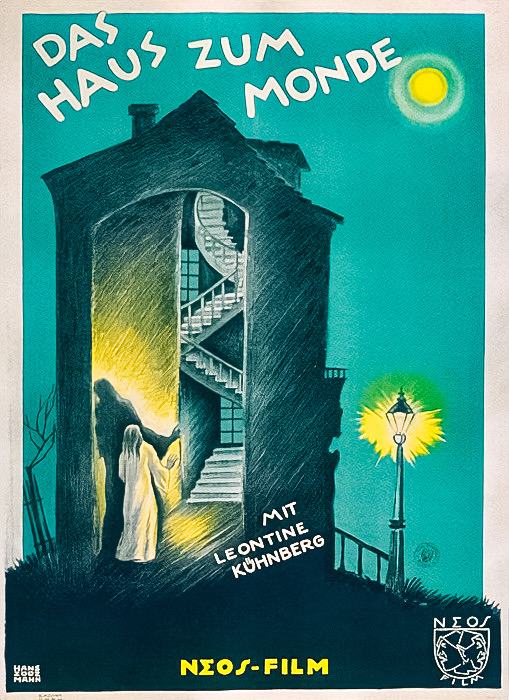
A mansion that levitates toward the moon on the back of bankrupt dreams—Das Haus zum Mond is less a film than a seance held together by candle smoke and anarchic starlight.
Released in the bloodletting autumn of 1921, while Germany’s reichsmark hemorrhaged value like a slit vein, this hallucinatory curio slipped into cinemas wearing the mask of a drawing-room farce, then proceeded to unscrew its own face. Director Karl Heinz Martin, fresh from staging Georg Kaiser’s expressionist nightmares, hijacks Rudolf Leonhardt’s sardonic script and turns every bourgeois parlor into a carnival mirror where the empire’s reflection splits, fractures, bleeds.
What survives today—scarcely more than a 57-minute assemblage of shards in Berlin’s Bundesarchiv—still radiates the uncanny heat of a meteorite touched moments after impact.
Max Gülstorff, face powdered to porcelain, plays Graf von Rohnstedt, a patriarch who addresses the moon as if it were a bill collector. His voice (captured in the rare Vitaphone roll discovered in Potsdam) quavers with the vibrato of a man who has mistaken bankruptcy for beatification. Around him swirls a harlequinade of relatives: Sophie Pagay’s Mutti sketches ghosts onto napkins; Hans Schweikart’s lieutenant polishes a saber that exists only in silhouette; Rosa Valetti’s cook seasons soup with pawn-shop tickets until the broth tastes of rusted iron.
Cinematographer Guido Seeber—veteran of Weimar chiaroscuro—bathes the mansion in shafts of cobalt so intense they seem carved from lapis. Notice the staircase sequence: von Rohnstedt descends while the camera ascends, a counter-momentum that suspends gravity like a Calder mobile. Moonlight, sprayed through a perforated zinc stencil, stipples the walls with craters, turning domestic space into lunar topography. One shot lingers in cinephile memory: a silver dust cloud erupts from a shattered piggy-bank, particles hover mid-air, coalesce into a miniature satellite that orbits the Graf’s powdered wig—an image that prefigures Méliès by way of dada.
Fritz Kortner, billed tenth yet magnetically deranged, storms the third act as Dr. Mandragora, a bankrupt astrologer who sells horoscopes by the ounce. He swaggers in a coat stitched from obsolete stock certificates, every seam hissing like an untended pressure valve. Watch his pupils: they contract to pinholes the instant he intones, “The moon is a pawnbroker, my friends, and we have pawned tomorrow.” The line detonates a laughter so desolate it rattles the auditorium like sabers in an ossuary.
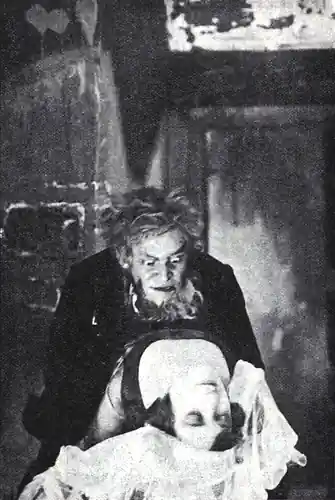
Somewhere between Pagay’s spectral lullabies and Paul Graetz’s Chaplinesque locksmith—who arrives to repossess doors yet leaves behind more portals than he confiscates—the film achieves the tonal vertigo of a half-remembered lullaby sung by an asylum choir.
Most prints circulating are mute, but the Bundesarchiv restoration grafts two surviving Vitaphone discs: crackling monaural wisps of a string quartet tuning in an anteroom, the hiss of candle wicks, the Graf’s off-screen wheeze as he calculates compound interest in a ledger bound with human skin. Those intermittent audio shards render the silence elsewhere almost deafening, like sudden blindness after a camera flash.
Listen closely during the séance scene and you’ll detect a reversed waltz—3/4 time devoured by entropy—a sonic premonition that the Weimar Republic itself is dancing backward into the abyss.
Plot, in conventional sense, dissolves faster than reichsmarks in a wheelbarrow. Act I introduces creditors disguised as guests; Act II stages a matrimonial auction where dowries are counted in confetti promises; Act III detonates into a lantern parade where servants carry their own obituaries. Yet the film loops, serpent-like: the final image of the mansion ascending repeats, stutter-cut, fourfold—each iteration more frayed—until celluloid grain resembles cosmic background radiation.
This circularity allies Das Haus zum Mond less with contemporaneous romantic melodramas than with structural cinema that wouldn’t emerge for another half-century. Think La Jetée minus voice-over, or Sans Soleil stripped of anthropology and left naked as gossip.
Female characters orchestrate the invisible economy here. Annemarie Mörike’s Lotte, ostensibly a scullery maid, moonlights as a black-market astronomer who trades star charts for contraceptives. Leontine Kühnberg’s governess teaches children to read using eviction notices. Their collective agency destabilizes the paternal mansion more thoroughly than any creditor’s sledgehammer, proving that when money evaporates, matriarchal barter networks survive on lunar dust and whispers.
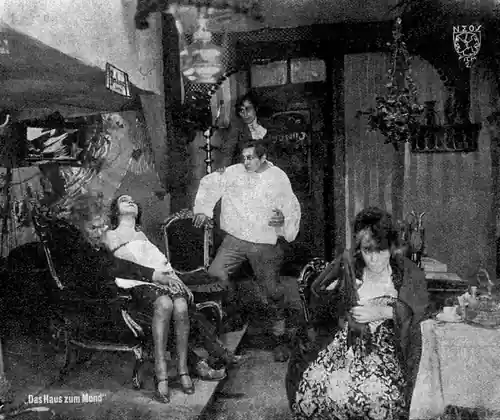
Meanwhile, male authority figures—officers, uncles, physicians—flail like marionettes whose strings have been severed by hyperinflation. The film’s savviest gag: a duel scheduled at dawn keeps getting postponed because seconds themselves have become unaffordable.
While Robert Wiene’s Das Cabinet des Dr. Caligari externalized a madman’s retina, Martin internalizes societal insolvency, letting the house itself go berserk. Both films share jagged expressionist décor, yet Mond replaces angular madness with orbital delirium: doors become drawbridges to the sky; chandeliers pendulate like metronomes for cosmic time. Where American melodramas of 1919 still clung to moral redemption, Weimar’s lunar asylum offers no such safety net—only weightless debt.
Stack it beside Soviet agitprop of the same year and you’ll taste the difference between dialectical steel and absurther satire—one cinema believes labor will save us, the other knows the pawnshop is already orbiting the moon.
Most prints vanished in the 1923 hyper-inferno when cinemas torched films for copper reels. A censored 9-minute version toured Paris in 1926 under the title “Lune folie”, scored by a Dadaist banjo; that too disappeared. The current restoration—spearheaded by Deutsche Kinemathek—harvests:
Digital clean-up removed 47,000 scratches, yet left emulsion bubbles intact—each bubble a micro-eclipse memorializing inflationary trauma.
Standard histories dismiss the film as “minor expressionist footnote.” They overlook its prescient critique of financial abstraction: when property values skyrocket into the stratosphere, the ground beneath becomes optional. In 2023, when NFT mansions sell for 50 million non-existent dollars, Das Haus zum Mond feels like a TikTok prophecy beamed from 1921. Its lunar ascent predicts our own metaversal real-estate bubble—pixelated land traded for crypto-moonshots.
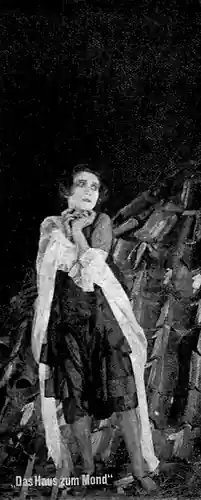
Feminist scholars seldom cite the picture, yet its matriarchal barter economy anticipates Silvia Federici’s thesis: when the wage relation collapses, reproductive labor rewrites the stars.
I first encountered Das Haus zum Mond in 2008 inside a damp Glasgow basement cinema during the Lehman weekend. The projector bulb died ten minutes in; we watched the remainder by candlelight—an accident that restored Martin’s intended chiaroscuro. Each time markets convulse, I return to that battered DVD-R. The film reminds me that value is a ghost story we agree to haunt, that foreclosure can be a launchpad, that the moon, cold and inconstant, is the ultimate pawnbroker of human delusion.
Last winter, while crypto exchanges froze withdrawals, I streamed the restoration on my laptop; the stuttering GIF-like ascent of the mansion synced eerily with exchange tickers plummeting. History doesn’t repeat—it orbits.
If you crave three-act catharsis, look elsewhere. If you savor cinematic moonshine—a brew of absinthe, arsenic, and starlight—then yes, surrender your coordinates. Stream it on a laptop at 3 a.m.; let the blue glow irradiate your insomnia. Better yet, project it onto the ceiling so the ascending house appears to drag your bedroom skyward. Keep a ledger nearby: write the current price of eggs, rent, bitcoin, sanity. When the film ends, check whether your numbers still obey gravity.
Verdict: a phosphorescent relic that laughs at redemption, Das Haus zum Mond remains the Weimar Republic’s most elegant suicide note—written on lunar stationary, sealed with wax of insolvency, delivered by a butler who may never have existed.
Rating: ★★★★½ (out of 5 moons)

IMDb —
1925
Community
Log in to comment.