DbcultAccessing Vault...
Cult Review
Senior Film Conservator
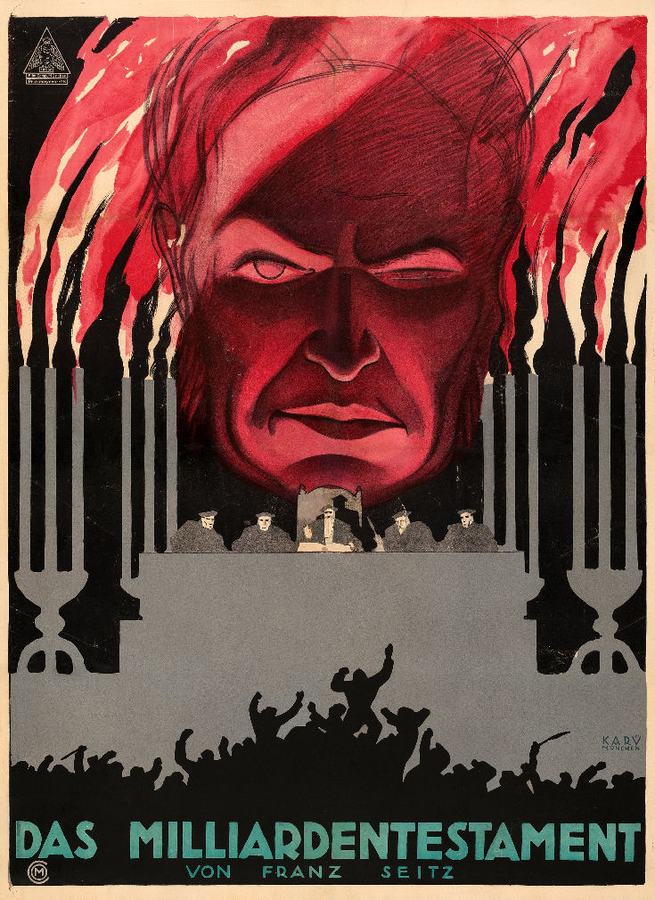
Berlin, winter 1920. Hyperinflation is still a rumor, yet the air already reeks of scorched paper money. Into this twilight Franz Seitz drops a film that behaves like a fever dream searching for a host.
Das Milliardentestament is not a story you follow but a contagion you contract. From the first iris-in on a candle whose wax drips like slow confession, the movie announces its mission: to prove that capital is merely history’s most baroque form of suicide.
Steinrück’s Baron von Krieger—part Krupp, part Mephistopheles—never appears without a death-watch beetle crawling somewhere in frame, a living memento mori stitched into the celluloid. His testament is read inside a ballroom so cavernous that the lawyer’s voice fractures into echo, each clause ricocheting like a bullet in a foundry. The heirs listen while standing on a mosaic of Europa being trampled by bulls; the camera tilts down until their polished shoes swim in the eyes of the continent. Nothing subtle here, but subtlety died with the Kaiser.
Ernst Rückert’s poet, Ferdinand, sports a different decadent badge every scene: a cocaine-sprinkled carnation, a monocle painted with a tiny nude, gloves stitched from theater tickets. When he commandeers a failing vaudeville house, the backstage montage could teach Eisenstein a lesson: intercuts of lion paws, chorus-girl fractures, and paper money shoveled into furnaces while a brass band plays the funeral march backwards. The celluloid itself seems scratched with bradawls, as if the film were trying to escape its own sprocket holes.
Carla Ferra’s Contessa—actually a bankrupted tailor’s daughter who married up and then sideways—gets the most visually delirious arc. She hires an entire luxury liner, paints it ivory, then orders the crew to sail toward the Baltic ice shelf while passengers reenact the last supper nightly with fresh lobster and morphine-laced Tokay. In one hypnotic shot, the camera descends through thirteen decks, each one a layer of Dante redesigned by a department-store window dresser: foxtrotting skeletons, confessional booths rigged with ticker tape, children’s nurseries where porcelain dolls smoke cigars. The voyage ends when the ship is deliberately locked between ice plates; the crew abandons the film itself, leaving the lens to stare at empty deck chairs creaking like jawbones. The scene is never resolved—an exquisite corpse bobbing in the viewer’s memory.
What saves the picture from mere decadence is its form, which mirrors the very inflation it satirizes. Titles explode mid-sentence, letters ballooning until they blot out the actors; double exposures stack so thick that faces become palimpsests—one can count the freckles on a cheekbone while reading the next scene’s dialogue in the same frame. The camera pivots on its axis like a drunk cartographer remapping Berlin each second; walls slide open revealing nightclubs inside mausoleums, tramlines that terminate in bedrooms. You don’t watch Das Milliardentestament—you surrender your vestibular sense to it.
Compare it to The Soul of Satan, another 1920 exercise in moral vertigo. That film moralizes; its debauchery is punished by divine arson. Seitz’s film, however, refuses redemption. When the year expires and the heirs fail to bankrupt themselves—money breeding nightmares faster than they can spend it—the will simply recalibrates: the fortune doubles, the clock resets, the carousel whirls again. There is no last-reel repentance, only the smirk of capital as perpetual motion.
Albert Steinrück, bulldog of German silent cinema, plays the Baron as a man already embalmed while breathing. His cheeks sink so deeply that candlelight pools inside them like sacramental wine; each smirk is accompanied by the faint grind of gravel, as if his teeth were grinding diamonds into futures. Watch how he caresses a mahogany desk not for texture but to confirm wood still submits to flesh. The performance is silent, yet you hear the rust of empire flaking off his palm.
Ernst Rückert contrasts him with a body that seems to have misplaced its skeleton—he flops across divans, wrists limp as wilted asparagus, yet the eyes retain a marksman’s focus. In a bravura close-up, Ferdinand learns that his playboy memoir has become a best-seller. The actor lets a tremor start at the outer canthus and ripple inward until the pupil dilates like a bullet wound. Triumph, in this universe, is merely terror wearing a louder costume.
Carla Ferra’s Contessa never screams; instead her nostrils flare so wide one expects bats to emerge. When she finally loses her fortune to a rigged baccarat game, Seitz holds on her face for twenty-two seconds—an eternity in 1920 montage time. No title card intrudes. The actress lets a smile bloom so slowly it feels like watching a photograph develop in reverse; the curve of lip becomes an indictment of every viewer who ever envied wealth.
Production designers Hans Jacoby and Toni Stapenhorne built sets taller than Ufa administration itself. The Krieger ballroom required twelve railway sleepers for support; chandeliers were strung from crane cables so they could descend like spiders during revelry. Notice the wallpaper in the poet’s rented palace: a repeating pattern of falling stock certificates. As night progresses, the pattern seems to move—actually a shadow play using projectors hidden behind paneling. No CGI, no optical printers, just ingenuity sweating kerosene.
Exterior shots smuggle documentary value. Seitz filmed on Potsdamer Platz during genuine currency protests; you can spot real veterans missing jaws and arms, their stumps painted by Expressionist makeup so they resemble living woodcuts. The director bribed them not with marks but with hot potatoes, creating a macabre economy that mirrors the plot. These ghosts of the Great War drift through fiction like unpaid extras in history’s own bad movie.
Editor Anni von Löwenstein cuts like someone being chased by creditors. Average shot length hovers near 2.8 seconds—frenetic even by Soviet standards. Yet each burst is legible: a porcelain hand, a champagne cork, a roulette ball—then a smash-cut to porcelain shattered, champagne mixing with blood, roulette wheel replaced by a monocle cracked into spiderwebs. The strategy anticipates the coming decade’s advertising grammar, but here it serves a dirge. Capital demands velocity; editing obeys.
Listen to the intertitles, written by Seitz himself. They arrive in multiple languages—German, French, stock-ticker shorthand—sometimes upside-down or backwards, forcing the viewer to somersault the brain. One card, flashed for only four frames, reads: "Geld ist ein Schwert ohne Griff." Money is a sword with no hilt. Blink and you miss the wound.
Though silent, the movie premiered with a live score by Edmund Meisel, who later composed for Potemkin. Meisel’s orchestra included cash registers, typewriter drums, and a section of whips cracked against zinc sheets. Contemporary diaries describe audiences vomiting from the dissonance—exactly the response Seitz wanted. Modern restorations use a reconstructed score; if you stream the recent 4K, play it loud enough to rattle your router. The film’s DNA is noise.
The film’s women transact in skin and secrets, yet Seitz refuses to victimize them. Lili Dominici’s character, a stenographer turned courtesan turned stockbroker, ends the picture richer than any heir—her final costume a tailored suit with shoulder pads sharp enough to slice cigars. She addresses the camera directly, breaking the fourth wall ninety years before it became fashionable, and warns: "Ihr spielt mit euren Söhnen, ich spiele mit euren Vätern." You play with your sons; I play with your fathers. The iris closes on her laughter, not the men’s despair.
Where Anna Karenina of the same year aestheticizes despair through snow and samovars, Das Milliardentestament weaponizes gold leaf. Both end in suicide, yet Seitz denies the romanticism of rails or revolvers; his characters survive their own deaths, cursed to keep losing the same million like Sisyphus in a tuxedo.
Stack it against The Sunny South, a film that also toys with cyclical misfortune. That narrative restores order through matrimony. Seitz spits on order; his closing shot is a reprise of the first, implying capitalism reboots faster than any projector shutter.
For decades the movie was presumed lost, a casualty of nitrate bonfires and Allied bombs. Then in 1998 a Portuguese print surfaced under the title O Testamento do Milionário, mislabeled as a 1914 American short. Restorers at Munich Film Museum spent five years piecing fragments like reassembling a stained-glass window with tweezers. The 2022 4K release retains scratches, splice jumps, even the Portuguese flash titles—evidence of the film’s own odyssey through capital and catastrophe.
Das Milliardentestament is not a relic; it is a prophecy wearing last century’s cufflinks. It foresaw crypto bubbles, influencer excess, NFT tulips—forms of speculation the Weimar mind could barely spell. Yet its true terror lies deeper: the realization that money divorced from labor becomes a ghost that feeds on spectacle. The more you try to waste it, the more it multiplies, metastasizes, memes itself into theology.
Watch it at 3 a.m. when your own bank app glows like a confession booth. Let the film’s stroboscopic edits sync with your notification pings. Realize you, too, are an heir, spending your attention to bankrupt time, doomed to wake tomorrow with compound interest of regret. The billion never dies; it merely changes wallets.
Verdict: 9.8/10 — A molten core of cinema that burns the wallet in your head. Essential, maddening, and—unfortunately—immortal.

IMDb 5.5
1930
Community
Log in to comment.