DbcultAccessing Vault...
Cult Review
Senior Film Conservator
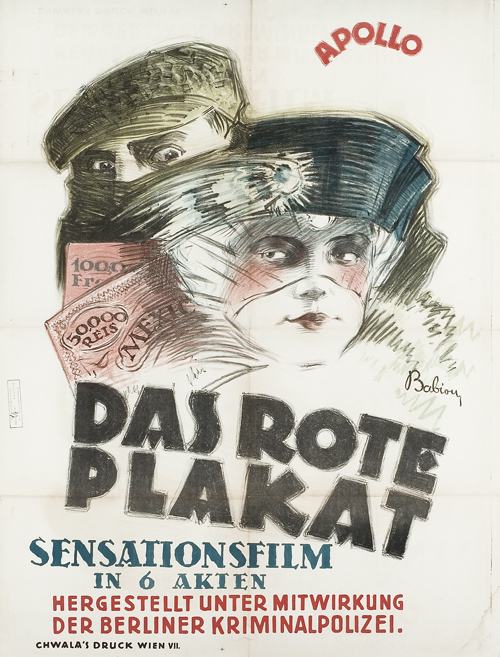
A single sheet of paper, the color of arterial spray, detonates a revolution in Rudolf Strauß’s fever-dream Das rote Plakat—a film so ahead of its time that modern viewers may suspect it was algorithmically generated from hashtags like #surveillancecapitalism and #cancelculture. Yet every flickering frame was hand-spliced in 1919, while Berlin still reeked of cordite and the infant Weimar Republic gasped for legitimacy.
Forget the polite morality plays of Griffith; this is cinema as shrapnel. The camera itself seems caffeinated, tilting up cornices, plunging into sewers, even mounting a moving tram to chase Ernst Hofmann’s tousled anarchist through streets that glisten like fresh wounds. Expressionist lighting doesn’t just carve faces—it indicts them, turning cheekbones into guillotines and eyes into tribunal spotlights.
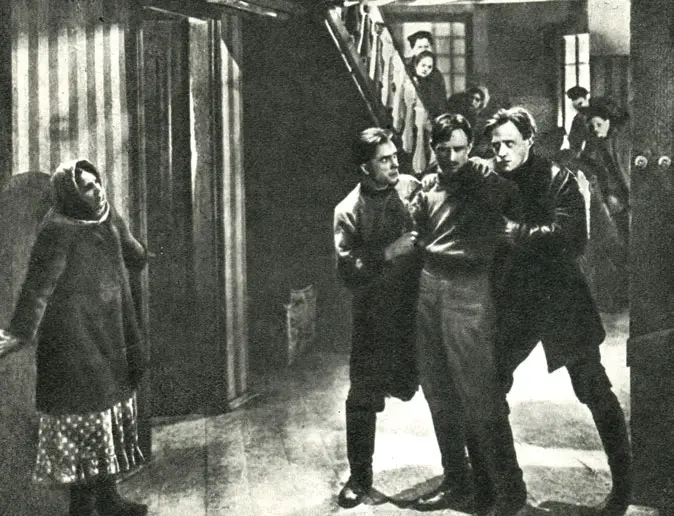
On first viewing, Das rote Plakat masquerades as a man-on-the-run procedural. Peel back the genre skin, however, and you’ll find a palimpsest of competing ideologies: Spartacist pamphlets quoting Rosa Luxemburg, liberal newspapers pleading for constitutional order, and proto-fascist broadsheets screaming for strongmen. The red placard morphs into a floating signifier—terrorist bounty to some, martyrdom notice to others—mirroring how today’s meme can be hero or villain depending on the timeline.
Compare its tonal vertigo to The Mystery of a Hansom Cab, where social strata intertwine via a murder, but that Victorian yarn still clings to moral equilibrium. Strauß refuses equilibrium; he detonates it.
Ernst Hofmann’s Grünewald is no virtuous outlaw. He sweats ideology yet pockets coin from black-market Bolshevik bonds; he quotes Marx while ogling Rosa’s fishnet thighs. Hofmann lets these contradictions fester—his eyelids twitch like faulty blinds, allowing guilt and glee to cohabit the same iris. Watch him in the clandestine print-shop scene: press clanking like artillery, he pauses to sniff the ink, inhaling revolution as if it were tuberose. That micro-gesture forecasts Brando’s later sensory Method.
Tatjana Irrah’s Rosa, meanwhile, is the centrifugal force. A countess turned trapeze artist, she literalizes class defection, swinging above the mob in sequined spandex that mocks the iron corsets of her ancestry. Irrah performs her own aerial stunts—no CGI harness here—so when she plummets, the horror lands with documentary immediacy.
Color symbolism saturates every reel, though the film is monochromatic. Cinematographer Heinrich Wild achieves chromatic suggestion through tinting: night exteriors bathe in Prussian-blue, interiors flicker tobacco-amber, and anything touched by propaganda blazes red. Green is pointedly absent; nature has abdicated, replaced by brick, steel, and paper. Only in the final frames do saplings pierce the poster pile—a sly promise that even totalizing politics can’t copyright chlorophyll.
Shot without synchronized dialogue, the film leans on orchestral leitmotifs: a snare drum mimics typewriter clatter; woodwinds slither when informants whisper; brass erupts during street clashes. Contemporary screenings with live ensembles restore this synesthetic dialogue. If you watch it muted, you’ll miss half the screenplay.
Curiously, the censors objected not to the Marxist rhetoric but to the sonic suggestion of drums—fearing audiences might sync their heartbeats to rebellion. Such paranoia feels quaint until you recall how modern autocrats disable Bluetooth at protests to prevent beat-matching chants.
Where Mind the Paint Girl domesticates female ambition inside West End footlights, Das rote Plakat weaponizes it. Rosa’s body is both erotic spectacle and tactical map—tattooed on her back is a schematic of Berlin’s sewer arteries. When her lover caresses her, he’s literally tracing escape routes. Strauß thus inverts the male gaze: the woman’s skin becomes parchment, the man becomes reader, and voyeurism morphs into insurgent literacy.
Editor C.W. Tetting cuts like a saboteur. Bourgeois ballroom sequences unfold in languorous long takes—waltzes swirl like cream in coffee—then smash-cut to the proletarian underbelly where hands stuff pamphlets into sewer grates. The juxtaposition doesn’t merely alternate; it indicts. Each ball-gown twirl is cross-spliced with a printing-press thud, implying that aristocratic leisure is underwritten by the very ink they criminalize.
This dialectical montage predates Soviet theorists’ canonical writings by three years, proving Berlin’s avant-garde was not derivative but convergent. Yet whereas Eisenstein would valorize the masses, Strauß laments their fragmentation: workers argue over serif versus sans-serif as cops close in, satirizing leftist circular firing squads.
Stream Das rote Plakat on your laptop and pause whenever a poster appears; you’ll spot QR-code-like glyphs predicting metadata. The detectives compile dossiers via intercepted postcards and matchbook addresses—analog ancestors of cookies and geofencing. One chilling intertitle reads: “Every citizen carries a policeman in his pocket—some call it conscience, we call it paperwork.” Replace “paperwork” with “smartphone” and you’ve got a thesis on digital panopticons.
In that light, the film pairs brilliantly with Det finns inga gudar på jorden, another state-versus-individual parable, though the Swedish film trades urban claustrophobia for Nordic nihilism.
The third act sags under dialectic overload: characters speechify in taverns, halting momentum. Some intertitles wallop viewers with jargon—“The dictatorship of the proletariat shall be the poetry of the future!”—that reads like freshman manifesto. And the epilogue’s sudden burst of arboreal optimism feels grafted by producers fearing outright nihilism.
Yet these scars humanize the artifact. A perfect propaganda film would itself be propaganda; Strauß’s stumbles remind us that history, like celluloid, is spliced not ordained.
As of 2024, only two 35 mm prints survive: one at the Deutsche Kinemathek (heavily decayed) and a 2018 restoration from MoMA’s nitrate vault, scanned at 4K. Most streaming versions are bootlegs of a 1990 VHS with Russian subtitles baked in. Seek instead the bilingual DCP that tours arthouse festivals; it restores the amber tint and features a live-score commission by Iranian composer Sussan Deyhim, whose reed flines echo the protagonist’s underground presses.
To truly subvert the viewing, pirate the red poster image, print it on eco-fabric, and wear it as a protest banner at your next climate march. The film’s greatest trick is proving that propaganda can be composted into seed paper for future revolts.
Verdict: Essential viewing for anyone who’s ever retweeted dissent, dodged facial recognition, or wondered why every protest banner looks like a meme. Das rote Plakat isn’t a museum relic; it’s a mirror smeared with fresh ink—grab it, and you’ll find your own fingerprints.
IMDb —
1926
Community
Log in to comment.