DbcultAccessing Vault...
Cult Review
Senior Film Conservator
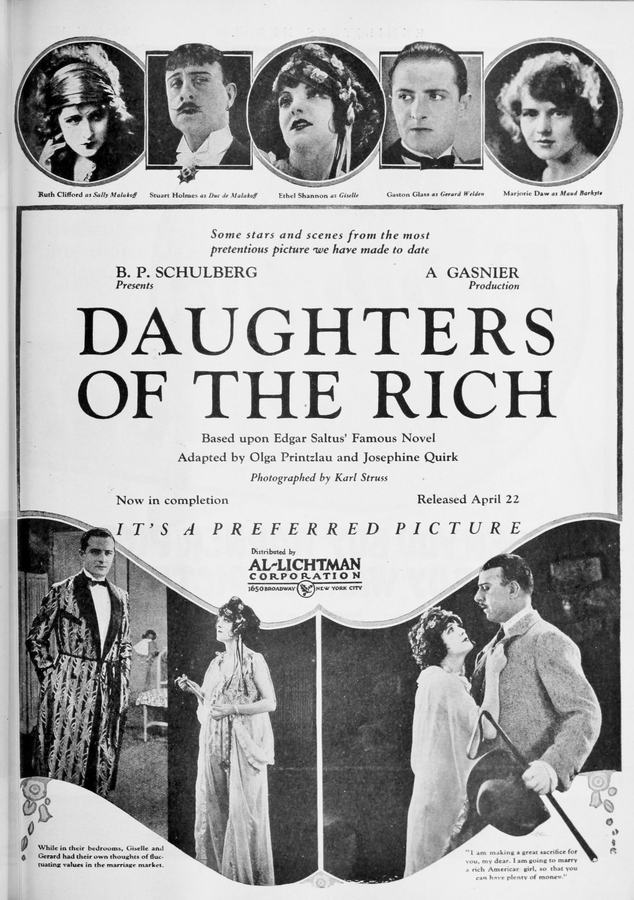
Step into the shimmering, often shadowy, world of early 20th-century cinema, where grand passions and intricate deceptions played out in hushed pantomime. Among the myriad silent films that graced the silver screen, Daughters of the Rich emerges as a compelling, if somewhat overlooked, testament to the era's fascination with societal pressures, romantic entanglement, and the corrosive power of ambition. Directed with a keen eye for dramatic tension, this 1923 feature, penned by the collaborative talents of Josephine Quirk, Edgar Saltus, and Olga Printzlau, plunges its audience into a narrative as convoluted and emotionally charged as any modern-day soap opera, yet imbued with a distinct period charm.
The film’s central conflict unfurls against the opulent backdrop of Parisian high society, a setting often chosen in silent melodramas to underscore themes of wealth, status, and moral decay. We are introduced to Maud Barhyte, portrayed with a delicate blend of innocence and resilience by Ruth Clifford, as she embarks on a romantic European sojourn with her fiancé, Gerald Welden (Gaston Glass), and her father (Josef Swickard). Their idyllic journey takes an unforeseen turn when they become the guests of the enigmatic Sally Malakoff (Miriam Cooper), a woman whose history is inextricably linked to Welden. Sally, a childhood sweetheart, had been propelled into an arranged marriage with the Duke Malakoff by her relentlessly ambitious, title-hungry mother (Truly Shattuck). This prior connection, festering beneath a veneer of civility, quickly becomes the catalyst for a meticulously orchestrated campaign of emotional sabotage.
Sally's character is a fascinating study in the destructive nature of unfulfilled desire and social climbing. Her machinations are not merely impulsive acts of jealousy but rather a calculated series of maneuvers designed to dismantle Maud and Gerald’s relationship. Through subtle hints, misinterpreted glances, and outright fabrications, Sally masterfully sows seeds of doubt, exploiting the inherent vulnerabilities of love and trust. This psychological warfare is the film’s driving force, showcasing the cunning and resourcefulness of a woman determined to reclaim what she believes is rightfully hers, regardless of the emotional wreckage left in her wake. Miriam Cooper’s portrayal of Sally is particularly noteworthy, conveying a complex blend of vulnerability, desperation, and ruthless ambition without uttering a single word, relying instead on nuanced facial expressions and body language—a hallmark of superior silent film acting.
The success of Sally’s scheme is tragically evident when Maud, heartbroken and convinced of Gerald’s infidelity, returns to America. Gerald, left in a state of confusion and believing Maud no longer loves him, falls prey to Sally’s renewed advances. The speed with which Sally divorces the Duke and marries Gerald underscores her single-minded pursuit of her desires. However, the triumph is fleeting. The truth, as it often does in such narratives, eventually surfaces. Gerald uncovers the full extent of Sally’s manipulative machinations, leading to a searing denunciation that shatters their fragile union. The revelation is devastating, not just for Gerald, but for Sally, whose carefully constructed world crumbles around her.
From this point, the film takes a darker turn, exploring themes of consequence and personal destruction. Sally, now an unhappy and desperate drug addict, finds herself trapped in a spiral of despair. Her tragic end, a suicide, serves as a grim commentary on the self-destructive nature of unchecked ambition and deceit. Yet, even in death, Sally plays a pivotal role in the narrative’s resolution. Her final act of sending confessions to Maud, exonerating Gerald, is a powerful moment of belated redemption. This twist elevates the film beyond a simple tale of romantic rivalry, adding layers of sacrifice and a desperate plea for justice. It’s a thematic thread that echoes the profound emotional weight found in films like Her Silent Sacrifice, where ultimate acts of selflessness become the turning point for others.
The strength of Daughters of the Rich lies not only in its intricate plot but also in the compelling performances of its cast. Ruth Clifford, as Maud, embodies the quintessential wronged heroine of the silent era, her expressive eyes conveying a spectrum of emotions from youthful joy to profound sorrow and ultimately, resolute determination. Her journey from naive fiancée to the instrument of justice is handled with commendable grace. Gaston Glass, as Gerald Welden, effectively portrays a man caught between two women, initially blinded by love and later disillusioned by betrayal. His arc from hopeful lover to wrongly accused prisoner, and finally to a man freed by truth, is a cornerstone of the film's emotional resonance.
Miriam Cooper’s Sally Malakoff, however, arguably steals the show. Her character is a force of nature, driven by a potent mix of past love and present resentment. Cooper navigates Sally’s transformation from a calculating schemer to a broken, addicted woman with remarkable depth. The subtle shifts in her demeanor, the fleeting glimpses of regret, and the ultimate, desperate act of confession are masterfully rendered, making Sally a truly memorable antagonist, whose actions, though destructive, ultimately pave the way for a form of closure. This kind of complex female villain, driven by societal pressures and personal demons, was a recurring motif in silent cinema, often seen in narratives exploring the darker side of ambition, not unlike the dramatic tensions found in films such as The Triumph of Love.
The directorial choices contribute significantly to the film's impact. The pacing, crucial in silent films, allows for moments of intense emotional build-up and dramatic revelation. Visual storytelling, through clever use of close-ups, intertitles, and symbolic imagery, effectively communicates the characters' inner turmoil and the unfolding plot. The Paris setting, while perhaps not as extensively utilized as a character in itself compared to some contemporary productions, still lends an air of European sophistication and timeless romance, contrasting sharply with the underlying currents of deceit. The collaborative screenplay by Josephine Quirk, Edgar Saltus, and Olga Printzlau is a testament to the intricate plotting prevalent in silent-era melodramas. They weave a narrative that, despite its numerous twists and turns, maintains a coherent emotional core, guiding the audience through deception, despair, and ultimately, a hard-won justice.
Beyond the thrilling plot, Daughters of the Rich delves into several enduring themes. The pervasive influence of wealth and social status is paramount. Sally's mother's obsession with a title for her daughter, leading to an arranged marriage, highlights the societal pressures that could warp individual lives. This pursuit of status, often at the expense of genuine affection, is a theme frequently explored in the social dramas of the era. The film also starkly illustrates the fragility of perception and the ease with which truth can be distorted by malicious intent. Gerald Welden's rapid descent from a man engaged to a loving woman to a wrongly accused murderer underscores the devastating power of misunderstanding and manipulation. It's a poignant reminder that appearances can be profoundly deceiving, a concept also subtly explored in films like A Coney Island Princess, albeit with a lighter touch.
Furthermore, the film touches upon the societal attitudes towards drug addiction, depicting Sally's tragic spiral as a consequence of her emotional turmoil and moral compromises. While presented within the melodramatic conventions of the time, it offers a glimpse into how such issues were portrayed and understood (or perhaps misunderstood) in early cinema. The ultimate triumph of justice, facilitated by Sally’s confession and Maud’s steadfastness, provides a powerful, albeit bittersweet, resolution, reinforcing the idea that truth, no matter how obscured, will eventually come to light. This pursuit of truth and justice, even against overwhelming odds, is a narrative cornerstone that continues to captivate audiences, much like the compelling historical narratives in films such as The Indian Wars, where moral clarity eventually emerges from chaos.
While Daughters of the Rich might not possess the same canonical status as some other silent masterpieces, its intricate plot, strong characterizations, and thematic depth make it a film worthy of re-examination. It stands as a testament to the enduring power of melodrama to explore complex human emotions and societal critiques. The film, like many of its contemporaries, relied heavily on visual storytelling and the expressive capabilities of its actors, demonstrating a unique artistry that predates the advent of synchronized sound. For enthusiasts of silent cinema, it offers a rich tapestry of period-specific storytelling, showcasing the dramatic flair and narrative ambition that defined the era. It serves as a potent reminder of the foundations upon which modern cinematic storytelling was built, a bridge from the theatrical traditions of the stage to the nascent language of the moving image.
The film’s conclusion, where Maud presents the crucial papers to the police, freeing Welden, is a satisfying culmination of the narrative’s tension. It’s a moment of pure, unadulterated cinematic catharsis, where the scales of justice, tipped precariously throughout the story, finally balance. The journey to this point is fraught with emotional peril, misguided decisions, and the machinations of a truly compelling antagonist. In its exploration of love lost and found, of betrayal and redemption, and of the societal pressures that often dictate individual fates, Daughters of the Rich remains a poignant and powerful piece of cinematic history, offering insights into the moral landscapes and dramatic tastes of the roaring twenties. Its legacy, though perhaps not widely celebrated, is etched in the enduring themes it explores and the powerful performances that bring its intricate narrative to life.
The collaborative effort of writers Josephine Quirk, Edgar Saltus, and Olga Printzlau is particularly commendable. Crafting such a layered narrative, filled with dramatic irony and character development, for a silent medium required a profound understanding of visual cues and emotional shorthand. The film's ability to maintain suspense and engage the audience without spoken dialogue is a testament to their skill in weaving a compelling story. This intricate plotting, where every misunderstanding and revelation serves a larger purpose, is a hallmark of well-executed silent-era screenwriting, demonstrating that complex narratives were not exclusive to the sound era. It showcases a dedication to storytelling that aimed to enthrall and provoke thought, even without the benefit of a spoken word, much like the detailed historical recounting found in One Hundred Years of Mormonism, which relies on visual narrative to convey its message.
Ultimately, Daughters of the Rich stands as a compelling artifact from a bygone cinematic era. It invites us to appreciate the artistry of silent film, where emotions were magnified, and stories unfolded with a balletic grace. It reminds us that tales of human frailty, ambition, and the enduring quest for truth and justice are timeless, transcending the technological limitations of their creation. For those willing to immerse themselves in its silent embrace, it offers a rich and rewarding experience, a window into a world where the unspoken word often carried the most profound meaning.
IMDb 5.4
1927
Community
Log in to comment.