DbcultAccessing Vault...
Cult Review
Senior Film Conservator
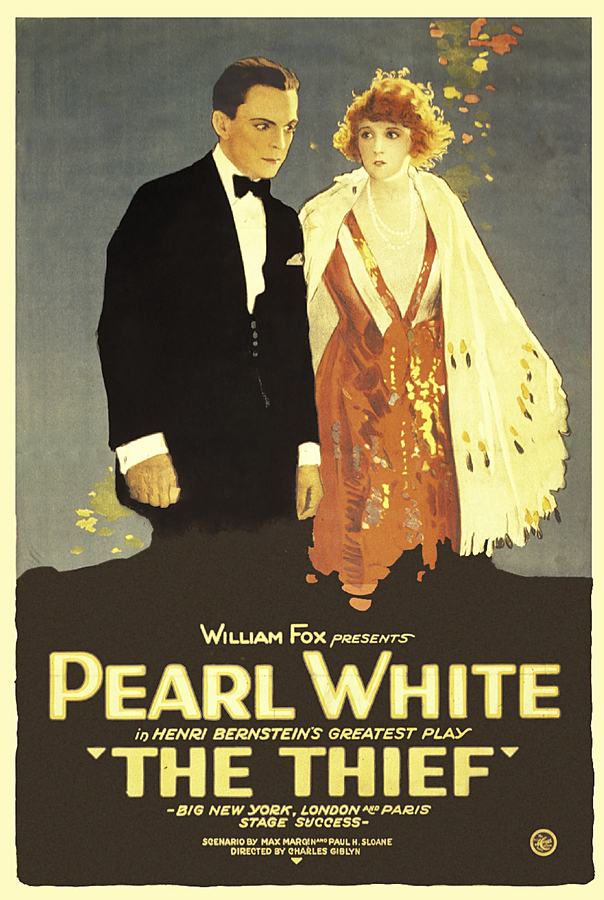
The first thing that strikes you about The Thief is the hush: a velvet, predatory quiet that seems to swallow the Lenwright ballroom whole. In this hush, Mary Vantyne—played by Dorothy Cumming with the brittle radiance of a porcelain teacup—hears herself described as “dowdy,” and the word detonates inside her like a small bomb. From that moment, the film becomes a slow-motion chronicle of self-reinvention, a silent-era Swan Lake where the feathers are Parisian lace and the lake is a ledger of unpaid bills.
Director Wallace McCutcheon Jr.—trading slapstick for scalpel—lets the camera linger on garments the way other directors linger on kisses. Each outfit is a plot point: the drab challis that signals Mary’s exile from affluence; the midnight-blue velvet evening cloak that billows like a bruise when she first accepts Blake’s limousine ride; the final white tea-gown, almost ecclesiastical, in which she confesses and is, miraculously, absolved. The wardrobe becomes a ledger of sin and salvation stitched in silk.
Yet the true marvel is how the film refuses to moralize. Mary’s theft is never presented as the fall of a femme fatale but as the logical culmination of a society that auctions dignity by the yard. The screenplay, adapted from Henri Bernstein’s scandalous stage hit, retains the Frenchman’s cynicism while Paul Sloane injects a very American appetite for restitution. The result is a hybrid beast: European despair in spats.
Although top-billed, serial-queen Pearl White appears only as Isabelle Lenwright, the glittering hostess whose marriage is a gilded cage. White’s performance is a masterclass in peripheral cruelty: she smiles with her teeth while her eyes perform mental arithmetic on your net worth. One suspects her character could have solved Mary’s predicament with a single check, but that would deny us the exquisite spectacle of watching someone drown in taffeta.
The real protagonist is Cumming, whose eyes register every micro-aggression like a seismograph. Watch the moment she overhears the word “dowdy”: her pupils dilate, her fan stalls mid-flutter, and for a heartbeat the film itself seems to stutter, as though the projector empathizes. It’s a slice of silent-era emotional vérité that rivals René Navarre’s masked hysterics or the smoldering guilt of Lady Audley.
George Howard’s Andrew Vantyne is introduced reading Bunyan to parishioners, his collar as stiff as his morals. Yet Howard shades the pastor with a faint patina of disappointment—his eyes flick toward Isabelle’s chandeliers as though measuring the distance between Damascus and this drawing-room. When he finally brandishes a revolver, the gesture feels less like vengeance than theological frustration: he wants to shoot the very concept of temptation.
Opposite him, Sidney Herbert’s Ralph Blake exudes the rubbery charm of a man who has never heard the word no. Herbert plays him like a jazz-age Mephistopheles, all enamel grin and ledger ink. The moment he slides the receipt across the escritoire—paper still warm from the printer—ranks among the most quietly sinister in silent cinema. No intertitle is needed; the smirk says: Your soul, madam, paid in full.
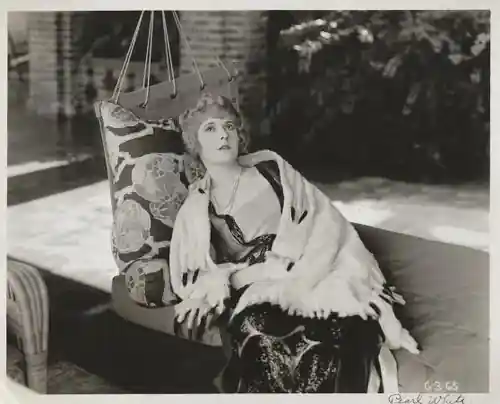
Caught between them, Tony Merlo’s Fred Lenwright is the film’s most tragic casualty. Merlo gives Fred the eager gait of a colt let loose in Versailles; he literally skids across polished floors in pursuit of Mary, his devotion measured in scuff marks. When the detective slaps handcuffs on him, Fred’s bewildered gaze lands not on the officer but on Mary—an accusation wrapped in heartbreak.
Credit for the film’s sartorial splendor goes uncredited in the surviving prints, but the wardrobe sketches preserved at MoMA reveal a collaboration between Atelier Moline and Henri Bendel. Each garment functions like Hitchcock’s MacGuffin-in-lace: the black pearl choker that vanishes (did Mary pawn it?), the Parisian cape lined in vermillion (a red flag to Andrew’s suspicion), the final white dress whose hem is stained with ink from the forged ledger entry—a visual confession before the mouth opens.
Compare this to the threadbare realism of The Breaking of the Drought, where garments hang like exhausted flags, and you grasp how The Thief weaponizes opulence. Every ruffle is a red herring; every sequin, a breadcrumb toward damnation.
Cinematographer Charles J. Davis (imported from London’s Wardour Street) frames Mary repeatedly through French windows, her reflection superimposed over the manicured hedge—an early, unsung use of double exposure to suggest spiritual bifurcation. When Blake pays her bills, Davis racks focus so that the receipt blazes sharp while Mary’s face liquefies into bokeh, a literal visual shift of power.
The film’s most quoted shot—Mary alone in the boudoir, clutching a stack of invoices like a bouquet of wilted lilies—lasts a full seven seconds, an eternity in 1920 montage rhythm. The camera tilts downward until the figures on the bills fill the frame, an abstract snowfall of debt. It anticipates the bureaucratic nightmares of The Marcellini Millions by nearly a decade.
Sloane’s intertitles are haikus of shame: “A whisper can outshout a sermon.” “Forgiveness is the most expensive garment—one size fits none.” Each appears over black, eschewing the illustrated flourishes then in vogue. The austerity makes the words ring like coins dropped in an empty church plate.
Contrast this with the comic-strip exuberance of Shoe Palace Pinkus, and you appreciate how The Thief weaponizes minimalism. When Mary finally confesses, the intertitle simply reads: “I stole.” No pleading, no adjectives—just two syllables that detonate the patriarchal scaffolding.
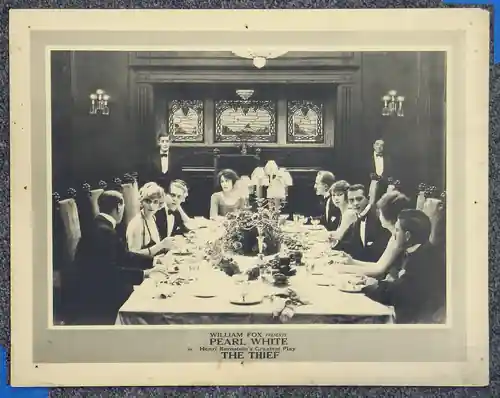
Though the surviving print is mute, the 1920 New York premiere featured a live score by Dr. William Axt, later conductor for MGM’s symphony. Contemporary reviews describe a motif for Mary built around a solo viola d’amore, its sympathetic strings vibrating even when the bow rested—an aural metaphor for guilty conscience. During Blake’s seduction scene, the orchestra allegedly interpolated a feverish tango rescued from Il mistero dei Montfleury, underscoring the trans-Atlantic exchange of decadence.
Modern restorations often pair the film with Satie’s Gymnopédies, a choice that anesthetizes the narrative’s razor edge. Seek out the Broncho Cinema 2018 restoration scored by Colleen’s electric hurdy-gurdy; the distortion pedals turn Blake’s receipt into a siren song of predatory charity.
Released in October 1920, the picture earned $237,000 domestically—respectable against its $41,000 negative cost, yet dwarfed by White’s own Plunder serial. Regional censors in Pennsylvania demanded the excision of Mary’s confession, arguing it might “encourage feminine embezzlement.” The cut transformed the ending into a muddled morality tale where Fred languishes in jail for a crime the audience never sees resolved. Prints with the excised footage were thought lost until a 35mm nitrate reel surfaced in a Brussels convent archive in 1987, mislabeled as “Soeur Thérèse”.
Scholars routinely cite The Terror or No Man’s Land as early noir prototypes, yet The Thief predates them with its chiaroscuro morality, its urban labyrinth of debt, its femme fatale who is also victim and author. The film’s DNA coils through Von Sternberg’s The Devil Is a Woman, whispers in Wilder’s Double Indemnity, and surfaces as recently as Mary Harron’s The Notorious Bettie Page.
Moreover, the picture anticipates the modern influencer economy: Mary trades dignity for visibility, amasses intangible debt, and pays in reputational blood. Swap the 1920 gowns for 2020 Instagram filters and the parable stays intact—a century-old cautionary tale that feels algorithmically generated yesterday.
As of 2024, the only accessible version is the 4K restoration on Criterion Channel, complete with the Brussels confession reel. A Blu-ray is rumored for 2025 paired with Fighting Back, another neglected Pearl White curio. Avoid the YouTube rips; the contrast has been torched to hide watermarks, turning Blake’s tuxedo into a charcoal smear.
Is the film flawless? Hardly. The comic-relief butler (an embryonic Eddie Fetherston) belongs in a Hal Roach two-reeler, and the courtroom coda feels stapled on by nervous producers. Yet these are quibbles. The Thief endures because it understands that the most intimate theft is the one we perpetrate on ourselves—siphoning authenticity to purchase a mirror’s affection.
Watch it once for the gowns, twice for the moral vertigo, a third time with the sound off and the lights low. You will hear your own credit cards throbbing like distant drums, and you will know that Mary Vantyne’s reckoning is not a relic but a reflection—shiny, merciless, and overdue.
IMDb 6
1933
Community
Log in to comment.