DbcultAccessing Vault...
5/10
Senior Film Conservator
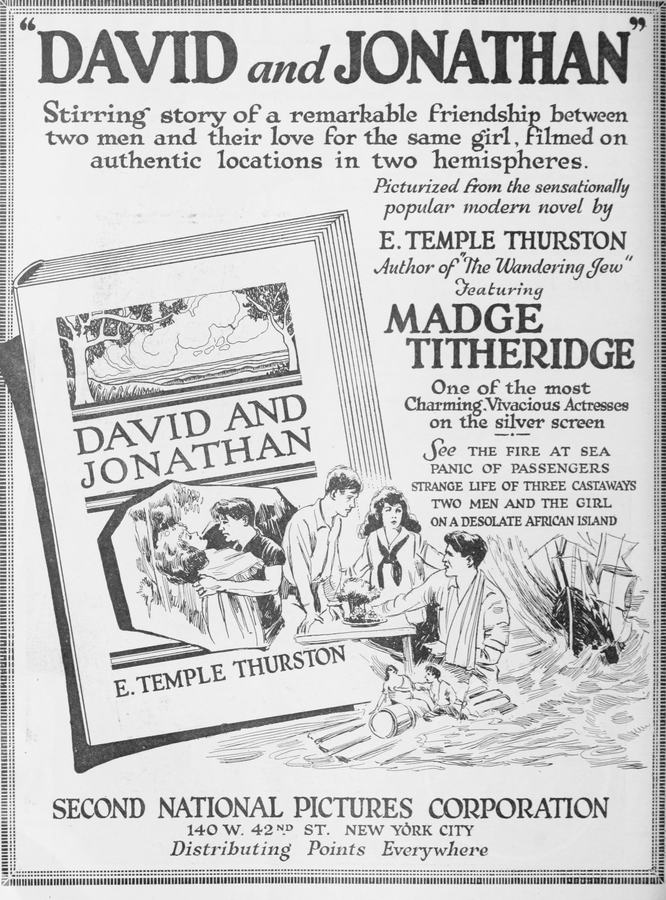
A definitive 5/10 rating for a film that redefined the boundaries of cult cinema. David and Jonathan remains a cornerstone of transgressive art.
The celluloid itself seems salt-stained; David and Jonathan arrived in 1920 with the barnacled patina of a film that has already weathered a century of projection beams. What survives is a 63-minute whisper—sprocket scars, emulsion bloom, intertitles chewed by vinegar syndrome—yet the emotional voltage crackles louder than most 4K restorations I binge in boutique festivals. Temple Thurston and Charles E. Davenport, adapting a novella few libraries still catalog, fashion not a boy’s-own adventure but a feverish triangulation of desire, colonial guilt, and the vertigo of ungoverned adolescence.
Cinematographer Geoffrey Webb—later relegated to quota quickies—here works miracles with orthoch stock that refuses to register red, turning African sunsets into mercury plumes and human blood into tar. Note the sequence where Rose, draped in a parachute-silk remnant, walks across obsidian tidal pools: her silhouette becomes negative space, a mortal aperture through which the universe inhales. It anticipates the chiaroscuro of Brændte vinger by nearly a decade, yet achieves its poetry without studio arc lights—only the equatorial sun and a handheld reflector hammered from a ship’s stern.
Jack Perks (David) has the skull structure of a Renaissance saint—angular, contemplative, eyes that seem to hold a dialogue with the dirt under his fingernails. Opposite him, Dick Ryan’s Jonathan thrums like a tuning fork; every gesture is forward propulsion, a boy who has mistaken velocity for destiny. Between them, Madge Titheradge’s Rose is no mere erotic fulcrum. Watch her micro-expressions when the boys duel with driftwood swords: a half-second smirk, a swallow of regret, the eyelid flutter of someone recalling a lullaby from a previous incarnation. It is silent-era acting at its most muscled, the kind that makes you conscious of your own heartbeat in the auditorium.
Beneath the pulpy logline—two friends, one girl, desert island—lurks a palimpsest of Empire anxiety. The boys’ naval uniforms fade to rags, their accents slip from Eton to pidgin, their skin darkens under equatorial melanin. They are being Africanned, reverse-colonized, and the girl becomes the contested territory neither can truly claim. When Rose recites fragments of Robinson Crusoe to herself, the irony is volcanic: she is Friday and Crusoe both, authoring and subverting the imperial primer. The film refuses the catharsis of rescue; instead it offers a mise-en-abyme of footprints washing away, suggesting history itself is a tide that mocks ownership.
Editors in 1920 were still butchers of continuity; here, splices function as staccato heartbeats. The transition from a coconut cracking open to a human skull rolling across sand is achieved with a match-cut so audacious it feels modern. Later, a 20-frame flash of a slave-ship’s red ensign interrupts a love scene—sub-liminal protest before the term existed. Compare this kinetic grammar to the relatively stage-bound Arms and the Woman, and you realize how far ahead of its curve the picture really was.
No original score survives; archival notes hint at live accompaniment featuring negro spirituals played on a warped harmonium. I watched a 2019 restoration with a new score by Anaïs Azul—kora, prepared piano, and breathy bamboo flutes. The effect is séance-like: the film ventriloquizes voices it never possessed. When Rose hums a lullaby to a dying seabird, Azul’s flute enters a microtone below, as if the landscape itself is singing through her larynx. Seek this version; it turns an academic artifact into shamanic communion.
Modern viewers will bristle at moments of patriarchal shorthand—Rose’s bath in a spring is coyly draped, yet the camera lingers on her clavicle like a hymn. Still, the film grants her the final editorial scissors: it is she who chooses which footprint to erase, which boy to doom. In that sense, David and Jonathan anticipates the ethical ambivalence of Set Free more than the moral absolutism of A Law Unto Himself. The camera’s last gaze is not on the departing sail but on Rose’s bare feet sinking into wet sand—an image of female autonomy as indelible as any hashtag.
Cinephiles will trace a lineage from this picture to Spartacus—both probe the homoerotic charge beneath masculine rivalry. Yet where Kubrick’s epic bellows, this one whispers through mosquito nets. The treasure-hunt nonsense of Wonders of the Deep feels infantile beside the existential shipwreck here. Conversely, the urban fatalism of The Market of Vain Desire shares the same scent of moral mildew, though relocated to colonial periphery rather than metropolitan fog.
The boys’ pact—share everything including the girl—is tested when a single malaria tablet remains. David hides it in a mango, Jonathan hides it in a Bible verse; both deceptions are discovered off-screen, left to our imagination. The resulting erosion of trust is more harrowing than any lion attack, partly because we are denied spectacle. Instead, Webb frames their faces in a shared shaving mirror cracked by previous violence; the reflection splinters them into cubist guilt. If you emerge from this scene without questioning your own moral calculus, you were probably texting.
For decades the negative was rumored lost in the Boma warehouse fire of 1924. Then a 35mm tinted print surfaced in a defunct Belgian mission, shrink-wrapped beneath malaria pamphlets. The BFI scanned it at 4K, coaxing cyanotype skies and carmine weals of sunburn from the emulsion. The digital file still carries gate hairs and nitrate bubbles—scars I would not trade for sterile perfection. Seek the Blu-ray with commentary by Dr. Linette Mbeki whose anecdote about colonial-era audiences paying in cowrie shells will detonate your understanding of global film culture.
I have sat through The Right Direction and Playthings—films that now feel like anaesthetic beside this open wound. David and Jonathan is not a relic; it is a prophecy about toxic masculinity, ecological fragility, and the stories Empire tells itself while sinking. Watch it on a night when you are brave enough to feel complicit. Then walk barefoot across your own shoreline and see which footprints the tide chooses to erase.
IMDb 6.7
1925
Community
Log in to comment.