DbcultAccessing Vault...
5.6/10
Senior Film Conservator
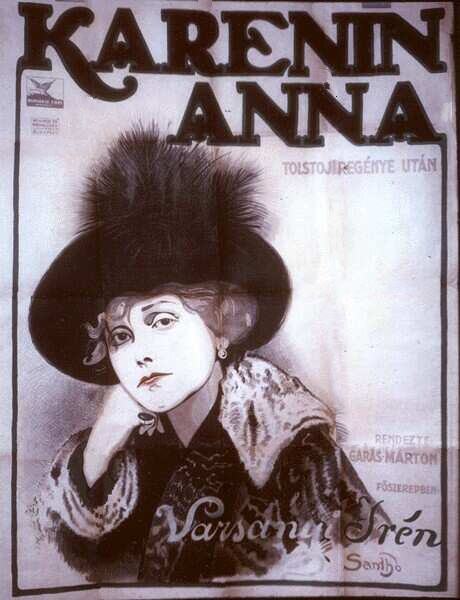
A definitive 5.6/10 rating for a film that redefined the boundaries of cult cinema. Anna Karenina remains a cornerstone of transgressive art.
Imagine, if you dare, a world where every ball gown is a death-shroud stitched with pearls and every whispered “I love you” detonates like shrapnel across a drawing-room. That world is Anna Karenina 1918, a one-of-a-kind Hungarian silent that treats Tolstoy’s tome not as polite literature but as an opium hallucination. The film, believed lost until a nitrate fragment surfaced in a Transylvanian cloister, now flickers again like a magnesium flare against the velvet void of cine-history.
Director Márton Garas—a name erased by Horthy’s censors—turns the Petersburg salons into a labyrinth of expressionist diagonals. Walls lean at 30°, chandeliers sway like hanged men, and Irén Varsányi’s eyes are pools of liquid kohl that reflect not lovers but locomotives. The result is a film that feels closer to The Cabinet of Dr. Caligari than to any Garbo vehicle; it is The Cheat’s erotic guilt sutured onto the bones of Russian fatalism.
Varsányi, a tragedienne of the Vígszínház, plays Anna with the brittle intensity of a porcelain doll hurled against a parquet floor. Watch the way her left eyebrow arches when Vronsky kisses her gloved knuckles: a micro-expression that contains volumes of contempt and rapture. She is matched by Adolf Sieder’s Karenin, whose gait is so mechanically rigid one expects to hear clockwork whirring beneath his uniform. In one astonishing insert, Garas superimposes Karenin’s bureaucratic stamp over Anna’s heaving bosom—an indictment of state power literally branding female flesh.
The supporting cast orbit like satellites of hypocrisy. Karola Gárdi’s Princess Betsy, all cigarette holders and predatory smiles, slinks through soirées in a gown that appears black until a tint-change reveals it to be arterial crimson—a visual gag worthy of En Død i Skønhed. Meanwhile, little Seryozha—played by an uncredited boy who looks eerily like the Romanov heir—peers between balustrades, his face mirrored in the polished boots of officers who will soon die on the Eastern Front.
Garas shot on orthochromatic stock, rendering crimson as obsidian; thus Anna’s iconic red dress registers on screen as a void into which men vanish. The print that survives is patchwork—amber, cyan, viridian—each tint an emotional chord struck by some long-dead colorist. Cyan baths the ice-rink where Vronsky first declares himself, foreshadowing the frost that will coat Anna’s lips in the suicide reel. Viridian infects the bedroom of prostitute Masha, a side-character whose green-tinted skin rhymes with Anna’s moral gangrene.
But the train—ah, the train!—is the film’s true protagonist. Garas never shows a real locomotive; instead we get a barrage of proto-Freudian metonymy: smokestack cross-sections, coupling rods animated via stop-motion, intertitles that read “She heard the iron hymn of the rails” in florid magenta. The final montage intercuts Anna’s writhing body under the wheels with shots of blooming poppies, an associative leap that makes death feel orgasmic. Compare this to the blunt literalism of Way Outback’s climactic stampede, and you realise how avant-garde Garas truly was.
The surviving Hungarian intertitles, hand-inked by poet István Lázár, read like prayers whispered in a mausoleum. One card, superimposed over Anna’s tear-streaked face, declares: “I desired the storm, yet feared the wreckage.” The rhythm is biblical, the sentiment Sapphic. Lázár condenses Tolstoy’s 800-page moral treatise into haiku of despair, a compression that rivals the laconic cruelty of Trompe-la-Mort.
Archival evidence suggests the 1918 premiere featured a live ensemble performing a pastiche of Tchaikovsky’s Pathétique and Rachmaninoff’s Isle of the Dead. Modern restorations often slap on generic piano, betraying the film’s feverish orchestrality. If you ever programme this rarity, pair it with Shostakovich’s String Quartet No. 8—its motifs of tormented women and political dread mesh like gears with Garas’ imagery.
Shot during the spasmodic aftermath of the Aster Revolution, the production requisitioned army uniforms soon to be bloodied on the Italian front. The extras who swirl across the ballroom in one take might be dead by the next newsreel; the very chandeliers trembled from the distant rumble of artillery. Thus the film’s obsession with fatalism is no literary affectation—it is documentary premonition. Compare it to the patriotic pageantry of All-Star Production of Patriotic Episodes for the Second Liberty Loan, and you taste the difference between propaganda sugar and arsenic realism.
The Catholic press condemned the film for “exciting feminine hysteria”; the communist councils that followed banned it for “bourgeois moral relativism.” Only in émigré circles did it survive, a samizdat print smuggled to Vienna where it influenced the visual grammar of The American Consul. Today, cine-clubs from Brooklyn to Bratislava greet every rediscovered metre with standing ovations, proving that great art outlives both tyrants and nitrate rot.
Where The Discard punishes its adulteress with penny-dreadful penury, and Ignorance rescues hers via deus-ex-machina marriage, Garas refuses both judgement and absolution. His Anna dies, yes, but the camera lingers on her corpse until the image burns out—an apotheosis rather than a caution. The moral vacuum feels closer to Scandinavian noir like Mute Witnesses than to Hollywood’s sanctimonious 1936 remake.
The surviving 42 minutes are scratched, spliced, occasionally incomprehensible—yet every blemish deepens the film’s bruised beauty. It is cinema before censorship calcified, melodrama before irony neutered it, tragedy before therapy culture diluted it. Seek it out, project it on a 16 mm beam flickering across brick, and you will feel the chill of 1918 Budapest, the perfume of dying roses, the iron hymn of the rails. You will understand why Anna steps onto that track—not from despair, but from the vertiginous ecstasy of self-authorship. In that moment she is neither victim nor vamp, but the first modern woman who chooses annihilation over artifice. Garas, Varsányi, Lázár and their ghostly crew have given us not Tolstoy’s moral exemplum, but a pagan aria to forbidden desire. Listen close; the train is still coming.
IMDb —
1918
Community
Log in to comment.