DbcultAccessing Vault...
Cult Review
Senior Film Conservator
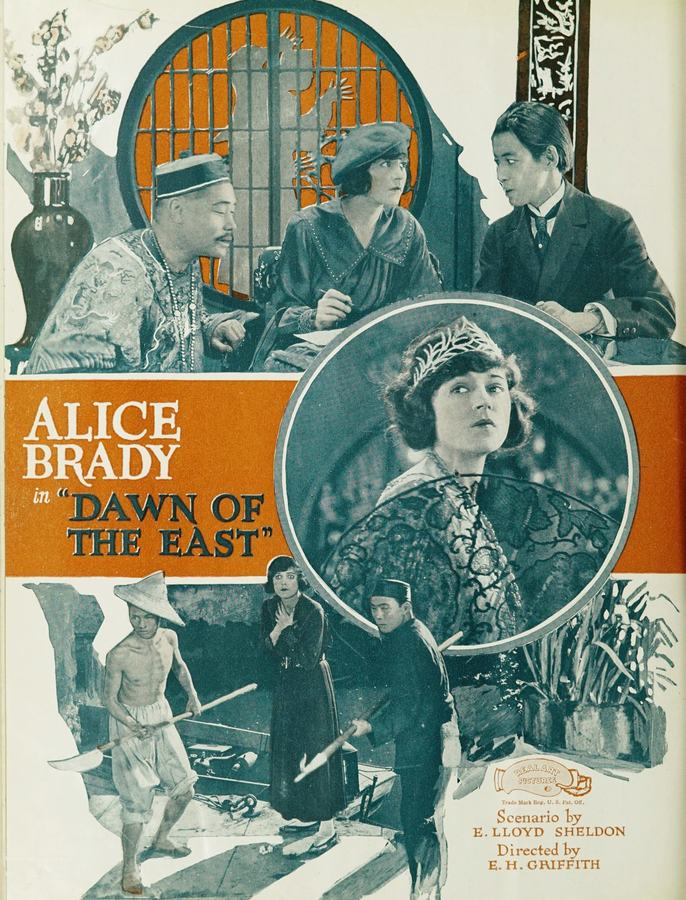
Dawn of the East is a cinematic alchemy of historical melodrama and political thriller, a film that lingers in the mind like the last note of a melancholic violin. Set during the interwar period, when Shanghai served as a liminal space for exiles, revolutionaries, and opportunists, the narrative orbits around Countess Natalya (Alice Brady), a Russian aristocrat who has traded her gilded past for the neon-lit shadows of Shanghai. Her story, a tapestry woven with threads of survival and subterfuge, unfolds in a city that is itself a character—a cacophony of Mandarin, English, French, and the ghostly whispers of a fallen empire. The film’s opening scene, a smoky cabaret number, establishes the Countess as both performer and prisoner, her voice a velvet noose that tightens with each passing scene.
The Russian Revolution has left Natalya adrift, her family’s estate reduced to a memory, her status a relic. She survives by selling her voice and her beauty, a transaction that echoes the commodification of identity in a globalized world. Her sister Sonya (America Chedister), a constant reminder of familial duty and guilt, is a silent specter in the background. Sonya’s invalidity, whether physical or metaphorical, becomes a motif for Natalya’s own entrapment. When the enigmatic Sotan (Michio Ito) enters her life, his offer of a marriage of convenience to the affluent Wu Ting (Patricio Reyes) is less a rescue than a calculated gamble. Sotan’s motives, veiled in civility, reveal a Machiavellian agenda: he is a self-appointed architect of the Romanov restoration, using Natalya as a pawn in a game that spans continents and ideologies.
The film’s brilliance lies in its ability to juxtapose the intimate and the geopolitical. Natalya’s flight to America with the dowry money, intended as a fresh start, becomes a descent into moral ambiguity. Her romance with Roger Strong (Frank Honda), an American diplomat with a boyish idealism, is fraught with tension. Strong’s character embodies the American Dream—the promise of reinvention—but Natalya, having navigated the treacherous waters of Shanghai, sees through his idealism. Their relationship, tender yet transactional, mirrors the film’s central conflict: the impossibility of escaping one’s past in a world where every act is a negotiation.
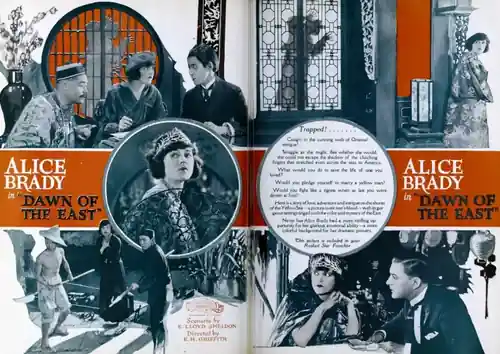
Sotan’s pursuit of Natalya into American soil elevates the narrative from personal drama to a Cold War-style espionage thriller. His blackmail, demanding information on Young’s (Kenneth Harlan) diplomatic missions, transforms Natalya into a double agent, her loyalties fractured by survival instincts. The film’s climax, a storm of revelations and betrayals, is less about resolution than about the futility of escaping one’s shadow. In a chilling monologue, Natalya declares, “I am not a Romanov. I am not a patriot. I am a woman who has sold her dreams to survive,” a line that crystallizes the film’s exploration of agency and complicity.
E. Lloyd Sheldon’s screenplay, often overlooked in film history, deserves a reevaluation for its nuanced portrayal of female agency in a patriarchal world. Natalya’s choices, though morally gray, are portrayed with empathy, avoiding the pitfalls of victimhood. The supporting cast, particularly Harriet Ross as Wu Ting’s enigmatic wife, adds layers of complexity. The film’s visual style, with its chiaroscuro lighting and art deco flourishes, mirrors the duality of its themes—light and shadow, East and West, past and present.
Comparisons to On the Banks of Allan Water are inevitable, given their shared focus on exiled nobility, but Dawn of the East distinguishes itself with a sharper political edge. Unlike Chris and His Wonderful Lamp, which leans into fantasy, this film is grounded in realism, its magic lying in the psychological depth of its characters. The film’s historical context—Shanghai as a haven for Russian émigrés—lends it authenticity, though Sheldon takes creative liberties to dramatize the cultural frictions.
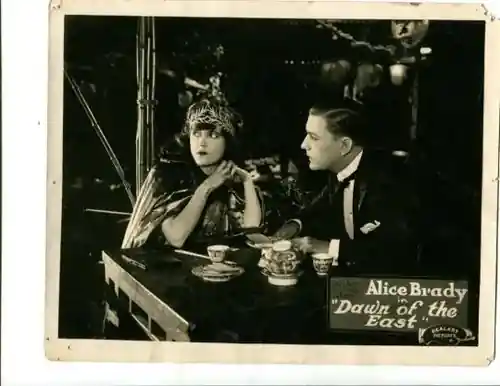
Technically, the film is a marvel. The score, a blend of Russian lullabies and American jazz, underscores the tension between Natalya’s roots and her aspirations. The cinematography, with its long takes and fluid transitions, captures the claustrophobia of Shanghai’s colonial enclaves and the sterile vastness of New York’s urban sprawl. The use of color—scarlet for Natalya’s corsets, monochrome for her memories of Russia—reinforces the film’s visual symbolism.
Critics of the era panned the film for its “overwrought melodrama,” but modern audiences can appreciate its prescient themes. The Countess’s journey—from exiled aristocrat to American expatriate—parallels the global displacement of the 20th century, a theme that resonates in today’s age of migration and cultural hybridity. The film’s interrogation of identity, particularly the intersection of gender and geopolitics, is strikingly relevant amidst current debates on nationalism and identity politics.
The final act, a confrontation between Natalya and Sotan in a rain-soaked alley, is a masterclass in tension. The dialogue, sparse and loaded, reveals the futility of Sotan’s schemes and Natalya’s exhaustion with being a pawn. Their exchange—“You think loyalty is a currency? I’ve spent every coin,” she retorts—cements the film’s existentialist undertones. The resolution, though bittersweet, avoids cliché, leaving the viewer with the unsettling question: In a world of shifting allegiances, is survival worth the price of self-betrayal?
In the shadow of The Secret Formula and The Girl Without a Soul, Dawn of the East stands as a testament to the resilience of storytelling in times of upheaval. It is a film that demands multiple viewings, each reveal peeling back another layer of its intricate narrative. For those seeking a cinematic experience that marries historical intrigue with intimate drama, this film is a hidden gem, a time capsule of a world where the personal was inextricably political.
IMDb 4.9
1930
Community
Log in to comment.