DbcultAccessing Vault...
Cult Review
Senior Film Conservator
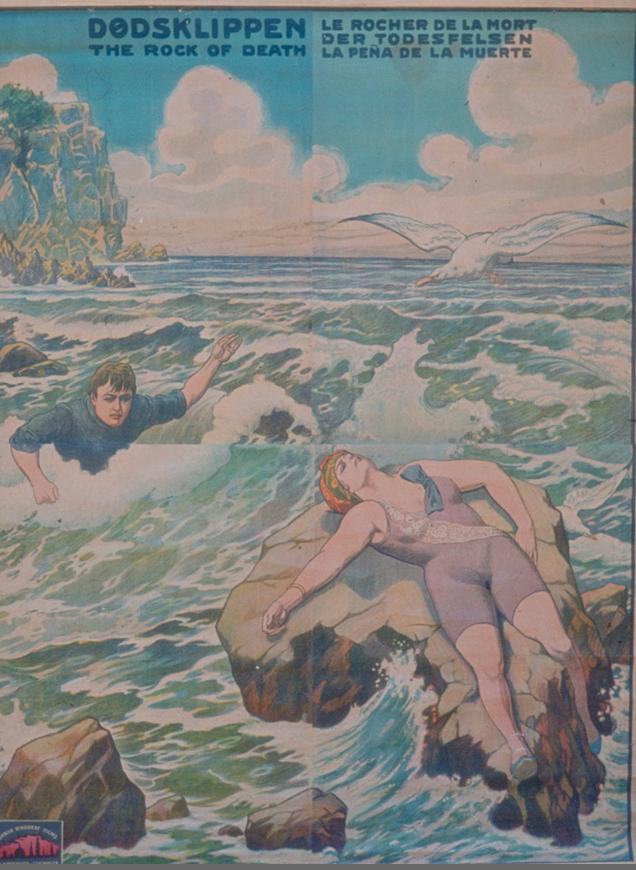
There exists a peculiar allure in revisiting the silent era, a period often dismissed as nascent but, in truth, a crucible of cinematic expression. Among the myriad films emerging from this fertile ground, the Danish production Dødsklippen stands as a testament to the power of visual storytelling, even when divorced from the spoken word. It is a film that, despite the passage of a century, retains a visceral impact, drawing viewers into its tragic orbit with an almost gravitational pull. Far from being a mere historical curiosity, it is a work that speaks to timeless human frailties and the unforgiving nature of fate, elements that resonate with a profound, almost primal force.
The genius of Dødsklippen lies in its masterful deployment of visual cues and exaggerated, yet deeply felt, performances. Elna From's screenplay, a labyrinthine exploration of human desire and its destructive potential, relies heavily on the actors' ability to convey complex emotional states through gesture, posture, and the subtle dance of facial expressions. Ella La Cour, as the steadfast Elara, delivers a performance of remarkable subtlety for the era, her eyes often betraying a profound inner turmoil that belies her character's outwardly serene demeanor. Her portrayal is a delicate balance of vulnerability and quiet strength, making her a compelling emotional anchor in a narrative prone to histrionics. Tronier Funder's Erik, the rugged fisherman, projects an earnestness that makes his eventual downfall all the more heartbreaking. His physical presence, imbued with a grounded authenticity, provides a stark contrast to the film's more ornate, villainous elements.
Hulda Lauritzen, playing the ambitious but ultimately tragic Solveig, navigates a treacherous arc with commendable skill. Her initial wide-eyed wonder at the Baron's advances gradually gives way to a horrified realization of her complicity, a transition conveyed with a poignant blend of shame and terror. Einar Zangenberg, as the insidious Baron von Stern, revels in his villainy, crafting a character whose charm is as chilling as his ruthlessness. Zangenberg understands the theatricality inherent in silent film antagonist roles, yet he manages to inject a believable, almost reptilian cunning into his portrayal, making the Baron a truly memorable figure of cinematic malevolence. The interplay between these performers is what elevates Dødsklippen beyond a simple melodrama, transforming it into a nuanced study of moral compromise and societal pressures.
The film's cinematography is another unsung hero, capturing the raw, untamed beauty of the Danish coastline with a stark realism that amplifies the narrative's inherent drama. The titular 'Death Cliff' is not merely a backdrop but a character in itself, its craggy visage and precipitous drop serving as a constant, looming metaphor for the characters' perilous journey. The use of natural light, often harsh and unforgiving, enhances the sense of realism, grounding the more melodramatic plot points in a tangible, almost tactile world. Directors of the era, though often uncredited or working collaboratively, frequently experimented with framing and composition to maximize emotional impact. In Dødsklippen, there are moments of striking visual poetry, particularly in the scenes set against the tempestuous sea, where the churning waves mirror the internal storms raging within the characters. This attention to environmental detail and its symbolic resonance sets it apart from many of its contemporaries, which often relied more heavily on interior, stage-bound settings.
Comparing this visual sophistication, one might draw parallels with the grand, sweeping landscapes seen in early travelogues or historical epics, though Dødsklippen uses its setting for psychological rather than purely illustrative effect. While films like Glacier National Park showcased natural wonders, Dødsklippen imbues its landscape with narrative weight, making the environment an active participant in the unfolding tragedy. This approach to setting foreshadows later developments in cinematic storytelling, where environment becomes integral to character and plot. The careful juxtaposition of intimate close-ups with wide, expansive shots of the dramatic coast further enhances the emotional scope, ensuring that the personal tragedies unfold within a vast, indifferent natural world.
At its heart, Dødsklippen is a profound meditation on the corrosive nature of unchecked ambition and the devastating repercussions of betrayal. The Baron's relentless pursuit of wealth and power, coupled with Solveig's desire for a more opulent life, drives the narrative forward into increasingly dark territory. The film explores how easily innocence can be corrupted and how quickly societal standing can be undermined by malicious forces. This theme of innocence lost and the price of worldly desires is a recurring motif in early cinema, seen in various forms from moralistic tales to grand historical dramas. The film's resolution, while tragic, offers a cathartic release, albeit one drenched in sorrow. It’s a stark reminder that some transgressions carry an inescapable cost, a sentiment powerfully articulated without a single spoken word.
The narrative’s engagement with moral quandaries and the struggle between good and evil places it firmly within the tradition of melodramatic storytelling, a genre that thrived in the silent era. However, Dødsklippen avoids simplistic binaries, presenting characters like Solveig with enough complexity to evoke empathy despite her flawed choices. This nuanced approach to character, particularly in a genre often criticized for its one-dimensional portrayals, elevates the film. The film's exploration of class differences and the vulnerability of the working class against predatory capitalist forces also adds a layer of social commentary, making it more than just a personal drama. It subtly critiques the emerging industrial age’s impact on traditional communities and values.
To fully appreciate Dødsklippen, one must consider its position within the burgeoning landscape of early European cinema. Danish cinema, particularly Nordisk Film, was a significant player during this period, known for its technical prowess and sophisticated melodramas. Films like Vampyrdanserinden (The Vampire Dancer) showcased a flair for the dramatic and often explored themes of forbidden love and psychological intrigue, setting a high bar for visual storytelling. Dødsklippen, while perhaps less overtly sensational, shares this commitment to rich character development and atmospheric tension. It demonstrates a maturity in filmmaking that belies its early production date, a testament to the rapid evolution of the cinematic art form.
The film's pacing, while deliberate by modern standards, is entirely consistent with the narrative conventions of its time. The slow build-up of tension, punctuated by moments of intense emotional outburst, allows the audience to fully immerse themselves in the characters' plight. This measured rhythm contrasts sharply with the rapid-fire editing and constant stimulation of contemporary cinema, demanding a different kind of engagement from the viewer—one that rewards patience and close observation. This deliberate pacing also allowed for a greater emphasis on the artistry of the actors, whose every gesture and glance carried significant weight. It is a style of filmmaking that, while perhaps challenging for some modern audiences, offers a unique window into the aesthetic sensibilities of a bygone era.
The ensemble cast of Dødsklippen collectively delivers a masterclass in silent film acting. Ella La Cour, as Elara, embodies a quiet dignity that anchors the emotional chaos around her. Her scenes of heartbreak are rendered with such genuine pathos that they transcend the limitations of the medium, creating a profound connection with the viewer. Tronier Funder, as Erik, projects a rugged honesty that makes his character's plight deeply sympathetic. His transformation from a jovial lover to a man broken by injustice is conveyed with a raw, visceral power. Hulda Lauritzen’s portrayal of Solveig is equally compelling, capturing the character’s tragic descent from hopeful ambition to crushing regret. Her expressive face tells a story of its own, a silent scream of remorse that resonates long after the film concludes. Einar Zangenberg, as the quintessential villain, Baron von Stern, chews scenery with delightful menace, yet never descends into caricature. His performance is a study in calculated cruelty, making him a truly formidable antagonist.
These performances, though amplified for the stage-like demands of silent cinema, are rooted in a deep understanding of human psychology. They communicate universal emotions without the crutch of dialogue, relying instead on the language of the body and the soul. This ability to convey complex emotional states through purely visual means is a hallmark of the finest silent film acting, and the cast of Dødsklippen demonstrates this skill with remarkable proficiency. Their nuanced work stands in contrast to some of the more overtly theatrical performances of the period, offering a glimpse into the evolving art of screen acting. Their work here could be seen as a precursor to the more restrained, yet equally powerful, performances that would define later cinematic eras, proving that subtlety was not entirely absent from the silent screen.
While perhaps not as widely known as some of its contemporaries, Dødsklippen deserves a place in the pantheon of significant early films. Its sophisticated narrative, compelling performances, and evocative cinematography contribute to a work that transcends its historical context. It is a film that challenges modern audiences to engage with storytelling on a different level, to appreciate the artistry of visual communication unmediated by sound. The enduring power of its themes—love, betrayal, ambition, and fate—ensures its relevance, proving that the human condition remains a fertile ground for dramatic exploration, regardless of the technological advancements in filmmaking. It serves as a powerful reminder of the foundational principles of cinema, where light, shadow, and human expression converge to create indelible narratives.
The film's influence, though perhaps subtle, can be traced through the lineage of European melodrama and psychological drama. Its use of environmental symbolism, particularly the foreboding presence of the 'Death Cliff,' prefigures later cinematic techniques where landscape becomes a mirror to the soul. Such thematic depth and visual sophistication contribute to a rich cinematic heritage that continues to inform and inspire filmmakers today. Revisiting Dødsklippen is not just an exercise in historical appreciation; it is an encounter with a powerful, emotionally resonant piece of art that speaks across the decades, reminding us of the timeless magic of the moving image. It compels us to consider the enduring questions of human nature and destiny, questions that remain as pertinent today as they were a century ago, proving that true art defies the constraints of time and evolving technology.
In conclusion, Dødsklippen is a film that richly rewards careful viewing. It is a potent blend of dramatic intensity, visual artistry, and compelling performances that collectively create a deeply moving experience. The narrative, while adhering to the conventions of silent-era melodrama, is elevated by its sophisticated execution and the profound emotional depth conveyed by its cast. It stands as a testament to the creative ingenuity of early Danish cinema and its ability to craft stories that resonate with universal truths. This film, with its intricate plot and powerful visual language, offers a compelling argument for the enduring artistic merit of silent film. It is a work that deserves to be rediscovered and celebrated, not merely as a relic of the past, but as a vibrant and vital piece of cinematic history that continues to speak volumes without uttering a single word. Its legacy is not just in its historical significance, but in its ability to still stir the soul and provoke thought, a true hallmark of enduring art.
IMDb —
1928
Community
Log in to comment.