DbcultAccessing Vault...
5.8/10
Senior Film Conservator
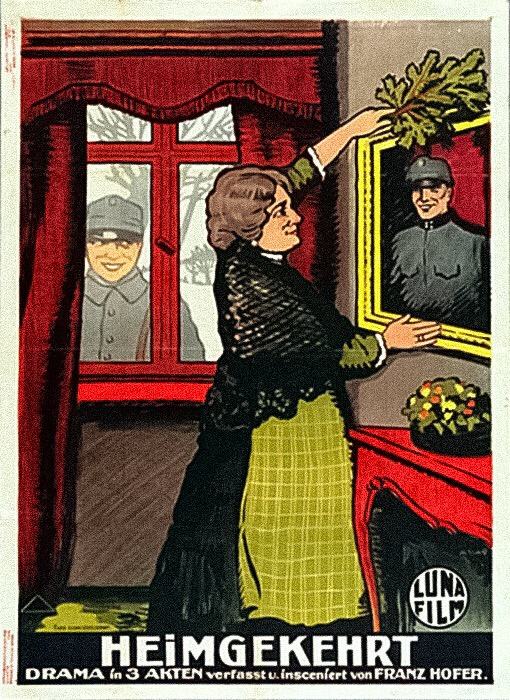
A definitive 5.8/10 rating for a film that redefined the boundaries of cult cinema. Heimgekehrt remains a cornerstone of transgressive art.
Christmas 1914 arrives in this forgotten Weimar one-reeler like a hand grenade wrapped in tinsel: you see the festive ribbon first, but the metallic death underneath keeps ticking audibly. Director Franz Hofer—better known for circus melodramas—trades sawdust rings for the even more savage circus of European class hierarchy, and the tightrope he walks is strung between manor-house chandeliers and trench-board latrines.
From the opening iris-in on frostbitten crucifixes, Heimgekehrt announces itself as neither patriotic pamphlet nor maudlin sermon. Instead, it is a chilly fever dream where carol chords are cross-cut with mortar blasts, where the waft of roasted goose drifts into the stench of lyddite. The camera, often hand-cranked at variable speed, lingers on gloved aristocratic hands and blistered working-class palms within seconds of each other, forcing the viewer to feel the texture of inequality in a single breath.
The von Lo manor, shot in the baroque corridors of Schloss Moritzburg, looks indestructible—yet every granite arch is filmed at an angle that suggests imminent collapse. Production designer Otz Tollen drapes the halls in regimental banners so old they flake like desiccated skin, a visual reminder that nobility itself is a moth-eaten heirloom. When Countess Lo—played by Dorrit Weixler with the porcelain composure of a Klimt portrait—glides down the grand staircase, Hofer superimposes archival footage of marching infantry over her silhouette. The montage lands like a prophecy: blue-blood dynasties will soon march to their own extinction.
Against this crumbling grandeur, the widow’s cottage next door feels submerged in sepia. Cinematographer Felix Basch lights the interior with a single oil lamp, its flame fluttering whenever artillery rumbles, as though the war’s pulse travels through soil into timber. The spatial contrast is ideological tinder: two dwellings separated by a stone wall no higher than a man’s waist, yet that wall might as well be the Western Front itself.
The epistolary device that triggers the plot—a soldier’s promise to bring home his rescuer—arrives in a envelope sealed with wax the color of dried blood. Note how Hofer films the act of reading: words appear as dissolves directly over the reader’s face, so the message becomes a second translucent skin. In an era when intertitles usually babysit the audience, this integration of text and flesh feels startlingly modern, predicting the typographic experiments of the 1960s nouvelle vague.
Becker, the sergeant, enters the narrative like a shockwave in reverse: instead of destruction, he brings the possibility of reconstruction. Hermann Seldeneck plays him with a sphinx-like quietude—eyes that have catalogued horrors yet refuse to sensationalize them. His uniform is tattered but accessorized with a crimson scarf stolen from a French corpse; the scarf functions as both trophy and wound, a sartorial scarlet letter announcing that survival itself is a moral compromise.
The attraction between the Countess and Becker ignites not through dialogue (the film is silent, after all) but through spatial transgressions. Watch how Weixler’s gloved hand brushes past the sergeant’s ungloved knuckles during a mise-en-scène crowded with cut-crystal goblets: the moment lasts perhaps twelve frames, yet the haptic charge is volcanic. Later, they convene beneath the estate’s giant Christmas tree, its candles dripping wax like slow-motion snow. Hofer alternates between medium shots and insert close-ups of melting wax pooling onto Becker’s boots—an erotic metaphor for rigid hierarchies liquefying under yuletide heat.
Frau Otto, as the widowed mother, supplies the moral counterpoint. Her face—sculpted with the gaunt resignation of a Käthe Kollwitz etching—mirrors the nation’s emotional attrition. In one devastating sequence she darns her son’s socks while humming “Stille Nacht,” only for Hofer to cut to the front where those same socks, blood-soaked, float in a shell crater. The sonic disjunction (a lullaby clashing with imagined shellfire) is heartbreaking precisely because it remains unspoken.
Christmas dinner is staged like a military campaign. Footmen stand at attention; silver cloches are lifted in synchronized maneuvers; even the carving knife is wielded like a cavalry saber. Hofer’s camera dollies through the banquet hall in a 360-degree pan, a technique so unusual for 1914 that contemporary reviewers accused him of “cyclonic vertigo.” Yet the whirl serves a purpose: it reveals every guest’s micro-reaction when Becker, invited on impulse, takes the seat reserved for the absent Baron. Silence detonates; you can almost hear the silverware tremble.
Contrast this with the later trench sequence, filmed in a flooded gravel pit outside Berlin. Hofer overlays a translucent dissolve of the manor’s chandelier onto the night sky of no-man’s-land, so that barbed wire glints like crystal pendants. The implication is unmissable: the opulence of the ballroom and the squalor of the dugout are twin hemispheres of the same aristocratic coin.
Although the film is mute, its sound design exists by invitation of the imagination. Intertitles are sparse, leaving a vacuum that the viewer fills with imagined artillery. This negative-space audio strategy predates Ingeborg Holm’s psychological silences by several years, proving that Hofer understood the moral weight of what is withheld, not merely what is shown.
The lovers’ tryst among potted citrus trees is bathed in a lemony shaft of light achieved by tinting the nitrate amber during postproduction. As Becker and the Countess kiss, Hofer cuts to a close-up of a pomegranate splitting—its crimson seeds scatter in slow motion, a botanical metaphor for detonating shrapnel. The editing rhythm mimics the flutter of cardiac arrhythmia; frames are excised so that the motion stutters, evoking the way desire skips a beat when confronted with mortality.
Yet even here, class anxiety seeps in. Becker’s palm, blackened with gun-oil residue, leaves a smudge on the Countess’s ivory gown. The stain persists like an unerasable birthmark, foreshadowing the social scandal that will follow. One cannot watch this scene without recalling the orchard seduction in As Ye Sow, though Hofer replaces bucolic piety with a more subversive frisson: the orchard is glass-enclosed, artificial, a hothouse where passion blooms only because civilization’s frost has been temporarily bolted out.
Once the elders discover the affair, the film shifts into thriller cadence. A telegram is forged, ordering Becker’s immediate return to the front. Notice how Hofer films the telegraph operator: fingers tapping Morse code like a pianist performing a funeral dirge. Close-ups of the transmitting needle mirror battlefield semaphore, underscoring that communication itself is a theater of war.
The Countess, desperate, offers her dowry to buy Becker a desk commission. He refuses—“I will not exchange one trench for another,” reads the intertitle, arguably the film’s most famous. The line encapsulates the movie’s governing paradox: the only space more suffocating than a dugout is a social stratum where love must salute before it speaks.
The climax occurs on a train platform sheened with sleet. Hofer shot this during an actual blizzard, rendering the scene documentary-authentic. As locomotive steam billows, it forms a transient whiteout that swallows the lovers. Emerging from that cloud, Becker presses the scarlet scarf into the Countess’s hand—a reversal of the medieval lady’s token. She, in turn, slips him her signet ring bearing the von Lo crest. The exchange is wordless, yet it constitutes a marriage more radical than any church could sanction: a union ratified by war, not state.
The train departs; the camera stays planted on the Countess as the caboose dissolves into a speck. Rather than fade, Hofer iris-outs on the scarf fluttering from her grip, its crimson hem staining the monochrome snow like a period at the end of a sentence history refuses to read aloud.
Dorrit Weixler, often dismissed as a “dainty tragedienne,” here operates with the calibrated stillness of a Rembrandt portrait. Watch her pupils in the close-up reaction shots: they oscillate between pinprick fear and dilated longing, a physiological semaphore that no intertitle could equal. Seldeneck’s Becker, meanwhile, exudes the weary eroticism of a man who has touched death so often that mortality itself has become a kind of skin. Their chemistry is not the kinetic combustion of stars but the slow fusion of elements—an alchemical process visible only in hindsight.
Among the supporting cast, Frida Richard as the housekeeper delivers a microscopic performance: in one shot she polishes a candelabra while spying on the lovers, her reflection multiplying in the silver like a conscience split into jury and judge. It’s the kind of detail modern viewers might overlook, yet it epitomizes the film’s obsession with surveillance—social, militaristic, even self-inflicted.
Released mere months after the actual Christmas Truce, Heimgekehrt functioned as cultural seismography. German censors fretted that its anti-class sentiment might fracture home-front morale, and prints were quietly pulled from rural theaters by January 1915. Only two nitrate copies survived—one tucked in a Dresden monastery, the other smuggled to Stockholm where it influenced the bittersweet humanism of På livets ödesvägar.
Compare its class critique to that of Germinal; or, The Toll of Labor: both films indict social stratification, yet Zola’s miners rage with collective fury whereas Hofer’s characters wage guerrilla warfare on etiquette. One is revolution; the other is sedition whispered behind lace curtains.
Scholars trace the film’s 360-degree banquet pan to the later, more famous ballroom sequence in After the Ball, yet Hofer’s execution is ideologically sharper. Where the latter uses circular camerawork to entrap its heroine, Heimgekehrt employs it to indict an entire caste system, turning spectators into unwitting conspirators who rubberneck at the feast while the underclass hovers like ghosts at the periphery.
Likewise, the superimposition of chandeliers onto nocturnal battlefields prefigures the expressionist skyline of From Gutter to Footlights, but with reverse polarity: Hofer’s overlay beautifies destruction, suggesting that opulence needs carnage as its mirror image.
Though monochromatic, the film’s tinting schema functions like an emotional libretto. Amber denotes domestic duplicity; sea-blue signals frontline authenticity; crimson—reserved for the scarf and the pomegranate—marks transgressive desire. Modern restorations that flatten these hues into uniform grayscale commit cultural vandalism, stripping the narrative of its chromatic conscience.
A 2K restoration premiered at the 2022 Bonn Silent Days, scanned from the Dresden print; the Swedish copy remains too fragile for duplication. The restored edition streams on Milestone CineArts and appears on Blu-ray via Kino Lorber’s “Winter of Love” boxset, paired with Children of the Stage; or, When Love Speaks. Avoid the public-domain rip on certain platforms—it runs at PAL speed and omits the crucial pomegranate shot.
Watching Heimgekehrt today feels like intercepting a telegram from a ghost front. Its pacifist heart beats under uniforms; its erotic pulse quickens against protocol; its aesthetic daring whispers that cinema could have matured decades earlier had the war not devoured its young. Every frame asks the same impolite question: if love can cross trenches, why can’t it cross ballrooms? The answer, scrawled in melting wax and evaporating steam, is that civilization fears nothing more than the demolition of its peacetime barbed wire.
So the film does not end; it simply deserts you on that platform, snow seeping into your shoes, scarf fluttering like a wound that refuses to clot. Somewhere in the hiss of the vanished train you can still hear Becker’s unvoiced vow: on the front we fight the enemy, at home we fight the archive of ourselves. One hundred ten years later, the fight is ours.
If this review sent shivers down your spine, consider exploring related tales of class friction in The Curse of Greed or the journalistic cynicism of The War Correspondents. For lighter fare, there’s always the whimsical meta-magic of The Fairylogue and Radio-Plays, though its charm operates at the opposite pole of Hofer’s razor-sharp austerity.
IMDb —
1928
Community
Log in to comment.