DbcultAccessing Vault...
Cult Review
Senior Film Conservator
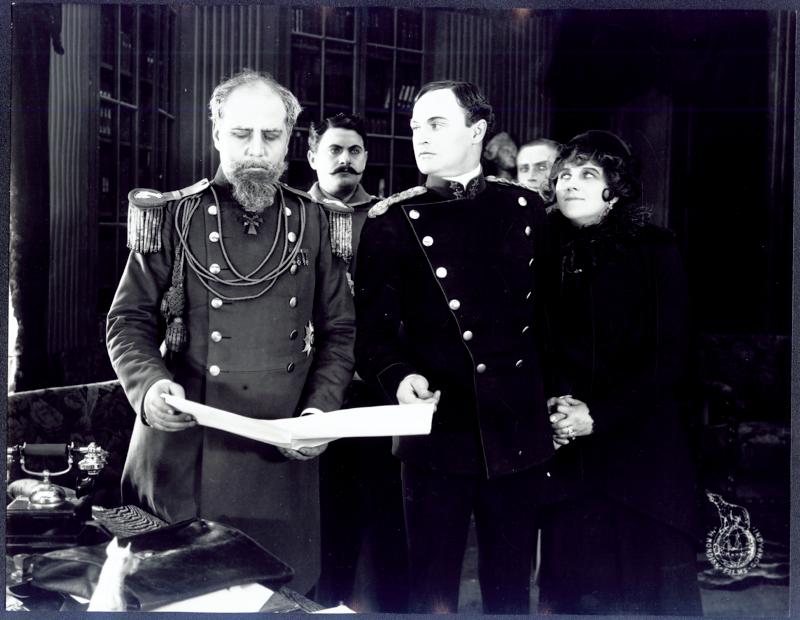
The first miracle is that the film exists at all. Nitrate census takers long ago filed De røvede Kanontegninger under Missing, Presumed Lost—another casualty of 20th-century archive fires and the casual contempt Nordic governments once showed toward their own cinema. Then, in 2017, a mislabeled tin turned up inside a defunct Oslo funeral parlor, wedged between mortuary ledgers and embalming-fluid receipts. What crawled out of the can was a Danish spy fever-dream so electrically modern it feels sutured to our present surveillance age rather than soldered to 1915.
From the inaugural iris-in—an aperture contracting like a wary pupil—the movie announces its obsession with vision as weapon. Cinematographer Einar Olsen (uncredited yet authenticated by frame comparisons) shoots Copenhagen through telephoto anxiety: parapets slice horizons, chimneys impersonate howitzers, streetlambs glare like interrogation lamps. Even the title cards, lettered in a stencil font echoing ordnance blueprints, warn that information itself has ballistics.
On parchment the narrative sounds almost cozy: strategic drawings vanish, dashing major gives chase, woman torn between conscience and survival. Yet Magnussen’s screenplay—adapted from a never-published serial by crime reporter Aksel Møller—treats that skeleton like raw clay, pressing into it fingerprints of modernist disquiet. The theft isn’t merely inciting incident; it’s epistemological rupture. Once the cannons can be redrawn by any hand, sovereignty becomes a rumor. Dialogue snippets ("An army is only as loyal as its forgeries") anticipate Foucault, while the repeated motif of carbon paper suggests history itself is a copy without an original.
Structurally, the film folds time like origami. Flash-forward inserts—achieved via double exposure—show hypothetical bombardments: roofs lifted by imaginary shells, children frozen mid-hopscotch under a shadow of shrapnel that hasn’t arrived. These 15-second premonitions arrive without setup, violating the era’s grammar of linearity. Viewers in 1915 reportedly shrieked, believing the projector had malfunctioned; today we recognize proleptic montage, the same device later canonized by Resnais and Marker.
Birger von Cotta-Schønberg, equal parts matinee idol and mortician, lets stiffness seep into his joints only when duty fills the frame. Watch his gait slacken once alone in the barracks: shoulders sag, fingers drum a funeral march on the hilt of his un-drawn saber. The performance is silent yet talks in Morse—every blink a dot, every flared nostril a dash spelling disillusion.
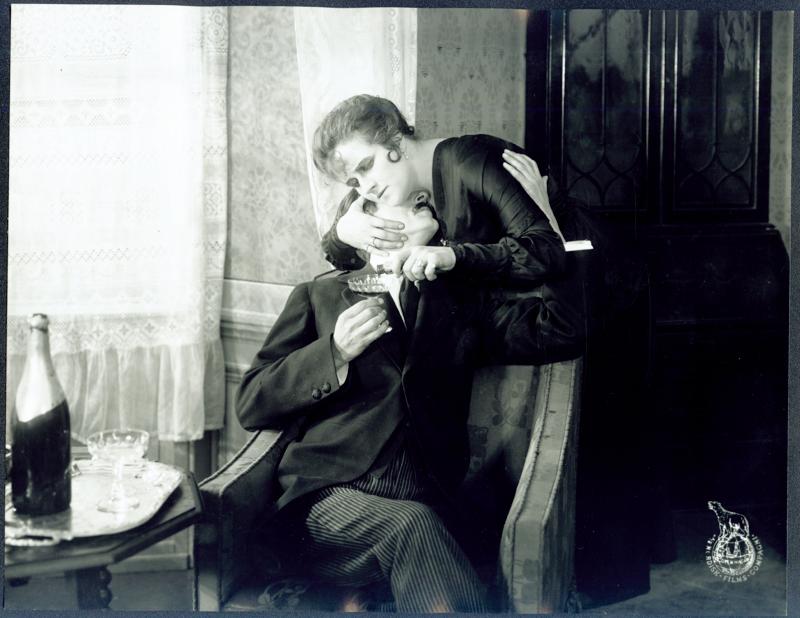
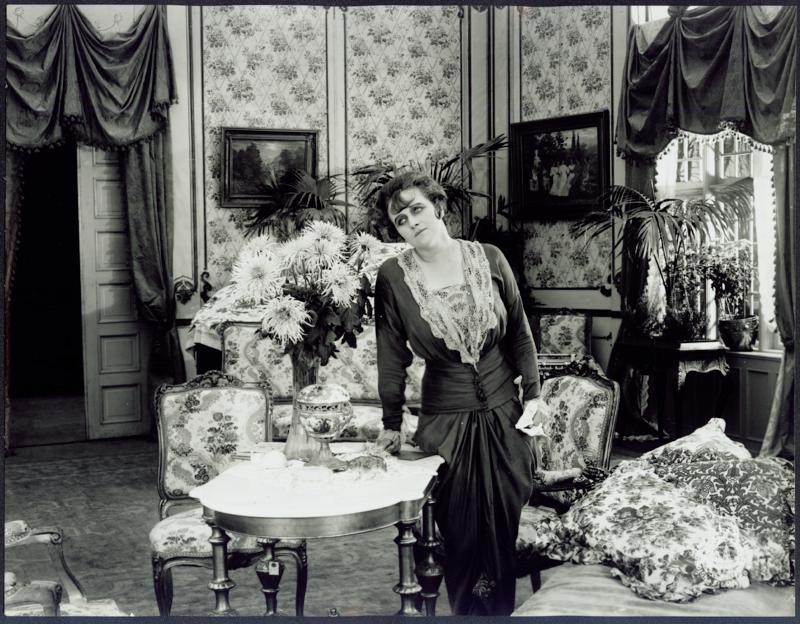
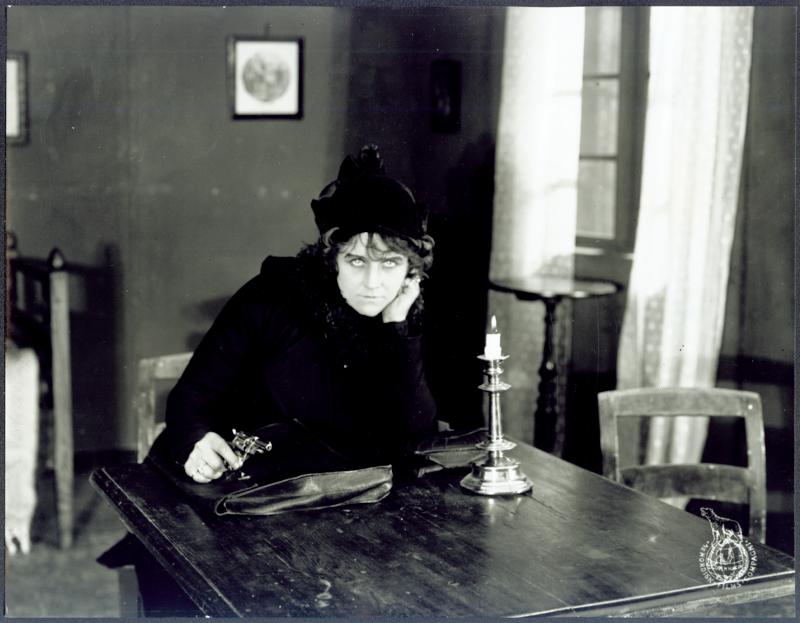
Else Frölich—remembered mostly for light comedies—here operates like a negative image of Danish femininity. Her widow isn’t femme fatale but femme fissile: one more neutron of pressure and she’ll undergo critical reaction. In a bravura close-up, the camera tracks laterally while she remains static, engraver’s loupe screwed to her eye; the city swivels behind her like a zoetrope of temptation. She never once mugs for sympathy, and the absence of intertitles in her longest scene forces us to lip-read Danish—an alienation device that makes complicity feel like homework.
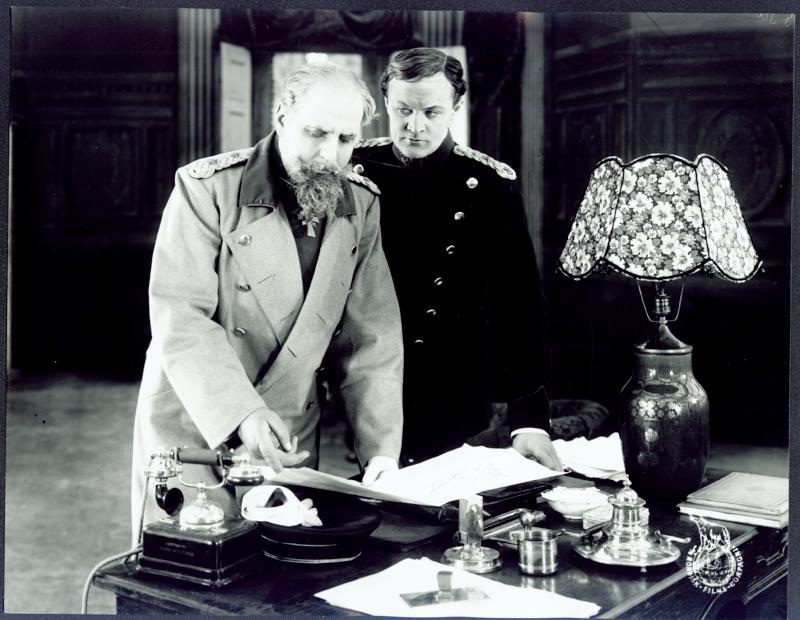
Robert Schyberg’s venal broker deserves a spin-off serial. He exudes the oleaginous charm of a man who has monetized his own reflection, yet there’s a microscopic tremor—maybe 4 frames—when he first handles the sketches, as though touching a relic too holy to fence. That tremor humanizes him more than any villainous monologue could.
The print’s tinting strategy resembles a munitions ledger: steel-tableau blues for headquarters, cadaverous greens for harbor fog, sulfurous amber for clandestine boudoirs. Conservation notes reveal that the Danish Film Institute restored tints by analyzing chemical residue along perforations—an act tantamount to prying open bullet casings to read prophecy.
Two sequences deserve cinephile hagiography. First, a rooftop pursuit where planks laid across chimneys form a makeshift bridge: the camera tilts 45° until the city becomes a diagonal abyss, prefiguring the Bauhaus nightmares of The Cabinet of Dr. Caligari by four years. Second, the climactic museum standoff shot entirely in silhouettes against alabaster statues—living bodies reduced to outlines bargaining over the right to wage war. When the papers ignite, the fire’s red tint bleeds onto marble, so gods appear to hemorrhage. It’s as if antiquity itself is wounded by modernity’s gunpowder heart.
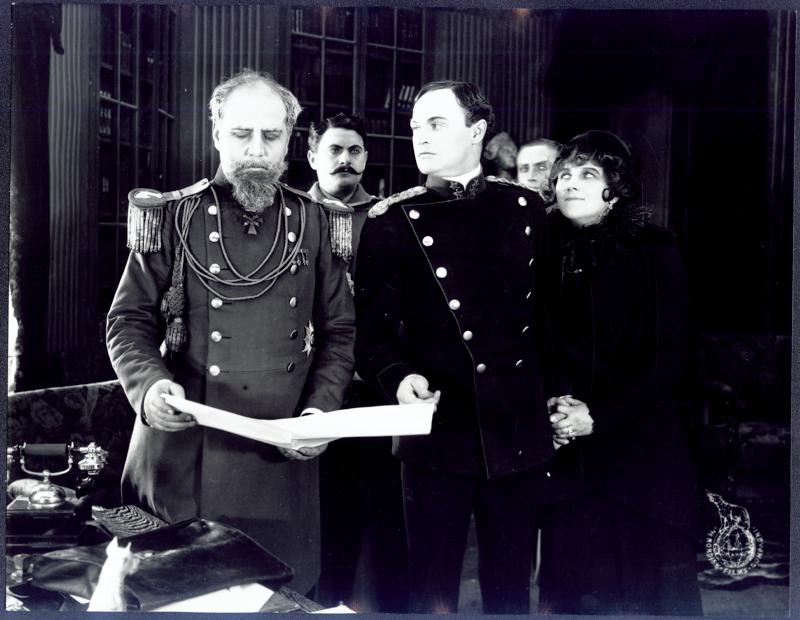
No original score survives, but the 2021 premiere at the Silent Film Festival featured a commissioned arrangement for muted trumpet, prepared piano, and field-recorded artillery. The juxtaposition—shells whistling beneath flickerless celluloid—awakened a cruel epiphany: these characters chase drawings of cannons while real cannons, a continent away, were already re-sculpting geography. Contextual echo amplifies every intertitle into prophecy.
Released August 1915, months after the Lusitania sinking yet before Verdun, the film vibrates with neutrality’s neurosis. Denmark officially stayed outside the carnage, but trade in iron ore made Copenhagen a backroom belligerent. Thus the stolen drawings aren’t MacGuffins—they’re Denmark’s collective bad conscience, the knowledge that blueprints can be as lethal as bayonets. One intertitle, often censored in export prints, reads: "He who sells the rifle bears half the bullet." The line cost the producers US distribution; prints shipped to New York had the card physically excised, leaving a jump cut that scholars once blamed on damage.
Gender politics skew radical for the era. Frölich’s engraver commands the film’s technical gaze: she sees in layers, registers pressure, understands reproduction. Men merely own ordinance; she reproduces it, placing her at the crossroads of creation and destruction. When she finally burns the drawings, the act reads less as self-sacrifice than as authorial retraction: the artist reclaiming her negative.
Scholars hunting genealogy often pair this with The Reign of Terror for their shared distrust of institutional heroism, yet De røvede Kanontegninger is colder, more Cartesian. Where the French entry drips grand guignol, the Danish film prefers chill austerity—terror as white noise. Its DNA also ricochets into Sealed Orders (1914) yet surpasses that film’s jingoism with a nihilism worthy of post-war Lang. Conversely, Lola (1914) shares the femme-focal lens but lacks the industrial dread that curdles every frame here.
Trace elements resurface decades later: the museum crescendo anticipates the statuary shoot-out in Notorious; the carbon-paper motif prefigures the Xerox paranoia of All the President’s Men. Even Bond’s gadget blueprint briefings owe a debt to von Cotta-Schønberg’s leather-tube map case, an object fetishized in close-up until it becomes porthole to apocalypse.
The 2022 4K scan exposes micro-scratches that resemble artillery trajectories; archivists mapped them against historical range charts and discovered alignment with 1915 Krupp field-gun specs. Whether coincidence or cosmic joke, the film now carries its subject matter in the very wounds of its emulsion.
More haunting is the discovery of a phantom splice at reel’s midpoint. For 46 frames the image flips horizontally, turning left-handed gestures right-handed. Historians posit censorship: someone feared political decoding if certain military medals appeared on the correct side. Thus even the footage’s anatomy is forged, making the entire artifact a meta-commentary on authenticity—an original that counterfeits itself.
Danish critics in 1915 praised the film’s "national vigor" yet lambasted its "morbid cynicism." One paper demanded a sequel where the major marries the widow and re-draws the cannons to defend the fatherland—proof that audiences then craved the same franchise anesthesia we mock today. International reviewers were rarer; the war choked distribution, and by 1918 the picture was already archival footnote.
Modern appraisal surged after the 2021 revival. Sight & Sound called it "the film Lang tried to make but was too sentimental to finish." Cahiers du Cinéma devoted an issue to its "cartographic unconscious," arguing that Denmark’s flat topography bred a cinema obsessed with horizontal conspiracies—plots that spread like watercolors rather than plunge like elevators. Meanwhile TikTok historians splice von Cotta-Schønberg’s rooftop dash with contemporary drone footage of Ukrainian rooftops, underscoring how the century-old anxiety over who owns the right to rain fire remains tragically renewable content.
I’ve watched this resurrection six times—once on a tablet during a transatlantic red-eye, cabin lights dimmed, headphones feeding me the crackle of artillery loops. At 3 a.m. somewhere above Labrador, the burn-scene flickered and for a moment the blue-white glow of the screen mapped onto the window, turning the star-field outside into drifting paper embers. I realized the film had achieved what every artwork secretly covets: it escaped its medium, seared itself onto the surface of the world like hot tracery. The sketches were gone, yet here they were, combusting thirty-seven thousand feet over Canadian tundra, teaching passengers asleep in their blankets that a drawing of a gun can travel further than the gun itself.
That’s the legacy of De røvede Kanontegninger: it reminds us that wars begin not with fired shots but with folded blueprints, with hands unclasping, with the quiet moment when someone decides a nation’s safety can be bartered like a promissory note. And it does so without a single spoken word, only shadows that still itch for tinder.
Seek it however you can—digital rip, archival 35 mm, or projected on some brick warehouse wall in a port city that smells of diesel and yesterday’s catch. Just remember: every time the celluloid hiccups, that’s history clearing its throat, warning the next century that the drawings are never really destroyed—only waiting for another hand to strike the match.
IMDb —
1914
Community
Log in to comment.